Once the walls are plastered, every wire in your house is out of sight. You cannot see it, touch it, or check it. All you can do is trust that the right wire was chosen for each job. If a wire is too thin or poorly made, the first sign may be a hot switch, a tripping breaker, or in the worst case, a fire.
So it pays to know your wires before the electrician starts. This guide explains the types of electrical wires used in buildings, which size goes where, and what the standards say, in simple words.
What Are the Main Types of Electrical Wires Used in Buildings?
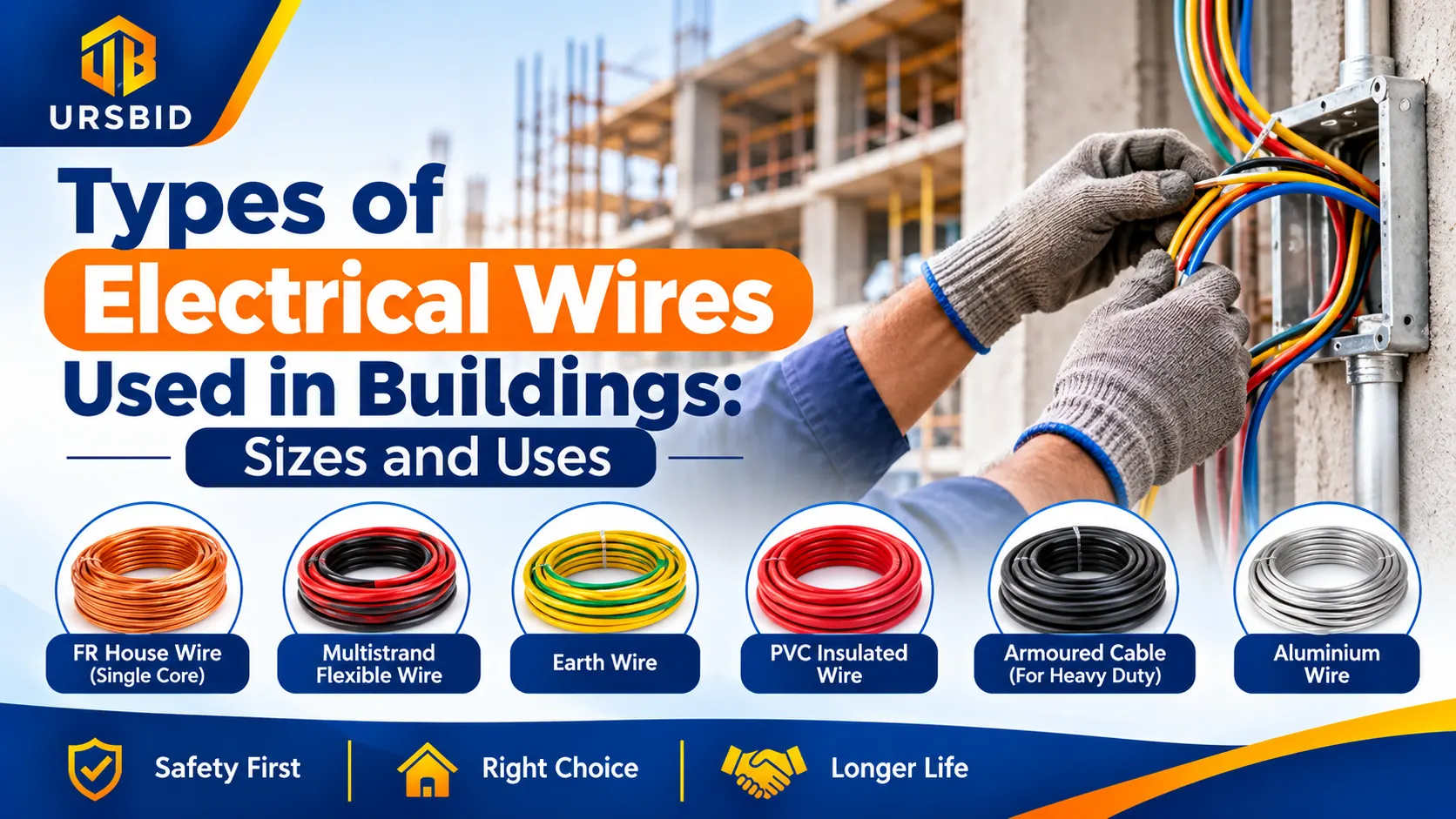
The main types of electrical wires used in buildings are single-core house wires, flexible cords, armoured cables, and special cables for data and earthing. For homes, single-core copper house wire does most of the work.
- Single-core house wire. A single copper conductor with PVC insulation. It is the standard for fixed wiring in conduits, for lights, sockets, ACs, and geysers. It comes in FR, FRLS, and HFFR grades.
- Flexible multi-core cords. Several wires in one cable. Used for appliances, extension boards, and portable equipment.
- Armoured cables. Power cables with a steel wire layer for protection. Used for underground and outdoor runs and for the main supply to a building.
- Aluminium service cables. Used for large sizes and incoming mains, where weight and cost matter.
- Earthing wire. A green or green-yellow wire that carries fault current safely to the ground.
- Data and TV cables. LAN, telephone, and coaxial cables for internet and TV.
You can compare electrical wires and cables from verified suppliers by posting your needs on URSBID.
FR vs FRLS Wire: What Is the Difference?
FR wire slows the spread of flame. FRLS wire also gives off less smoke. The higher grades, FR-LSH and HFFR, also release less harmful gas in a fire.
|
Type |
Full name |
In a fire |
Common use |
|
FR |
Flame Retardant |
Slows flame, but gives heavy black smoke |
Basic house wiring in low-rise homes |
|
FRLS |
Flame Retardant Low Smoke |
Much less smoke |
Apartments and multi-storey homes |
|
FR-LSH |
FR Low Smoke Halogen |
Low smoke and low acid gas |
Hospitals, hotels, taller buildings |
|
HFFR |
Halogen Free Flame Retardant |
Very low smoke, almost no acid gas |
Hospitals, metro, data centres |
|
HRFR |
Heat Resistant FR |
Handles higher heat |
AC, geyser, and hot conduit runs |
Smoke is often the real danger in a fire, because it blocks escape routes. That is why low-smoke wire is worth a small extra cost in flats and shared buildings. For homes up to ground plus three floors, FR wire to IS 694:2010 is the minimum under the National Building Code. For ground plus four floors and above, low-smoke halogen grades are needed. Hospitals and metro stations need HFFR to IS 17048:2018.
(Grade comparison source: CablePriceIndia, Types of Cables in India.)
Which Electrical Wire Size for House Circuits Should You Use?
Use thin wire for lights and thicker wire for appliances. A common guide is 1.0 to 1.5 sq mm for lights and fans, 2.5 sq mm for power sockets, and 4 to 6 sq mm for AC and geyser circuits.
|
Circuit |
Typical load |
Wire size |
|
Light point and fan |
Up to 6 A |
1.0 to 1.5 sq mm |
|
General 5 A socket |
Up to 10 A |
1.5 sq mm |
|
15 A or 16 A power socket, kitchen |
Up to 16 A |
2.5 sq mm |
|
AC, geyser, induction |
Up to 25 A |
4.0 sq mm |
|
Sub-main from the main board |
Up to 32 A |
6.0 sq mm |
(Size source: CablePriceIndia, Home Wiring Cable Guide India 2026.)
Sources differ a little. Some put a 1.5 ton AC on 2.5 sq mm wire for short runs. Wire size depends on the load and also the length of the run. A long run needs a thicker wire to avoid heat and voltage drop. So treat this table as a guide and let your electrician or engineer set the final sizes.
For planning, one source estimates a typical 2BHK needs about 200 m of 1.0 sq mm wire, 300 m of 1.5, 200 m of 2.5, 50 m of 4.0, and 50 m of 6.0 sq mm wire. Your own drawing may differ.
(Quantity source: CablePriceIndia, Home Wiring Cable Guide India 2026.)
Copper vs Aluminium Wire: Which Is Better for Buildings?
Copper is better for wiring inside homes. Aluminium is used for large sizes and incoming service mains, where weight and cost matter more.
Copper carries more current for the same size. It holds tight at switch and socket terminals and lasts longer. Aluminium is lighter and cheaper, and it is legal and common for big cables. But in small circuits, it needs more care at terminals and can loosen over time. For the 1 to 6 sq mm circuits in a house, copper is the normal choice.
What Does the Wire Colour Code Mean?
A colour code helps any electrician read your wiring safely. Green or green-yellow is always earth. The colours for live and neutral have changed over time.
Older Indian homes used red for live and black for neutral. Newer practice follows the IEC style, with brown for live and blue for neutral. Three-phase systems use more colours for the three phases. Ask your electrician which code your installation follows, and use the same one all through. Never use a green wire for anything but earth.
Which Indian Standards Cover Which Cables?
Each cable family has its own standard. For house wire, look for IS 694:2010 and the ISI mark.
|
Cable |
Standard |
|
PVC house wire (FR, FRLS, FR-LSH, HRFR) |
IS 694:2010 |
|
Halogen-free (HFFR, LSZH) |
IS 17048:2018 |
|
Armoured PVC power cables |
IS 1554 |
|
High-voltage XLPE cables |
IS 7098 |
(Standards source: CablePriceIndia, Types of Cables in India.)
How Do You Check Wire Quality Before Buying?
Check the ISI mark, the IS number, and the brand printed on the wire. Buy from an authorised dealer and keep the bill.
Good wire has the maker's name, the size, the IS number, and the voltage printed on the insulation at regular gaps. The copper should look bright and even. The insulation should be smooth and firm. Counterfeit wire is a real risk in some markets, so a very low price is a warning. (Counterfeit risk source: HomeRun, Best Electrical Wires for Homes in Bangalore.)
Also check the coil length and the size on the label with your electrician, and ask for the test certificate on large orders.
What Mistakes Should You Avoid With Electrical Wires?
Do not use thin wire to save money. It heats up under load, which is a fire risk.
Do not mix wire colours. Always follow one colour code.
Do not skip earthing. Run an earth wire to every socket and metal body.
Do not use aluminium wire for small indoor circuits without expert advice.
Do not use cheap, unmarked wire. Only buy ISI-marked wire.
Do not cut corners on the electrician. You can find electrification work services on URSBID for wiring and fitting.
Where Can You Buy Electrical Wires Online?
You can buy electrical wires online through URSBID by posting your requirement and getting quotes from verified suppliers.
Once you know the wire types and sizes you need, the next step is to compare rates. To Buy Electrical Wires Online through URSBID, share the wire type, size, grade, quantity, and delivery place. Registered vendors will send their quotations directly to you. Ask each one for the IS number and the batch details before you decide.
Frequently Asked Questions
What are the types of electrical wires used in buildings?
The main types are single-core house wire (FR, FRLS, HFFR), flexible cords, armoured cables, aluminium service cables, earthing wire, and data cables.
What is the difference between FR and FRLS wire?
FR wire resists flame spread. FRLS wire also produces less smoke, so it is safer in flats and shared buildings.
Which wire size is used for house wiring?
Typically 1.0 to 1.5 sq mm for lights and fans, 2.5 sq mm for power sockets, and 4 to 6 sq mm for AC and geyser circuits. Your electrician sets the final size by load and length.
Is copper or aluminium wire better for a house?
Copper is better for circuits inside the home. Aluminium is used for larger cables and service mains.
Which IS code covers house wire?
IS 694:2010 covers PVC insulated house wire. Halogen-free grades follow IS 17048:2018.
Final Thoughts
Wires are small, hidden, and easy to ignore. But they carry every watt your home uses. Choose copper FR or FRLS wire, check the ISI mark, use the right size for each circuit, and follow one colour code. Then your wiring will do its quiet job safely for decades.
Ready to compare prices? Get electrical wire rates on URSBID by posting your requirement, and receive quotes from verified suppliers.