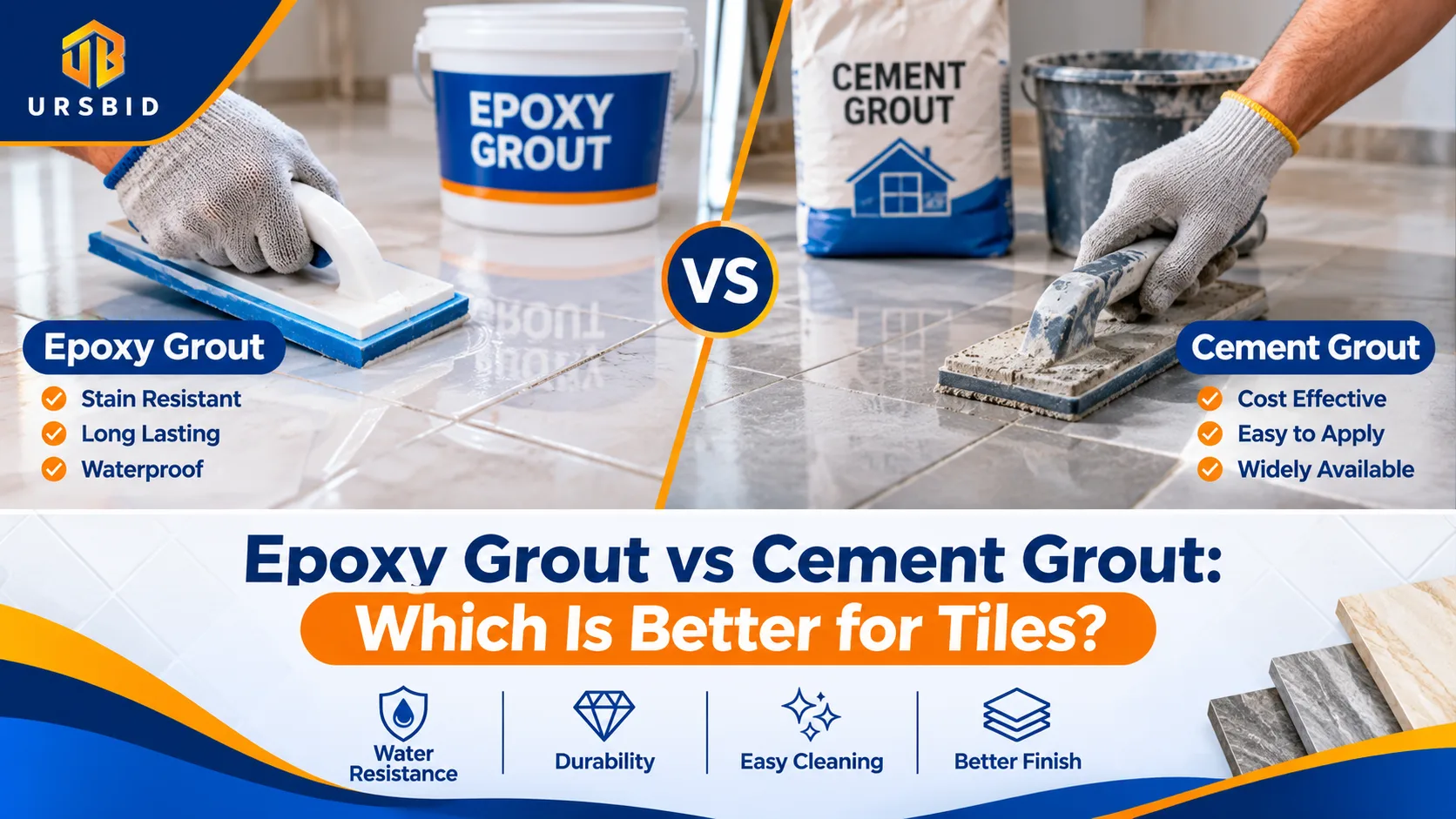
Two bathrooms are tiled in the same week with the same tiles. In one, the joints are cement grout. In the other, they are epoxy. After two years, the first bathroom has grey, patchy joints with dark spots. The second still looks like the day it was done. The tiles were never the problem. The grout was.
The big question is whether epoxy is worth its price. This guide compares epoxy grout vs cement grout in simple words, with Indian rates, so you can decide room by room.
What Is the Difference Between Epoxy Grout and Cement Grout?
Cement grout is made from cement, fine sand, and pigment, and it sets by drying and curing. Epoxy grout is a two-part resin that sets by a chemical reaction. Epoxy is non-porous. Cement is porous.
That one difference explains most of the rest. Cement grout soaks up water and dirt. It needs sealing. Epoxy does not soak up anything, so stains and mould have little to hold on to. Here is a quick comparison:
|
Feature |
Cement grout |
Epoxy grout |
|
Made from |
Cement, sand, pigment |
Resin, hardener, filler |
|
Porosity |
Porous |
Non-porous |
|
Stain and mould resistance |
Low to fair |
Very high |
|
Sealing needed |
Yes |
No |
|
Working time |
Longer |
Short, about 45 to 60 minutes |
|
Ease of use |
Easy |
Hard, needs a skilled tiler |
|
Price per kg |
Low |
High |
|
Best for |
Dry rooms and walls |
Wet areas, kitchens, busy floors |
(Comparison source: BuildWiz, Tile Grout Guide.)
What Are the Types of Cement Grout?
There are three main grout types. Standard cement grout is the cheapest. Polymer-modified cement grout adds flexibility and water resistance. Epoxy sits at the top for performance.
- Standard cement grout. Portland cement, fine sand, and colour. Cheap and easy, but porous.
- Polymer-modified cement grout. Cement with added polymers. It is more flexible, resists water better, and cracks less. This is the sensible upgrade for many wet areas.
- Epoxy grout. A resin system with no cement. Best for water, stains, and chemicals.
European standard EN 13888 sorts grouts the same way, into cement grouts (CG) and reaction resin grouts (RG), which include epoxy. (Types source: BuildWiz, Tile Grout Guide.)
Epoxy Grout vs Cement Grout for Bathroom: Which Is Better?
For wet floors and showers, epoxy grout is better. For bathroom walls that stay mostly dry, polymer-modified cement grout is usually enough.
A shower floor stays wet for hours each day. Cement grout there will slowly darken, grow mould, and may crack. Epoxy stays clean and keeps its colour. On walls above the splash zone, the water load is far lower, and a good polymer-modified grout works well and costs much less. A mixed approach is common. Use epoxy in the shower area and bathroom floor, and polymer cement grout elsewhere.
What Is the Cement Grout Price in India Compared With Epoxy?
Cement grout price in India is about Rs 70 to 150 per kg. Epoxy grout costs about Rs 700 to 1,100 or more per kg. Epoxy is roughly ten times more per kilo.
|
Grout type |
Price per kg (Rs, approx.) |
|
Cement-based grout |
About 70 to 150 |
|
Epoxy grout |
About 700 to 1,100 or more |
(Price source: Roff, Tile Grout Price in India. Roff is a tile-care brand, so treat the range as a guide.)
The total cost looks different when you work out a real room. One guide says a 5 kg pack of cement grout covers about 8 to 15 square metres of 3 mm joints, and a 5 kg epoxy kit covers about 6 to 12. A 100 sq ft bathroom floor is about 9.3 square metres. That works out to roughly:
- Cement grout: about 3 to 6 kg, so about Rs 200 to 900 in material.
- Epoxy grout: about 4 to 6 kg, so about Rs 2,700 to 6,400 in material.
So the extra material cost for one bathroom floor is a few thousand rupees. Tilers also charge about 20% to 40% more to apply epoxy, because it sets fast and needs careful cleaning. (Coverage and labour source: BuildWiz, Epoxy Grout Guide, a UK guide.)
Small tiles and wide joints use much more grout, so these numbers can rise.
How Long Does Each Grout Last, and What Upkeep Does It Need?
Epoxy usually lasts longer and needs almost no upkeep. Cement grout lasts a shorter time and needs sealing and cleaning.
Rough figures often quoted are about 5 to 8 years for cement grout in wet areas, and 15 to 20 years for epoxy. These numbers are loose, so treat them as a guide, not a promise. Cement grout needs sealing, often every year or two in wet areas, and it needs regular scrubbing. Epoxy does not need sealing. A damp cloth is usually enough.
Over ten years, the upkeep and regrouting of cement grout can close much of the price gap in wet rooms. In dry rooms, it never will, so cement grout stays the better value there.
How Hard Is Each One to Apply?
Cement grout is easy and forgiving. Epoxy is fast and unforgiving. If you make a mistake with epoxy, it is very hard to fix.
Cement grout gives you time to push it into joints and wipe the tiles clean. Epoxy gives you only about 45 to 60 minutes at room temperature, and less in heat. Cured epoxy haze on tile faces is difficult to remove. That is why a skilled tiler matters. You can find finishing and flooring work services on URSBID for this work.
Some epoxy grouts can also change colour under strong sunlight. For balconies and open terraces, choose a product made for outdoor use.
How Do You Choose Between Epoxy and Cement Grout?
Choose by how wet and busy the area is, and by your budget.
|
Area |
Better choice |
|
Shower and bathroom floor |
Epoxy |
|
Bathroom walls (dry zone) |
Polymer-modified cement |
|
Kitchen counter and backsplash |
Epoxy |
|
Kitchen floor |
Polymer-modified cement or epoxy |
|
Living room and bedroom floors |
Cement or polymer-modified cement |
|
Swimming pool and wet balcony |
Epoxy, outdoor rated |
|
Tight budget and dry area |
Cement |
What Mistakes Should You Avoid With Tile Grout?
- Do not use plain cement grout in a shower floor. It will stain and grow mould.
- Do not mix a big batch of epoxy. It will harden before you finish.
- Do not compare only the price per kg. Look at coverage, labour, and upkeep.
- Do not skip sealing cement grout in wet areas. It protects against stains.
- Do not grout before the tile adhesive has set. Wait as the adhesive maker advises.
- Do not choose a colour from a tiny sample. Check it against the tile in your own light.
Where Can You Buy Tile Grout Online?
You can buy tile grout online through URSBID by posting your requirement and getting quotes from verified suppliers.
Once you know which grout you need for each area, the next step is to compare rates. To Buy Epoxy Grout Online through URSBID, say clearly that you need grout for tile joints. Share the colour, quantity, and delivery place. Registered vendors will send their quotations directly to you.
If you still need tiles, you can get tile rates on the same platform.
Frequently Asked Questions
Is epoxy grout better than cement grout?
Epoxy is better for wet, stain-prone, and busy areas because it is non-porous. Cement grout is better for dry rooms and tight budgets.
How much does epoxy grout cost compared with cement grout in India?
Cement grout costs about Rs 70 to 150 per kg. Epoxy costs about Rs 700 to 1,100 or more per kg. For one bathroom floor, the extra is usually a few thousand rupees.
Does cement grout need sealing?
Yes. Cement grout is porous and needs sealing, often every year or two in wet areas. Epoxy does not need sealing.
Which grout is best for a bathroom?
Epoxy is best for showers and wet floors. Polymer-modified cement grout is a good, lower-cost choice for dry bathroom walls.
Is epoxy grout hard to apply?
Yes. It has a short working time of about 45 to 60 minutes, and it is hard to clean off tiles once it cures. Use a skilled tiler.
Final Thoughts
Epoxy and cement grout are both good, but for different places. Epoxy costs more and asks more of the tiler, but it stays clean in wet areas. Cement grout is cheap and easy, and it is enough for dry rooms. Use epoxy where water sits, polymer-modified cement elsewhere, and pay a skilled tiler. That mix keeps your joints clean without overspending.
Ready to compare prices? Get epoxy grout rates on URSBID by posting your requirement, and receive quotes from verified suppliers.