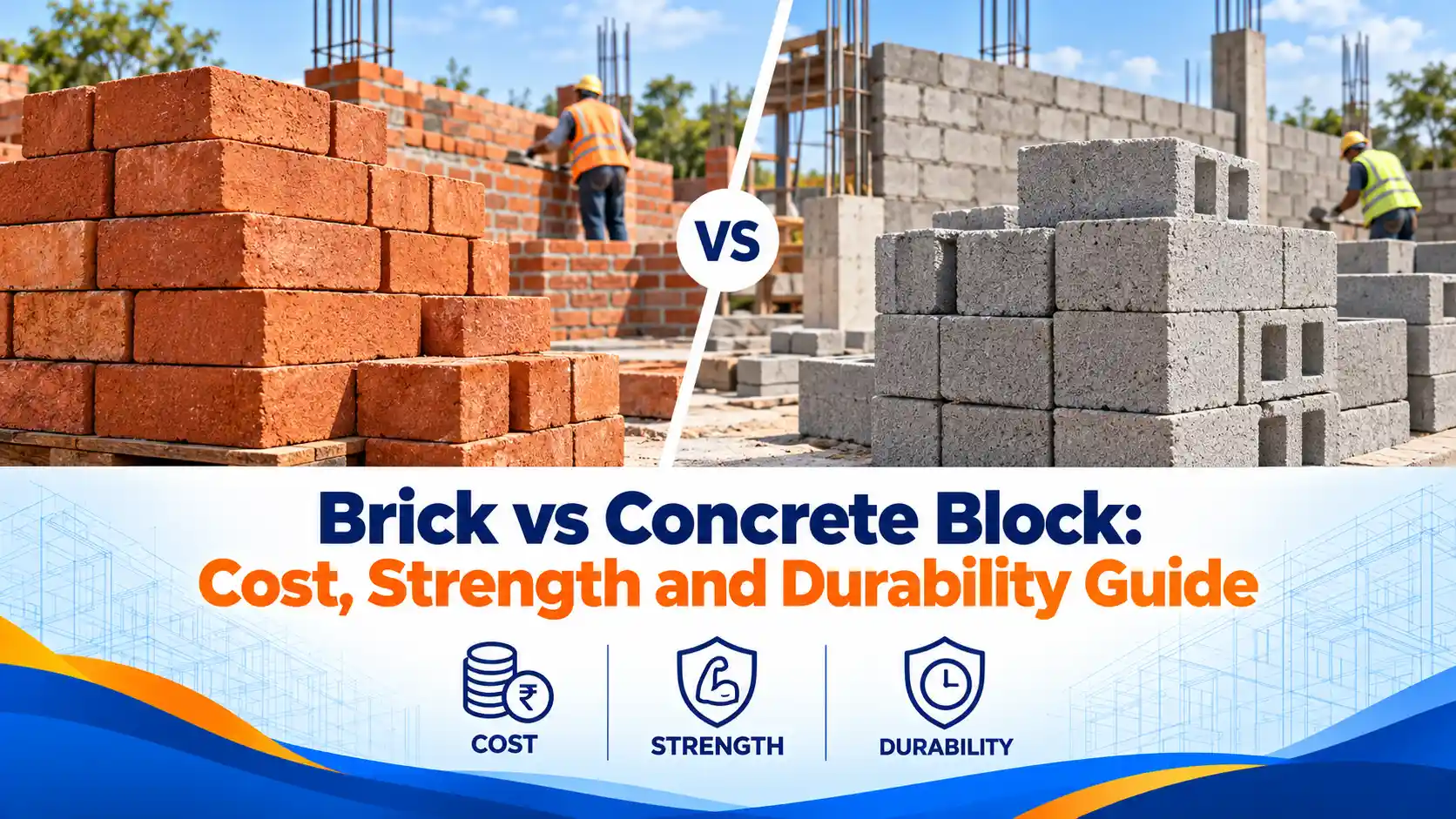
A mason lays a red clay brick. It is small, light, and he lays it one at a time. Next to him, another crew lifts a big grey concrete block, about the size of eight bricks, and sets it in a single move. Both walls will stand. But they will cost different amounts, weigh different amounts, and behave differently for decades.
This guide compares brick vs concrete block in plain words. You will see how they differ in cost, strength, and durability, and which one suits which wall.
What Is the Difference Between Brick and Concrete Block?
A clay brick is baked from clay in a kiln. Aconcrete block is cast from cement, sand, and stone aggregate, then cured. Blocks are much bigger than bricks, and they can be hollow or solid.
The most common concrete block in India is 400 x 200 x 200 mm. That is the size of the face of a wall, 8 inches thick. A common brick is much smaller, so you need many more of them. Here is a quick comparison:
|
Feature |
Clay brick |
Concrete block |
|
Made from |
Clay, baked in a kiln |
Cement, sand and aggregate, cured |
|
Standard |
IS 1077 |
IS 2185 Part 1 |
|
Typical size |
About 190 x 90 x 90 mm or larger older sizes |
400 x 200 x 200 mm (8 inch), also 150 and 100 mm |
|
Water absorption limit |
Up to 20% |
Up to 10% |
|
Mortar needed |
More joints, more mortar |
Fewer joints, about half the mortar |
|
Weight of wall per m² |
About 340 to 380 kg (230 mm wall) |
About 230 to 280 kg (hollow 200 mm wall) |
(Comparison source:BuildCalc, Concrete Block vs Clay Brick.)
Concrete Block vs Brick Cost: Which Is Cheaper?
For most walls, concrete block is cheaper. It usually costs about 8% to 15% less per square metre of unplastered wall, mainly because it needs less mortar and less labour time.
Look at the price per piece first. A 200 mm hollow concrete block costs about Rs 35 to 65, and a 200 mm solid block about Rs 50 to 80. A first class red brick costs about Rs 8 to 12. That makes bricks look much cheaper. But a wall needs far more bricks.
Here is a simple material-only example for one square foot of wall:
|
Wall type |
Units per sq ft |
Price per unit (Rs) |
Material cost per sq ft (Rs) |
|
9-inch brick wall |
About 9.1 bricks |
8 to 12 |
About 73 to 109 |
|
8-inch hollow block wall |
About 1.16 blocks |
35 to 65 |
About 41 to 75 |
(Block price source:Concrete Block Calculator India, 2025 to 2026 ranges.)
Block walls also use about 40% to 50% less wet mortar. That saves cement, sand, water, and mason time. Rates change by city and brand, so use these numbers as a guide and ask for fresh quotes.
How Does Concrete Block Strength Compare With Brick?
Both are strong enough for ordinary houses. Concrete block strength is set by IS 2185 Part 1. Hollow blocks start at about 3.5 N/mm², and solid blocks go from about 4 to 15 N/mm².
Bricks under IS 1077 start at a minimum class of 3.5 N/mm², and go up to 35 N/mm² in the strongest classes. So the ranges overlap. A good common brick and a standard hollow block have about the same minimum strength. The real difference is the grade you pick. For a load-bearing wall, ask your engineer for the minimum strength you need, then ask the seller for a test report.
(Block strength source:Building Aaya, Solid Concrete Blocks and IS 2185 Specifications.)
(Brick strength source:Brick n Bolt, Properties of Bricks, citing IS 1077 and IS 3495.)
Brick vs Concrete Block Durability: Which Lasts Longer?
Both can last many decades. Concrete block has a lower water absorption limit, which helps in damp climates. Clay brick lasts well too, if it is well burnt and low in salts.
IS 2185 allows blocks to absorb up to 10% water by weight. Common bricks may absorb up to 20%. Lower absorption means less damp, less salt movement, and fewer stains. That is a point for blocks. A well-burnt, dense brick does very well on its own, and old brick buildings prove it.
Each has its weak spot. A poor, under-burnt brick soaks up water and crumbles. A concrete block that is used before it is fully cured can shrink and cause cracks in the wall. So check how long the blocks were cured, and ask for the water absorption number for both materials. (Absorption source:Buildiyo, Hollow Blocks Price and Guide.)
How Do Weight and Building Speed Compare?
Concrete block walls are lighter and faster. A hollow block wall weighs about 230 to 280 kg per m², against about 340 to 380 kg for a brick wall of normal thickness.
A lighter wall puts less load on your foundation and beams. Large blocks also mean fewer pieces to lay and fewer joints, so masons finish a wall faster. A single hollow block is also easier to cut and handle than a solid one. Hollow cores can even carry electrical conduits, so there is less chiselling later. Bricks are small and easy to handle one at a time, but a whole wall takes more time.
Which Is Better for Each Wall?
Choose by the job. Both do well in most walls. Pick brick when you want a classic look. Pick block when you want speed and lower cost.
|
Wall |
Better choice |
Why |
|
External load-bearing wall |
Either, by grade |
Check the strength class with your engineer |
|
Internal partition |
Hollow block |
Light, fast, low cost |
|
Boundary wall |
Hollow or solid block |
Fast and cheaper |
|
Plinth and basement |
Solid block or strong brick |
Higher strength, low absorption |
|
Exposed face brick look |
Brick |
Natural colour and texture |
|
Wall with electrical conduit |
Hollow block |
Cores carry the conduit |
What Mistakes Should You Avoid When Choosing Between Them?
Do not compare the price per piece. A brick costs less than a block, but a wall needs many more bricks, plus more mortar.
Do not use blocks that are not fully cured. They can shrink and crack your walls.
Do not choose by name alone. Ask for the strength class and the water absorption figure for both bricks and blocks.
Do not fix heavy items to hollow blocks without proper anchors. Plan the fixings before you build.
Do not skip a skilled mason. Block work needs even joints and a level base. You can findbrick work services on URSBID for both brick and block walls.
Where Can You Buy Bricks and Concrete Blocks Online?
You can buy bricks and concrete blocks online through URSBID by posting your requirement and getting quotes from verified suppliers.
Once you know which one suits your wall, the next step is to compare rates. ToBuy Bricks and Blocks Online through URSBID, share the type, size, strength class, quantity, and delivery place. Registered vendors will send their quotations directly to you. Ask each one for the test report and the curing age of the blocks.
Frequently Asked Questions
Which is better, brick or concrete block?
Neither is always better. Concrete blocks are usually cheaper, lighter, and faster to build with. Bricks give a classic look and have a wide range of strength grades.
Is concrete block cheaper than brick?
Usually yes. A block wall often costs about 8% to 15% less than a brick wall, because it needs less mortar and labour, even though bricks cost less per piece.
Are concrete blocks as strong as bricks?
For ordinary houses, yes. Hollow blocks start at about 3.5 N/mm² and solid blocks run from about 4 to 15 N/mm². Common bricks start at 3.5 N/mm² and go much higher in stronger classes.
Which lasts longer, brick or concrete block?
Both last for decades. Blocks absorb less water under IS 2185, which helps in damp places. A well-burnt brick also lasts very well.
How many concrete blocks do I need per square metre?
About 12.5 blocks per square metre for 400 x 200 mm blocks with joints. Add a small amount for breakage.
Final Thoughts
Brick and concrete block both build good walls. Blocks save mortar, weight, and time, and they cost less per wall. Bricks give you a classic look and a wide choice of strength grades. Compare the cost per wall, not per piece. Ask for the strength class, check the absorption figure, and use well-cured blocks and well-burnt bricks. That is how you get a wall that lasts.
Ready to compare prices?Get brick and block rates on URSBID by posting your requirement, and receive quotes from verified suppliers.