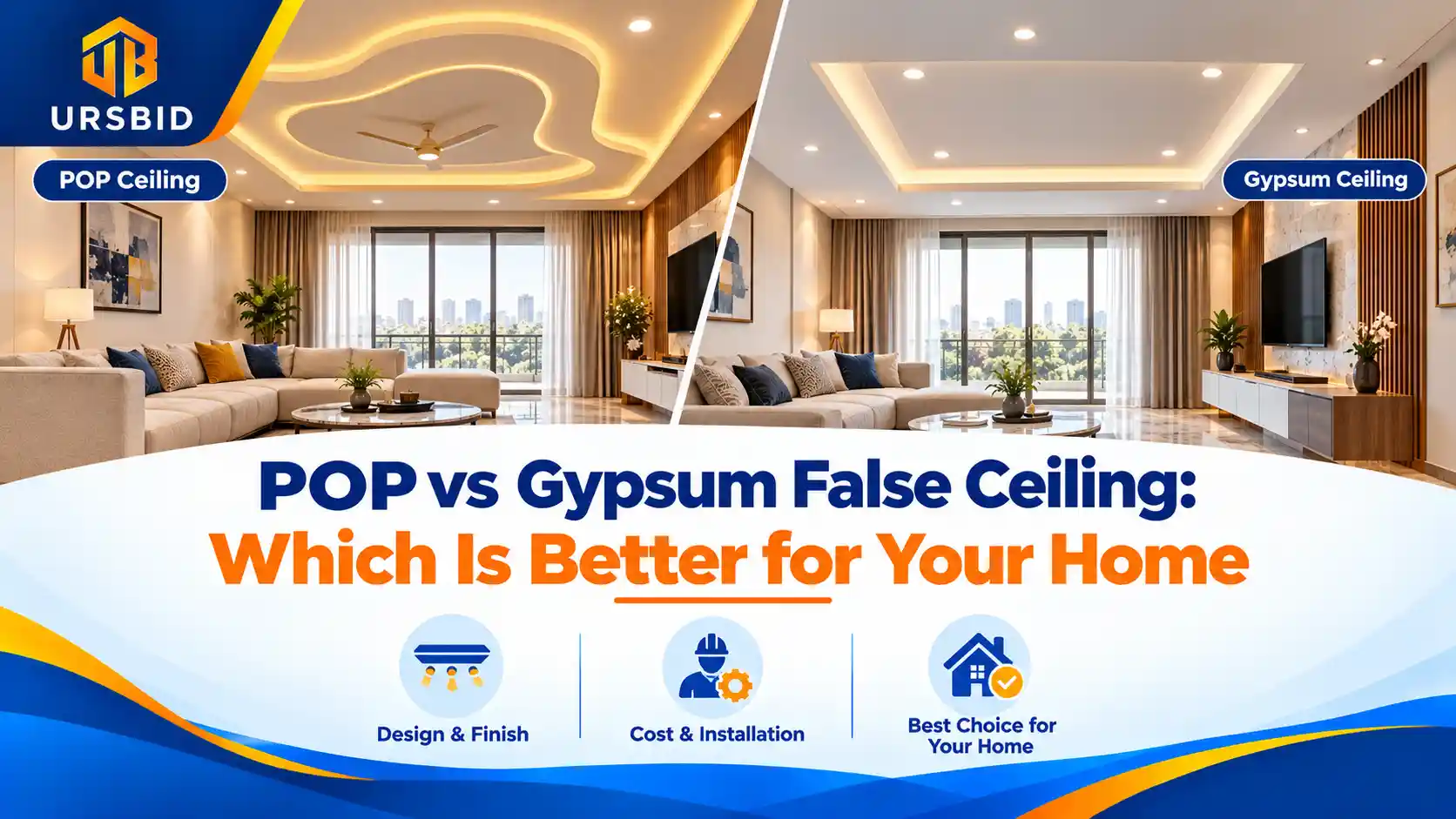
Two neighbours renovate their living rooms in the same year. One picks POP because it is cheaper. The other picks gypsum. Two years later, the first has fine hairline cracks along the ceiling edges. The second has a smooth, clean ceiling. But the first ceiling has beautiful curved mouldings, and the second is plain and flat.
Both choices made sense. POP and gypsum are very different materials, and each wins in a different way. This guide compares POP vs gypsum false ceiling in simple words, so you can choose what fits your room and budget.
What Is the Difference Between POP and Gypsum False Ceiling?
POP (Plaster of Paris) is a wet plaster that is shaped on site. Gypsum is a ready-made board that is screwed onto a metal frame. That one difference changes the finish, speed, and cracking.
POP is a powder made from gypsum. It hardens when mixed with water. A worker applies it by hand over a frame, then shapes and finishes it. Gypsum board is made in a factory, with a gypsum core between paper layers. It arrives flat and ready to fix. Here is a quick comparison:
|
Feature |
POP |
Gypsum board |
|
How it is made |
Wet plaster applied on site |
Factory-made board fixed on a frame |
|
Finish |
Good, depends on the worker |
Smooth and even |
|
Curves and mouldings |
Excellent |
Limited |
|
Weight |
Heavier |
Lighter |
|
Site mess |
Wet, dusty work |
Mostly dry work |
|
Cracks |
More likely over time |
Less likely when jointed well |
|
Moisture |
Poor |
Poor, better with moisture-resistant board |
|
Fire resistance |
Moderate |
Higher |
Gypsum board is the most common choice for modern flat ceilings with cove lights.
Which Is Better, POP or Gypsum False Ceiling?
For most homes, gypsum is better. It gives a cleaner finish, installs faster, and cracks less. POP is better when you want curves, mouldings, or the lowest upfront cost in a dry room.
So the answer depends on your design. If you want a flat ceiling with a neat cove, choose gypsum. If you want ornate cornices, round shapes, or deep carved details, POP can do what gypsum board cannot. One guide puts it clearly: POP costs less and handles curves and custom mouldings, while gypsum gives a better finish with less mess.
Think of it this way. Gypsum is the safe, modern choice. POP is the flexible, artistic choice.
Does POP Crack More Than Gypsum?
Yes, POP is more likely to crack. A good worker makes a strong ceiling, but an average one can leave hairline cracks within a few years.
POP is applied wet, and it needs time to cure and dry. If it dries too fast or the frame moves, cracks appear along stress lines. Gypsum boards are fixed in flat sheets, and the joints are sealed with tape and filler, so cracks are less common. Neither is crack-proof. A damp slab or a loose frame can crack either one.
What Is the POP False Ceiling Cost vs Gypsum False Ceiling Cost?
POP false ceiling cost is about Rs 60 to 120 per sq ft installed. Gypsum false ceiling cost is about Rs 75 to 180 per sq ft. Gypsum is usually 20% to 30% higher at the start.
Here are indicative installed rates for 2026:
|
Item |
POP |
Gypsum |
|
Rate with material and labour (Rs per sq ft) |
About 60 to 120 |
About 75 to 180 |
|
Labour only (Rs per sq ft) |
About 20 to 45 |
About 25 to 50 |
|
10 x 10 ft room (100 sq ft) |
About Rs 6,000 to 12,000 |
About Rs 7,500 to 18,000 |
(Cost source: Indiframe, False Ceiling Cost in India 2026: POP vs Gypsum.)
Rates differ by city. Metro cities can run 15% to 20% higher. Lights, cove strips, and paint cost extra.
The lower POP price is not the whole story. Many sources say gypsum lasts about 15 to 20 years, while POP lasts about 10 to 15, or less in humid places. The same cost guide says gypsum can cost less over 10 years, because it needs fewer repairs. (Lifespan source: Comaron, False Ceiling Comparison: Gyproc vs POP vs PVC.)
How Long Does Installation Take for POP and Gypsum?
Gypsum is faster. A single room usually takes 1 to 3 days with gypsum, and about 3 to 5 days with POP, because POP needs drying time.
Gypsum work is mostly dry. The frame goes up, boards are fixed, joints are taped and sanded, and the ceiling is painted. POP involves wet plaster, drying between layers, and a lot of dust. For a full flat, that gap grows to several days. If you are living in the home during the work, the cleaner, shorter gypsum job is a big plus
Which Is Better for Moisture and Fire?
Neither POP nor standard gypsum likes water. For fire, gypsum is better. In wet rooms, use moisture-resistant gypsum or PVC.
POP absorbs water, then cracks, sags, and grows mould. In wet zones, it can fail within a few years. Standard gypsum board also suffers if it stays damp, but moisture-resistant (green) boards handle humid spaces better. Gypsum boards are also available in fire-rated types, which makes them the safer choice around lights and wiring. For bathrooms, PVC is the simplest answer.
Which Ceiling Should You Choose for Each Room?
Pick by design and by how damp the room is. Gypsum suits most dry rooms. POP suits curved, decorative work.
|
Room or need |
Better choice |
|
Living room with flat ceiling and cove |
Gypsum |
|
Ornate cornices, round or carved designs |
POP |
|
Bedroom |
Gypsum |
|
Kitchen |
Moisture-resistant gypsum or PVC |
|
Bathroom |
PVC |
|
Tight budget in a dry room |
POP |
|
Ceiling with AC ducts and lights |
Gypsum |
What Mistakes Should You Avoid When Choosing Between POP and Gypsum?
Do not choose POP only because it is cheaper. Check your design first. A plain flat ceiling often looks better and lasts longer in gypsum.
Do not use plain POP or standard gypsum in a bathroom. Both absorb moisture and sag.
Do not hire an untrained worker for POP. The finish depends on skill. You can find interior and decoration services on URSBID for both POP and gypsum work.
Do not hang fans or heavy lights from the ceiling. Fix them to the slab.
Do not compare quotes without the same brand, thickness, and frame. A cheaper quote may use thin boards or a weak frame.
Where Can You Buy False Ceiling Materials Online?
You can buy false ceiling materials online through URSBID by posting your requirement and getting quotes from verified suppliers.
Once you have chosen between POP and gypsum, the next step is to compare rates. To Buy False Ceiling Materials Online through URSBID, share the material type, brand, thickness, area, and delivery place. Registered vendors will send their quotations directly to you. Ask each one about the frame details and the delivery terms.
Frequently Asked Questions
Which is better, POP or gypsum false ceiling?
Gypsum is better for most flat ceilings because it is cleaner, faster, and cracks less. POP is better for curves, mouldings, and a lower upfront cost in dry rooms.
Is POP cheaper than gypsum?
Yes, usually. POP costs about Rs 60 to 120 per sq ft installed and gypsum about Rs 75 to 180. Gypsum may cost less over the years because it needs fewer repairs.
Does POP crack more than gypsum?
Yes. POP is more likely to develop hairline cracks, especially if it is cured badly or the frame moves. Gypsum joints are taped, so cracks are less common.
Can I use POP in a bathroom?
No. POP absorbs moisture, sags, and grows mould. Use PVC or moisture-resistant gypsum board instead.
How long does a gypsum false ceiling last?
Most sources say about 15 to 20 years with good installation and dry conditions. POP often lasts about 10 to 15 years, or less in humid places.
Final Thoughts
POP and gypsum are both good materials, but they do different jobs. Gypsum is the clean, fast, modern choice for most rooms. POP is the flexible choice for curves and rich mouldings, if you have a skilled worker. Check your design, your room's dampness, and your budget over the long term. Then you can pick the ceiling that stays smooth and good-looking for years.
Ready to compare prices? Get false ceiling rates on URSBID by posting your requirement, and receive quotes from verified suppliers.