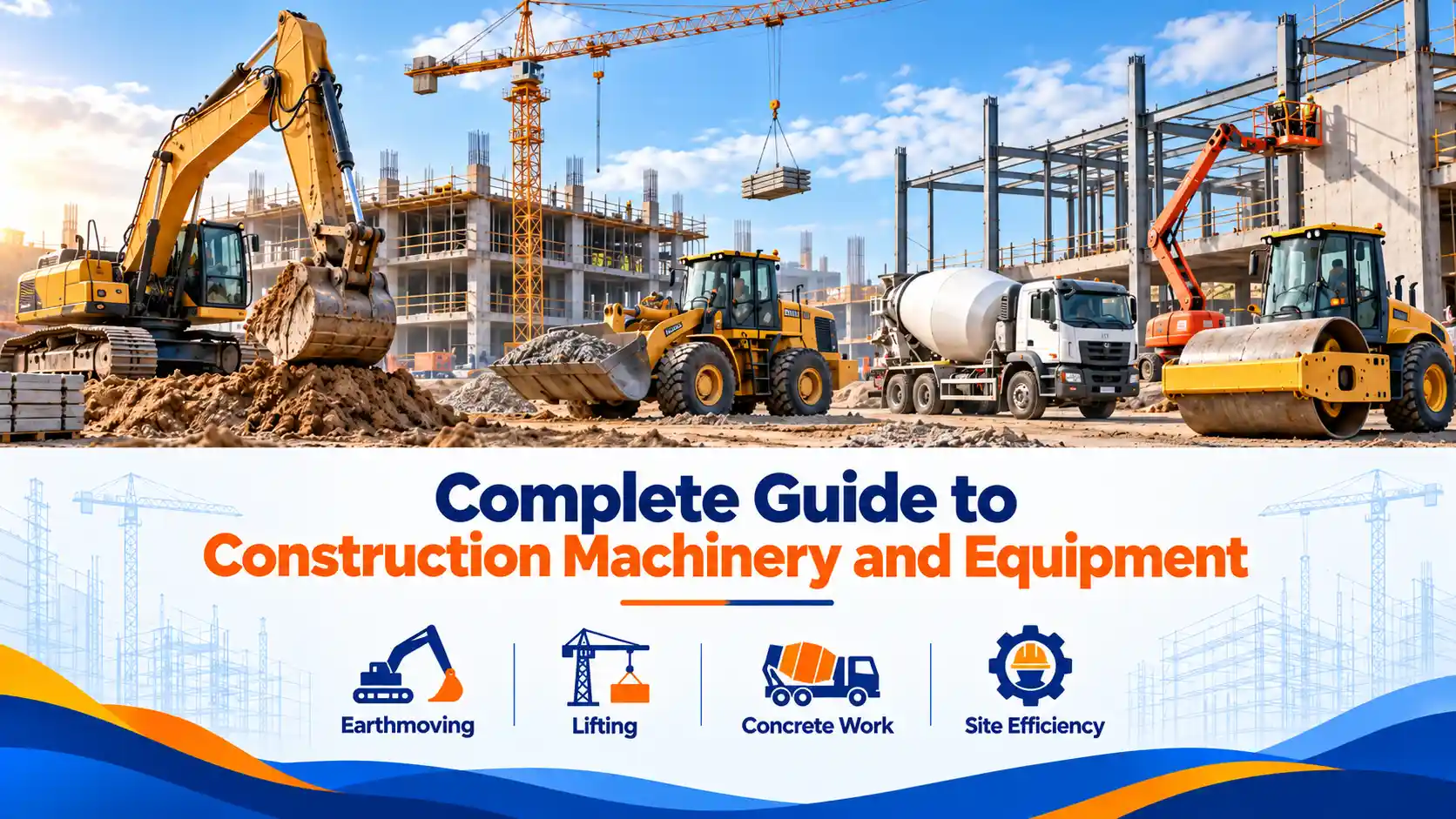
Every big project starts the same way, not with bricks or cement, but with machines clearing and shaping the ground long before any structure takes form. Construction machinery and equipment rarely gets the attention that materials do, yet choosing the wrong machine for the job, or renting when buying made more sense, can cost a project more time and money than almost any material decision.
This guide covers the main types of construction machinery and equipment used on Indian sites today, what each one actually does, and how to decide between renting and buying for your project.
Types of Construction Machinery and Equipment
- Excavators dig, lift, and move earth and debris, and remain the single most widely used machine on Indian construction sites, from small residential foundations to major infrastructure projects.
- Backhoe loaders combine a front loading bucket with a rear excavator arm, making them versatile for smaller sites that need both digging and loading capability from one machine.
- Bulldozers push and level large volumes of earth, commonly used for site clearing, grading, and rough terrain shaping before finer excavation work begins.
- Cranes, whether mobile, tower, or fixed, lift and place heavy materials at height, essential for high-rise construction, steel erection, and precast element placement.
- Concrete mixers and pumps prepare and deliver concrete to the pour location, with pumps particularly valuable for upper floors and hard-to-reach areas on larger buildings.
- Compactors and rollers compress soil, gravel, or asphalt layers to the density required for stable foundations and durable road surfaces.
- Dumpers and tippers transport loose material, like excavated soil or aggregate, across a site or to and from external locations.
- Motor graders fine-tune ground surfaces to a precise level, commonly used in road construction and large-scale site preparation.
What Is Heavy Equipment for Construction Actually Used For?
Heavy equipment for construction is used to move, lift, and shape material at a scale and speed that manual labour simply can't match, cutting project timelines significantly on any job beyond small-scale residential work.
A single excavator can move in an hour what would take a large labour crew a full day to dig by hand. Cranes make it possible to construct buildings well beyond the height manual lifting could ever reach. Compactors ensure soil and road layers meet the density standards required for long-term stability, something that can't be reliably achieved through manual tamping alone. This combination of speed, precision, and capability is exactly why heavy equipment has become central to nearly every construction project above a certain size, residential builds included.
What Is Earthmoving Machinery and Where Is It Used?
Earthmoving machinery refers to equipment specifically designed to excavate, move, or grade earth and other loose material, and it makes up the largest single category of construction machinery in use across India.
Excavators, bulldozers, backhoe loaders, and motor graders all fall under this category, and together they handle the groundwork every project needs before any structural work can begin, site clearing, foundation excavation, trenching for utilities, and final grading. Earthmoving machinery consistently accounts for the largest share of construction equipment demand in India, driven heavily by highway construction, metro rail projects, and large-scale urban development where the sheer volume of earth that needs moving makes manual methods impractical.
Should You Choose Construction Equipment Rental or Buying?
Choose construction equipment rental for short-term or occasional needs, and buying only when a machine will see consistent, ongoing use across multiple projects.
Renting avoids the large upfront cost of purchasing equipment, along with the ongoing expenses of maintenance, storage, and depreciation that come with ownership. It's the practical choice for a single project, a specialised machine you'll rarely need again, or when you want to try different equipment brands before committing to a purchase. Buying makes more sense when a contractor runs equipment nearly continuously across back-to-back projects, since ownership becomes more cost-effective than rental fees over enough usage hours, and it also means the equipment is always available on your own schedule rather than dependent on a rental company's inventory.
How Big Is India's Construction Equipment Market
India's construction equipment market was valued at around USD 15.37 billion in 2025, and it's projected to reach USD 29.50 billion by 2034, growing at a yearly rate of about 7.5%. Heavy construction equipment accounts for the largest share of this market, and earthmoving machinery, excavators in particular, dominates equipment demand, driven by highway expansion, metro rail construction, and large urban infrastructure projects across the country. (Market data source:IMARC Group India Construction Equipment Market Report, 2026.)
For contractors and project owners, this growth has brought more rental options and equipment brands into the market than a decade ago, making it worth comparing suppliers and rental terms directly rather than defaulting to a single familiar vendor.
What Mistakes Should You Avoid With Construction Machinery?
Don't choose equipment size based on the biggest available option. An oversized excavator on a tight residential site wastes fuel and manoeuvring time, while an undersized machine on a large earthwork job simply takes too long to get the work done.
Don't skip checking a rented machine's maintenance history and operating hours. A poorly maintained machine can break down mid-project, costing far more in downtime than the rental savings were worth.
Don't overlook operator skill when planning equipment needs. Even the right machine underperforms badly in inexperienced hands, so factoring in a qualified operator is as important as choosing the equipment itself.
Where Can You Get Construction Equipment Rates and Quotes?
You can get construction machinery and equipment rates through URSBID by posting your requirement and receiving quotes from verified suppliers.
Whether you need to rent an excavator for a short project or source heavier equipment for ongoing work, the traditional approach of calling around to local rental yards is slow and rarely gives you a clear price comparison. Toget equipment rates through URSBID, describe your requirement, machine type, duration, and location, and registered vendors send their quotations directly, so you can compare real options before committing.
If your project also needs a fabrication or repair service alongside equipment, checkingmetal fabrication services on the same platform helps keep your material, equipment, and labour sourcing coordinated.
Frequently Asked Questions
What types of construction machinery are most commonly used in India? Excavators, backhoe loaders, cranes, concrete mixers and pumps, compactors, and dumpers are among the most widely used construction machinery, with earthmoving equipment like excavators accounting for the largest share of overall demand.
Is it cheaper to rent or buy construction equipment? Renting is generally cheaper for short-term or occasional projects, since it avoids the upfront cost and ongoing maintenance of ownership, while buying becomes more cost-effective for contractors using the same equipment consistently across multiple projects.
What is earthmoving machinery used for? Earthmoving machinery, including excavators, bulldozers, and motor graders, is used for site clearing, excavation, trenching, and grading, the groundwork stage that needs to happen before any structural construction begins.
How do I choose the right size of excavator for my project? Match the excavator's size to the scale of the job, a compact or mini excavator suits tight residential sites, while larger crawler excavators are better suited to major earthwork on infrastructure or commercial projects.
Does construction equipment rental include an operator? This varies by rental provider and agreement, so it's worth confirming upfront whether the rental includes a qualified operator or if you'll need to arrange one separately, since operator skill significantly affects how well the equipment performs.
Final Thoughts
Construction machinery and equipment quietly determines how fast and how well a project actually gets built, long before materials like cement and steel take centre stage. Matching the right machine to the job, deciding sensibly between renting and buying, and factoring in operator skill are the kind of decisions that keep a project on schedule instead of stuck waiting on equipment that was never the right fit to begin with.
Ready to source machinery for your project?Get construction equipment rates on URSBID by posting your requirement, and receive quotes from verified suppliers.