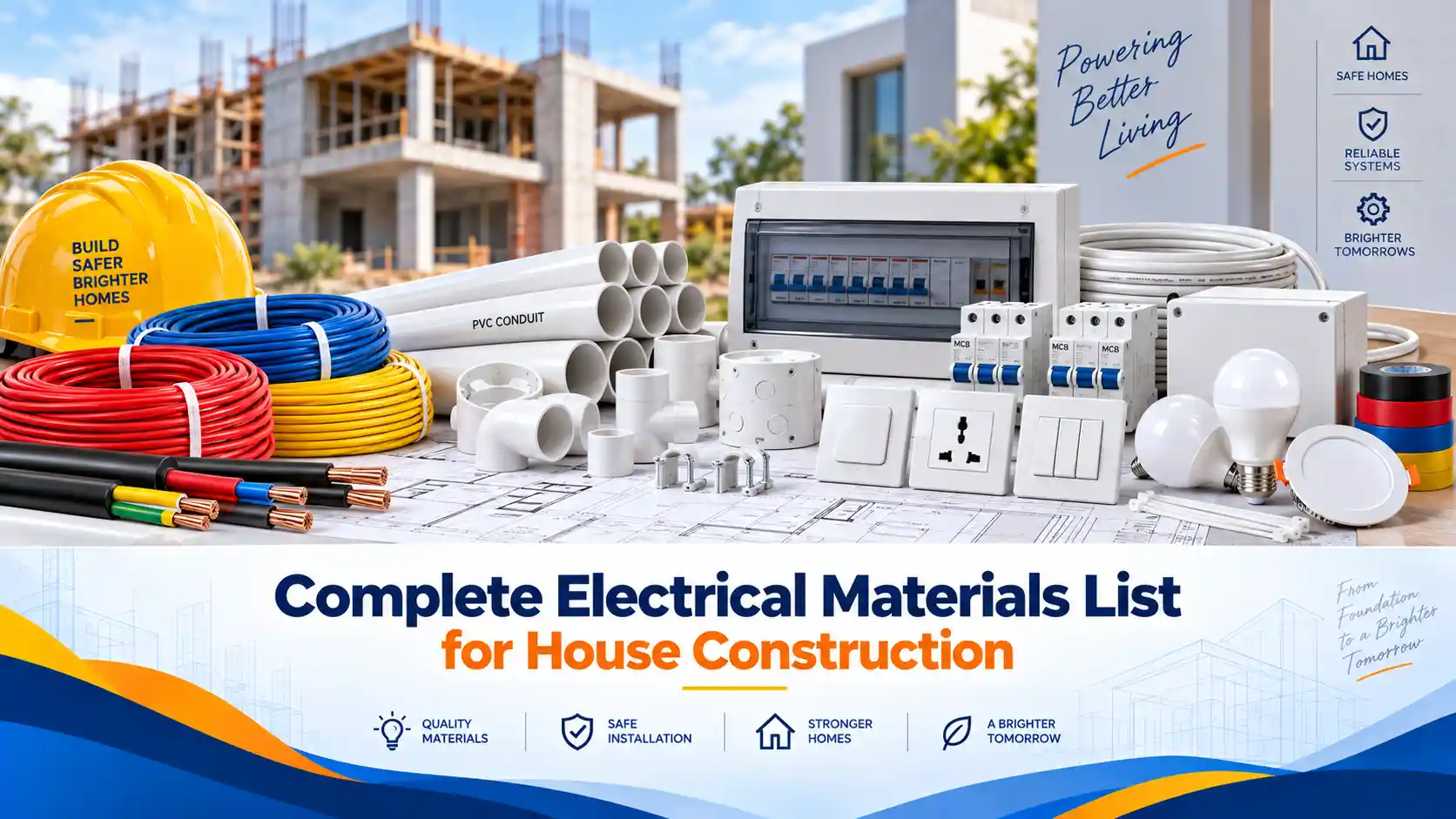
Electrical work is the one part of a house build that disappears completely once the walls are plastered. Every wire, every conduit pipe, every junction box gets sealed inside the structure, and from that point on, fixing a mistake means breaking a wall rather than making a phone call. That's exactly why getting the electrical materials list right before the wiring stage matters more than almost any other decision in a build.
This guide walks through the essential electrical materials for house construction, what each one does, and what to check before your electrician starts work.
Essential Electrical Materials List for a New Home
- Wires and cables carry current through the house, from the main board to every switch, socket, and light point.
- Conduit pipes protect wiring inside walls and ceilings, usually PVC, laid before plastering so wires can be pulled through later.
- Distribution board (DB) houses the MCBs and acts as the central point where power splits off to different circuits in the house.
- MCBs (Miniature Circuit Breakers) cut power automatically if a circuit is overloaded or short-circuits, protecting both the wiring and anyone using it.
- Switches and sockets are the visible points where the electrical system meets daily use, for lights, fans, and plug points.
- Junction boxes house wire connections safely at points where cables split or change direction, particularly behind ceiling fixtures.
- Earthing materials, including earth wire and earthing electrodes, protect the household from electrical faults by directing stray current safely into the ground.
- Light fixtures and fans connect to the wiring system at the final stage, though these are often chosen separately from the core electrical materials.
What Electrical Wiring Materials Should You Choose for a House?
Choose wiring materials based on copper conductor quality and insulation rating, not just the price per coil.
Copper remains the standard conductor for house wiring in India, valued for its strong conductivity and reliability over decades of use. Aluminium wiring exists as a cheaper alternative but is generally reserved for larger industrial installations rather than home wiring, since it has lower conductivity and needs thicker cable for the same current-carrying capacity. Wire insulation also matters. FR (fire retardant) and FRLS (fire retardant low smoke) rated cables cost slightly more than standard PVC-insulated wire, but they resist catching fire and release less smoke if they do, a genuinely important safety margin inside a home's walls.
How Do You Choose the Right MCB and Switches for Your Home?
Choose MCBs based on the load each circuit carries, and choose switches based on daily use and safety certification rather than appearance alone.
MCBs come rated in amperes, and each circuit in your home needs an MCB sized to match its expected load, lighting circuits typically need a lower rating than a circuit feeding an air conditioner or water heater. Using an undersized MCB causes nuisance tripping, while an oversized one fails to protect the circuit properly during an actual fault. For switches, look for ISI certification as a baseline, and consider modular switches for a cleaner look and easier future upgrades, since individual switch modules can be replaced without rewiring the entire plate.
What Electrical Fittings Does a House Need Beyond the Basics?
Beyond wiring and switches, a house needs electrical fittings like junction boxes, earthing accessories, and circuit protection devices to make the system safe and complete.
An RCCB (Residual Current Circuit Breaker) adds an extra layer of protection beyond a standard MCB, cutting power quickly if it detects current leaking to earth, which matters most in areas prone to dampness, like bathrooms and outdoor points. Cable trays and clips keep wiring organised and properly supported inside conduits, reducing strain on connections over time. A good earthing system, often overlooked, is what actually protects people and appliances during a fault, so it deserves the same attention as the visible switches and sockets.
How Big Is India's Demand for Electrical Wiring Materials
India's electrical wires and cables market was valued at around USD 7 billion in 2025, and it's projected to reach USD 11.3 billion by 2034, growing at a yearly rate of about 5.3%. Construction is one of the largest end-user segments driving this demand, alongside the power sector, and low-voltage cables for residential and commercial buildings are seeing particularly strong growth under India's expanding urban housing programs. (Market data source:IMARC Group India Electrical Wires and Cables Market Report, 2026.)
For homeowners, this steady growth means a wider range of certified brands and price points than a decade ago, which makes it worth comparing quotes directly rather than accepting whatever an electrician's usual supplier stocks.
What Mistakes Should You Avoid With Electrical Materials?
Don't undersize your wiring to save on upfront cost. A wire that's too thin for its circuit's load heats up under use, which is a genuine fire risk hidden inside a wall, not just a minor inefficiency.
Don't skip planning your circuit layout before conduit pipes go into the walls. Adding a new switch or socket point later, after plastering, means cutting into a finished wall, which is a far bigger job than getting the layout right the first time.
Don't treat earthing as optional. A home without proper earthing puts anyone touching a faulty appliance at real risk, and it's one of the cheapest parts of the entire electrical materials list relative to the protection it provides.
Where Can You Buy Electrical Materials Online for Your House?
You can buy electrical materials online through URSBID by posting your requirement and getting quotes from verified suppliers.
Once your electrician has confirmed the wire gauge, MCB ratings, and fittings your house needs, the next step is finding a supplier who delivers consistent, certified quality at a fair price. Toget electrical material rates through URSBID, describe your requirement and registered vendors send their quotations directly, so you can compare real pricing instead of relying on a single local shop's stock.
If your project also needs water supply materials or sanitary fittings around the same time, it helps to request those quotes together, since electrical and plumbing work often happen on overlapping construction stages.
Frequently Asked Questions
What electrical materials are needed for house construction?
A house needs wires and cables, conduit pipes, a distribution board, MCBs, switches and sockets, junction boxes, earthing materials, and light fixtures, with the exact quantity depending on the home's size and layout.
Should I use copper or aluminium wiring for my house?
Copper is the standard choice for residential wiring in India due to its strong conductivity and reliability, while aluminium is generally reserved for larger industrial installations rather than home use.
What is the difference between an MCB and an RCCB?
An MCB protects a circuit from overload and short-circuits by cutting power automatically, while an RCCB adds protection against current leaking to earth, which is especially important in bathrooms and other damp areas.
Why does earthing matter in house wiring?
Proper earthing directs stray electrical current safely into the ground during a fault, protecting people and appliances from electric shock, making it one of the most important safety elements in a home's electrical system.
Can I add new switch points after the walls are plastered?
It's possible but far more difficult and costly, since it means cutting into a finished wall. Planning your full circuit layout before conduit pipes are laid avoids this problem entirely.
Final Thoughts
Electrical materials rarely get the visual attention that tiles or paint receive, but they're the one system in a house where a mistake stays hidden until it becomes a real problem. Choosing the right wire gauge, correctly rated MCBs, certified switches, and proper earthing before the walls close up is what keeps a home's electrical system safe and low-maintenance for decades, rather than a source of recurring, hard-to-fix issues.
Ready to source materials for your build?Get electrical material rates on URSBID by posting your requirement, and receive quotes from verified suppliers for wires, MCBs, switches, and fittings.