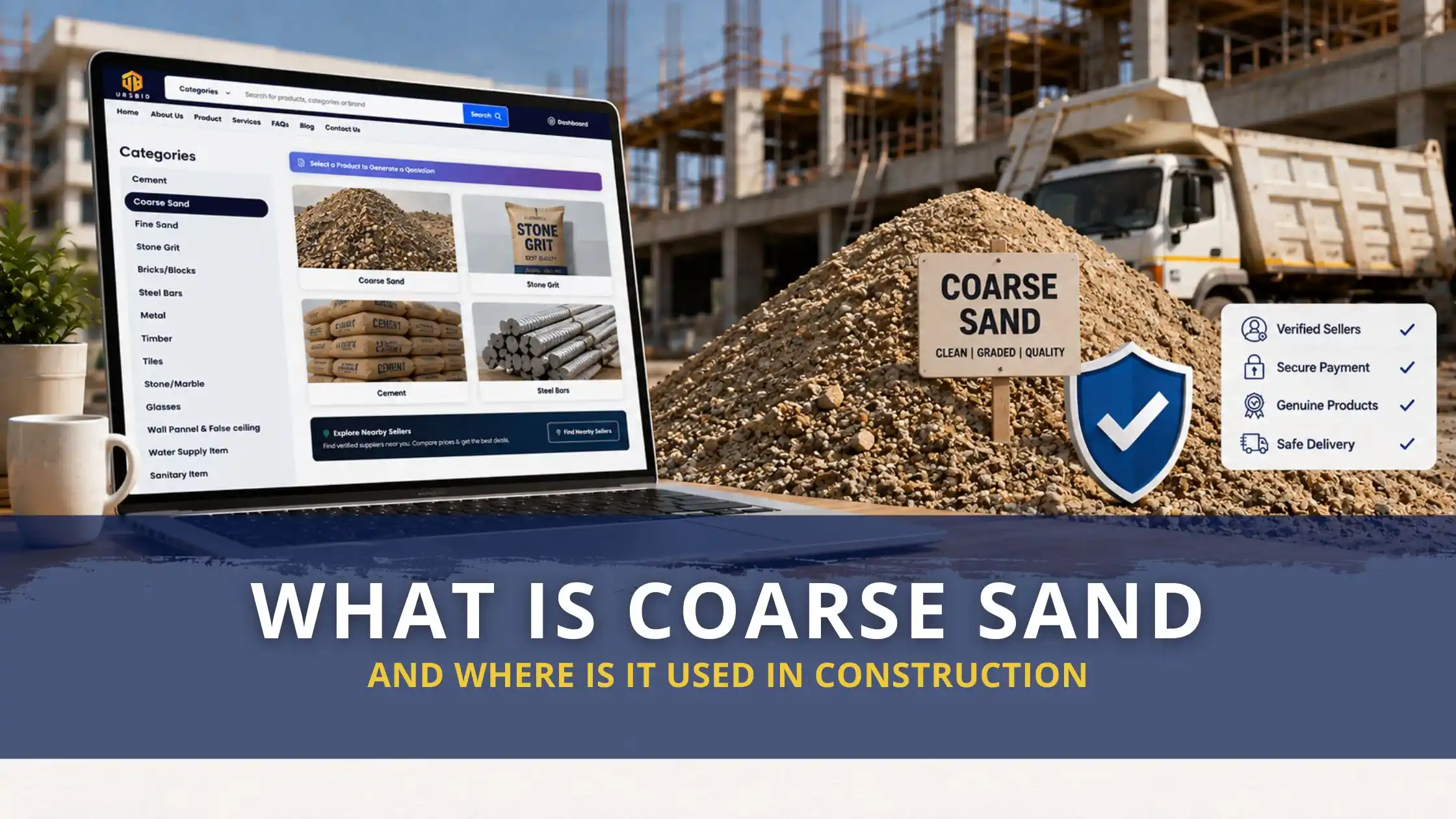
Walk onto almost any construction site and you'll see at least two very different-looking piles of sand — one coarse and gritty, the other soft and fine enough to sift through your fingers. Most people assume "sand is sand," but using the wrong type in the wrong place is one of the quieter reasons concrete comes out weaker than expected or plaster develops fine cracks within a year.
Coarse sand is the one doing the heavy lifting — literally. It's the backbone of most concrete and structural mixes, and understanding exactly what it is, where it should (and shouldn't) be used, and how to judge its quality can save a project from problems that don't show up until much later. This guide breaks all of that down clearly.
What Is Coarse Sand?
Coarse sand is a naturally occurring granular material with a rough texture and comparatively large particle size, typically ranging from 2.0 mm to 4.75 mm. It's often called by regional names like badarpur sand or river sand, depending on where it's sourced. Good-quality coarse sand is clean — free from clay, silt, and organic impurities — which matters because those impurities weaken the bond it forms with cement.
Unlike fine sand, which is used mainly for surface work like plastering, coarse sand's larger, rougher particles interlock well within a concrete or mortar mix, giving the final material more strength and stability. That's the core reason it's the default choice wherever structural strength matters more than surface finish.
Coarse Sand vs. Fine Sand: The Key Difference
It's worth being precise about this distinction, since the two are easy to confuse:
- Coarse sand: Larger particles (2.0-4.75 mm), rough texture, used for strength-critical applications like concrete and foundation work.
- Fine sand: Smaller particles, smoother texture, used for surface-level applications likeplastering and flooring where a smooth finish matters more than raw strength.
Using fine sand where coarse sand is needed (or vice versa) is a common site-level mistake — fine sand in a concrete mix reduces the mix's structural strength, while coarse sand used for plastering leaves a rough, uneven surface that's hard to finish properly.
Where Coarse Sand Is Used in Construction
1. Concrete Mix for Foundations, Beams, Columns, and Slabs
This is coarse sand's primary application. In a standard concrete mix, coarse sand acts as the fine aggregate that fills gaps between larger aggregates (like crushed stone), binding everything together withcement into a dense, strong mass. Foundations, columns, beams, and slabs — the structural elements that carry a building's load — all depend on coarse sand's interlocking particle structure for strength and durability.
2. Brickwork and Blockwork Mortar
When laying bricks or blocks, the mortar joining them needs enough body and strength to hold the structure together under load. Coarse sand is commonly used in this mortar mix, particularly for load-bearing walls, where a stronger bond matters more than a perfectly smooth joint finish.
3. RCC (Reinforced Cement Concrete) Work
Any reinforced concrete element — wheresteel bars are embedded within concrete to handle tensile load — relies on a well-graded concrete mix, and coarse sand is a standard component of that mix design. The quality and grading of the sand directly affects how well the concrete bonds around the reinforcement.
4. Road and Pavement Base Layers
Coarse sand is also used as part of the base and sub-base layers in road construction, where its particle structure helps with load distribution and drainage beneath the surface layer.
5. Backfilling and Leveling Work
Because of its stability under compaction, coarse sand is often used for backfilling trenches and leveling ground before further construction work, particularly where drainage and compaction strength matter more than a smooth finish. On sites where natural stone flooring or cladding follows this stage, buyers often sourcestone and marble at the same time to keep the project timeline moving.
What Coarse Sand Is Not Ideal For
Just as important as knowing where to use coarse sand is knowing where to avoid it:
- Plastering walls and ceilings: Its rough texture makes it difficult to achieve a smooth, even surface — fine sand or plaster sand is the better choice here.
- Flooring finish layers: Similarly, floor finishing work benefits from finer, smoother sand rather than coarse sand's larger particles.
- Decorative or exposed finish work: Anywhere the sand contributes to visible surface texture, coarse sand's roughness works against the desired finish.
How to Check Coarse Sand Quality Before Using It
Not all coarse sand sold in the market meets the standard needed for structural work. A few practical checks help separate good-quality sand from substandard stock:
1. The Silt Content Test
A simple field test: take a sample in a transparent bottle, add water, shake it, and let it settle. If a visible layer of silt settles on top of the sand within a few minutes, the silt content is likely too high (ideally under 3-4% for structural use). Excess silt weakens the bond between sand, cement, and aggregate.
2. Visual and Touch Check
Good coarse sand should feel gritty and free of visible clay lumps or organic debris (leaves, roots, or decomposed matter). If it feels sticky or forms clumps when squeezed wet, that's a sign of clay contamination.
3. Particle Size Consistency (Grading)
Well-graded coarse sand contains a reasonable mix of particle sizes within the 2.0-4.75 mm range rather than being dominated by one extreme. Inconsistent grading affects how well the sand packs and bonds within a concrete mix.
4. Source Verification
Coarse sand sourced from riverbeds should ideally come from licensed, legally permitted extraction sites — both for quality consistency and to avoid using illegally mined material, which is increasingly restricted in several Indian states.
5. Moisture Content Awareness
Sand's moisture content affects the water-cement ratio in a concrete mix. Buyers working on larger structural projects should ideally get a moisture content estimate from the supplier, especially during monsoon months when sand naturally retains more water.
Coarse Sand and India's Sand Sourcing Challenges
Sand sourcing in India has become more regulated in recent years, with several states restricting river sand mining to control environmental impact. This has pushed many buyers toward alternatives like M-sand (manufactured sand), which is produced by crushing granite and can serve as a substitute for natural coarse sand in many concrete applications, provided its grading and quality meet the required standard.
For buyers and contractors, this makes sourcing from a verified, transparent supplier more important than ever — not just for quality assurance, but to be confident the material comes from a legitimate, compliant source in the first place.
Buying Coarse Sand Online Through a Verified Marketplace
Sourcing coarse sand the traditional way — through a local dealer with limited stock visibility — makes it hard to compare quality, pricing, or supplier legitimacy before committing to a bulk order. OnURSBID, you can browse coarse sand listings directly, post your quantity and grading requirement, and receive competitive quotes from verified suppliers rather than relying on a single local source.
Since most structural projects need more than one material sourced consistently, keeping your entire procurement — sand, aggregates, and everything that goes into the same mix — verified on one platform saves the trouble of separately vetting a new supplier for each item.
For a broader look at how different sand types compare beyond just coarse sand — including M-sand, pit sand, and plaster sand — URSBID's own guide ontypes of sand used in construction is a useful next read.
Frequently Asked Questions
What is coarse sand used for in construction? Coarse sand is primarily used in concrete mixes for foundations, beams, columns, and slabs, as well as in mortar for brickwork and blockwork, where structural strength matters more than surface smoothness.
What is the particle size range of coarse sand? Coarse sand typically has a particle size ranging from 2.0 mm to 4.75 mm, giving it a rough, gritty texture compared to fine sand.
Can coarse sand be used for plastering? No, coarse sand is not ideal for plastering since its larger, rougher particles make it difficult to achieve a smooth surface finish. Fine sand or plaster sand is the better choice for that purpose.
How do I check the quality of coarse sand before buying? Check for excessive silt content using a simple settling test, look for visible clay or organic contamination, and confirm consistent particle grading within the 2.0-4.75 mm range before using it in structural work.
Is M-sand a good substitute for natural coarse sand? Yes, manufactured sand (M-sand) can substitute for natural coarse sand in most concrete applications, provided its grading and quality meet the required construction standards — and it's increasingly used due to restrictions on river sand mining in several regions.
Final Thoughts
Coarse sand doesn't get as much attention as cement or steel in construction planning, but it plays just as direct a role in whether a concrete structure ends up strong and durable or quietly under-strength. Knowing when to use it, how to check its quality, and where to source it from a legitimate, verified supplier is a small amount of diligence that protects a much bigger investment down the line.
If you're sourcing materials for an upcoming project,browse verified coarse sand suppliers on URSBID and compare quotes before placing your order.