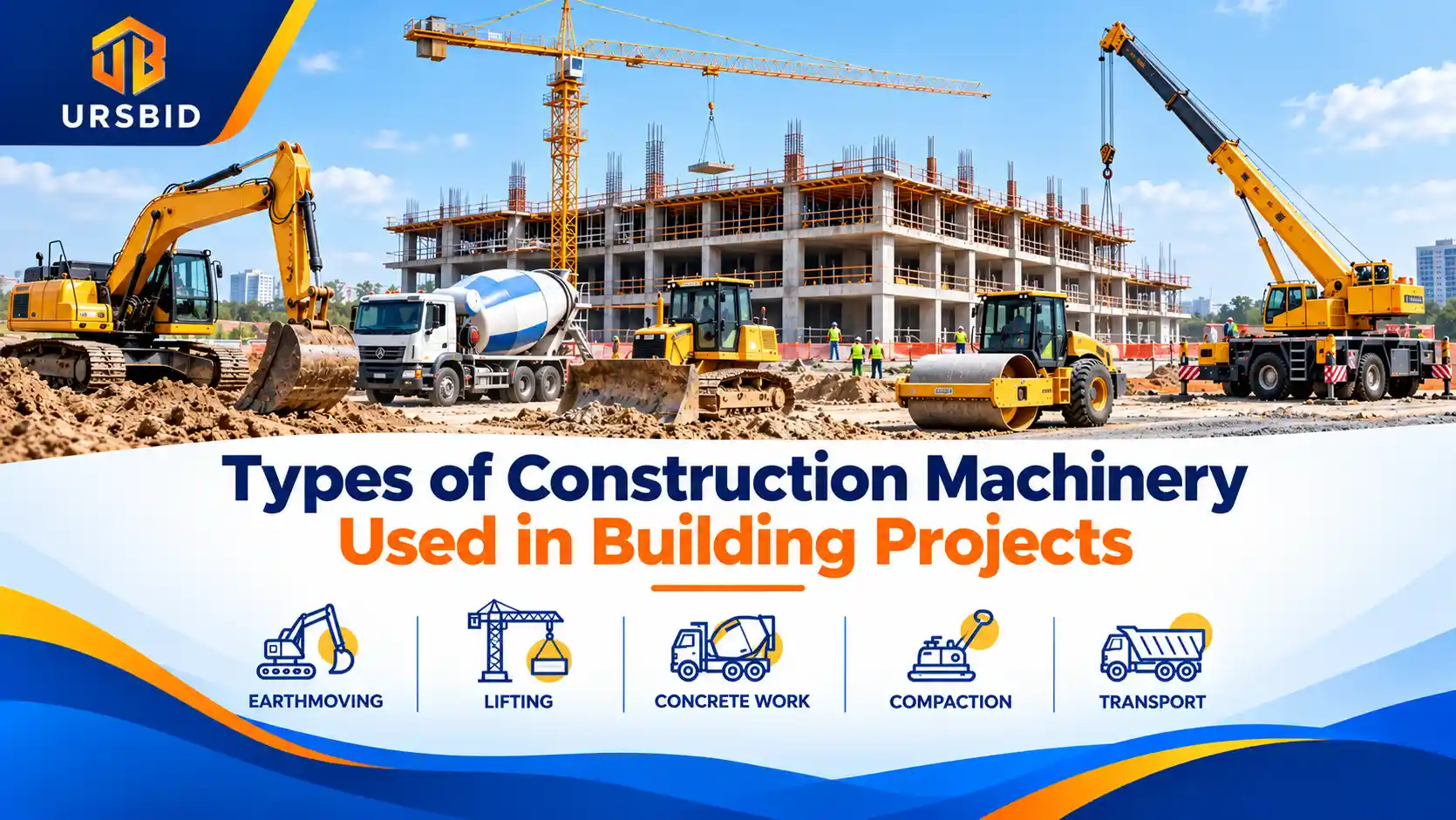
On day one of a building project, there is no wall, no column, and no slab. There is only a plot of land and a yellow machine digging into it. A few months later, a different machine lifts steel to the fifth floor. Later still, a truck with a spinning drum pours the roof.
Each stage of a building uses different machines. If you know which one belongs where, you can plan your budget and time better. This guide explains the types of construction machinery used in building projects, stage by stage, in simple words.
Which Types of Construction Machinery Are Used in Building Projects?
Building projects use machines at five stages: site preparation, foundation, concrete structure, lifting, and finishing. Each stage needs different equipment.
- Site preparation: bulldozers, backhoe loaders, and dumpers clear and level the land.
- Foundation: excavators, compactors, and piling rigs dig and prepare the ground.
- Concrete structure: concrete mixers, transit mixers, pumps, and vibrators build columns, beams, and slabs. Bar cutting and bending machines prepare the steel.
- Lifting: cranes, hoists, and telehandlers move materials up and across the site.
- Finishing: small power tools, plastering machines, and lifts for finishing walls and floors.
What Construction Machinery for Foundation Work Do You Need?
Construction machinery for foundation work starts with an excavator or backhoe loader to dig, then a compactor to firm the ground. Tall buildings on weak soil may also need a piling rig.
Here is what each machine does:
- Excavator. Digs foundation pits and trenches. Mini excavators fit small plots with tight access.
- Backhoe loader. Digs at the back and loads at the front. It is the common all-round machine on small and medium sites.
- Dumper or tipper. Carries the excavated soil away or brings in fill.
- Compactor or rammer. Presses soil and gravel firm, so the foundation does not settle.
- Dewatering pump. Removes ground water from the pit.
- Piling rig. Drills deep piles for tall buildings or weak soil. Your structural engineer decides whether you need it.
If you only need the digging done and do not want to arrange machines yourself, you can findexcavation work services on URSBID.
Which Machines Pour and Finish the Concrete Structure?
Concrete work uses mixers, pumps, and vibrators. Steel work uses bar cutters and bar benders. Together they build the columns, beams, and slabs.
- Concrete mixer. A drum mixer makes concrete on site for small jobs.
- Transit mixer. A truck that brings ready-mix concrete from a plant. It keeps the concrete turning on the way.
- Concrete pump. Sends concrete through a pipe or boom to upper floors and hard-to-reach spots.
- Needle vibrator. Pushes air out of the wet concrete, so it fills every gap and gains strength.
- Bar cutting and bending machines. Cut and shape steel bars quickly and accurately.
A pump is worth it on upper floors. Carrying concrete by hand to the second or third slab is slow, and joints in the pour can become weak. If you want a trained team for pouring, you can findconcreting work services on URSBID.
How Do Tower Crane and Hoist for Buildings Work?
A tower crane and hoist for buildings lift heavy and bulky material to upper floors. Tower cranes serve tall projects. Hoists and mobile cranes serve smaller ones.
- Tower crane. Fixed to the ground and rising above the building. Used on high-rise projects to lift steel, shuttering, and concrete buckets.
- Mobile crane. Drives to the site and lifts for a short time. Good for placing heavy items like steel beams or tanks.
- Material hoist. A cage or platform that lifts bricks, cement bags, and tiles to upper floors.
- Passenger hoist. Carries workers up and down on tall projects.
- Telehandler or forklift. Moves pallets and loads around the site.
For a one or two floor home, a simple hoist or winch is often enough. Do not rent a heavy crane for a small job.
Which Machines Do You Need for a Small House and a High-Rise?
A small house needs a few light machines. A high-rise needs many heavy ones. The size of the project decides the list.
|
Project size |
Typical machines |
|
Small house (G or G+1) |
Backhoe or mini excavator, small mixer, needle vibrator, bar cutter and bender |
|
Mid-rise (G+3 to G+6) |
Above, plus concrete pump, material hoist, mobile crane |
|
High-rise |
Above, plus tower crane, transit mixers or batching plant, piling rig, passenger hoist |
How Big Is the Construction Equipment Market in India?
India sold 136,995 construction machines in FY26, about 2% fewer than the year before, according to the Indian Construction Equipment Manufacturers' Association (ICEMA). Earthmoving machines made up about 71% of the total, or 97,236 units. Concrete equipment stayed steady at 14,486 units, and material handling equipment was 15,290 units.
Domestic sales fell about 7%, while exports rose about 31.5%. Over 95% of the equipment sold in India is made in India. ICEMA says India is the world's third-largest construction equipment market. (Market data source:NBM&CW, India Construction Equipment Sales Decline 2% in FY26, 2026.)
(Third-largest market claim:Equipment India, ICEMA Reports Resilient CE Industry Amid Export Surge, 2026.)
In the year before, backhoe loaders led the earthmoving segment with about 53,000 units, roughly 54% of its sales, followed by crawler excavators at about 36%. That tells you which machines are the most common on Indian sites.
(Earlier data source:Business Standard, ICEMA FY25 sales.)
Should You Rent or Buy Machinery for a House Project?
For most house projects, rent. Buy only if you will use the machine on many projects through the year.
Construction equipment rental for house projects saves the big upfront cost, plus servicing, storage, and operator wages. You pay only for the days or hours you need. To compare options, you can findconstruction equipment rental providers on URSBID.
Before you rent, ask about these points: whether an operator and fuel are included, the minimum hours charged, transport to and from the site, and what happens if the machine breaks down.
What Mistakes Should You Avoid With Construction Machinery?
Do not use a machine that is too big for the site. A large excavator on a narrow plot wastes time and can damage neighbouring walls.
Do not skip the operator check. Ask if the operator is trained, especially for cranes and hoists.
Do not ignore safety. Lifting machines should have valid inspection papers, and the area below a lift should be kept clear.
Do not forget site access. Check gate width, road strength, and overhead wires before a heavy machine arrives.
Do not compare quotes on different terms. One supplier may include the operator and fuel, and another may not.
Where Can You Buy Construction Machinery Online?
You can buy construction machinery online through URSBID by posting your requirement and getting quotes from verified suppliers.
Once you know which machine fits your stage, the next step is to get rates. ToBuy Construction Machinery Online through URSBID, share the machine type, capacity, new or used, quantity, and delivery place. Registered vendors will send their quotations directly to you. Ask each one about warranty, spare parts, and service support before you decide.
Frequently Asked Questions
What are the main types of construction machinery used in building projects?
The main types are excavators and backhoe loaders for digging, compactors for soil, concrete mixers and pumps for the structure, and cranes and hoists for lifting.
Which machine is used for foundation work?
Excavators and backhoe loaders dig the foundation. Compactors firm the soil. Piling rigs are used for deep foundations in tall buildings or weak soil.
Do I need a tower crane for my house?
No. Tower cranes are for high-rise projects. A small house usually needs only a hoist, a mixer, and a backhoe or mini excavator.
What is the difference between a concrete mixer and a transit mixer?
A concrete mixer makes concrete on site. A transit mixer is a truck that brings ready-mixed concrete from a plant and keeps it turning on the way.
Is it better to rent or buy construction machinery for a house?
Renting is usually better for a single house project. Buying makes sense only if you will use the machine on many projects throughout the year.
Final Thoughts
Building projects run on machines, and each stage needs a different one. Excavators and backhoes open the ground. Mixers and pumps build the structure. Cranes and hoists lift the load. Match the machine to the stage and to the size of your project, and rent unless you will use it often. That keeps your project moving and your costs under control.
Ready to compare prices?Get construction machinery rates on URSBID by posting your requirement, and receive quotes from verified suppliers.