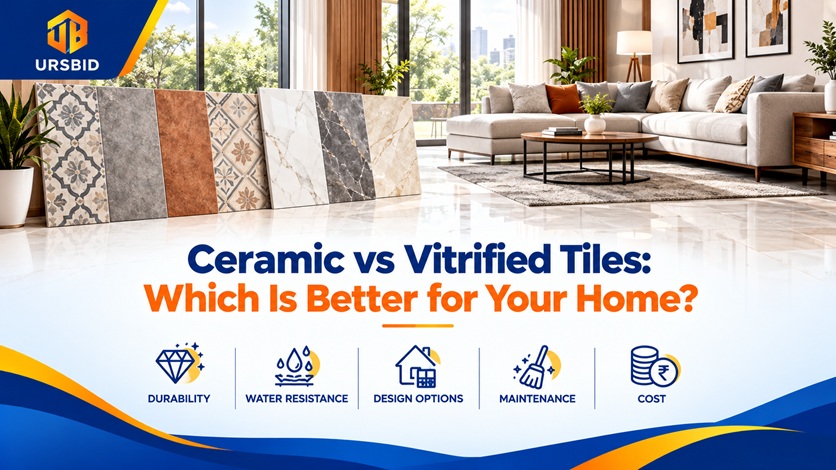
You walk into a tile shop. The dealer holds up two tiles that look almost the same. One costs Rs 45 a square foot. The other costs Rs 85. "Both are good quality," he says. Are they? Not really. They are made differently, they behave differently, and they belong in different parts of your house.
The easiest way to see the difference is to look at water. This guide explains ceramic vs vitrified tiles in simple words. You will learn how to tell them apart, where each one works best, and what they cost.
What Is the Difference Between Ceramic and Vitrified Tiles?
The main difference between ceramic and vitrified tiles is how much water they absorb. Vitrified tiles soak up almost none. Ceramic tiles soak up much more. This one fact decides strength, price, and where each tile should be used.
Ceramic tiles are made from clay and fired at a lower heat. Vitrified tiles are made from clay mixed with silica and feldspar. They are pressed hard and fired at very high heat, often above 1,200°C. The clay and silica melt together into a dense, glass-like body.
Here is a quick comparison:
|
Feature |
Ceramic tiles |
Vitrified tiles |
|
Water absorption |
3% to over 10% |
0.5% or less |
|
Firing heat |
Lower |
Very high, often above 1,200°C |
|
Strength |
Good for light use |
Higher, built for heavy use |
|
Price (tile only) |
Lower |
Higher |
|
Cutting |
Easier |
Harder, needs good tools |
|
Best use |
Walls, low-traffic areas |
Floors, wet zones, heavy traffic |
What Is Vitrified Tiles Water Absorption and Why Does It Matter?
Vitrified tiles water absorption is 0.5% or less of the tile's weight. In India, this puts the tile in Group BIa under IS 15622. A tile that absorbs more than that is not truly vitrified.
Why does this matter? A tile that soaks up water can stain, swell slightly, and grow mould in damp rooms. It can also crack over time. A dense tile does none of that. The standard sorts tiles into groups like this:
- Group BIa: 0.5% or less. This is vitrified tile.
- Group BIIa and BIIb: 3% to 10%. Ceramic floor tiles.
- Group BIII: over 10%. Ceramic wall tiles.
So when a dealer says "vitrified," ask to see the water absorption number on the box. If it says 0.5% or less, or BIa, the tile is vitrified. (Standards source:Infralens, IS 15622:2017.)
(Group names source:Aparna Enterprises, Ceramic vs Vitrified Tiles Guide.)
Which Is Stronger and Longer Lasting, Ceramic or Vitrified?
Vitrified tiles are stronger and last longer on floors. IS 15622 sets a minimum bending strength of 35 N/mm² for fully vitrified tiles. For tiles 7.5 mm thick or more, it also sets a breaking strength of about 1,300 N.
Ceramic tiles are not weak. They work well on walls, where nothing steps on them. But on a floor, ceramic tiles can chip at the edges, wear off at the glaze, and crack when heavy furniture is dragged across them. Vitrified tiles handle that kind of use much better.
(Strength data source:Infralens, IS 15622:2017.)
Strength also depends on thickness and the tile's wear rating, so check both when you buy a floor tile.
How Do Ceramic Tiles Price and Vitrified Tiles Cost Compare?
Ceramic tiles price is lower. For August 2026, tile alone costs about Rs 28 to 55 per sq ft for ceramic and Rs 40 to 110 per sq ft for most vitrified tiles. Large-format glazed vitrified tiles (GVT) cost about Rs 75 to 160 per sq ft.
|
Tile type |
Tile only (Rs per sq ft) |
|
Ceramic |
About 28 to 55 |
|
Vitrified (most types) |
About 40 to 110 |
|
Large-format GVT |
About 75 to 160 |
(Price source:Interior Decor Designs, Floor Tiles Price in India 2026.)
Ceramic is cheaper to buy. But on a busy floor, a ceramic tile may need replacing sooner. Vitrified costs more today, but it often costs less over the life of the house. For wall cladding, ceramic remains the sensible and cheaper pick.
Where Should You Use Ceramic and Where Should You Use Vitrified Tiles?
Use ceramic for walls and low-traffic spaces. Usevitrified tiles for floors, wet areas, and busy rooms.
Good places for ceramic tiles:
- Bathroom and kitchen walls
- Kitchen backsplash
- Bedroom walls and accent walls
- Low-traffic areas, such as a small storeroom
Good places for vitrified tiles:
- Living room and dining room floors
- Kitchen and bathroom floors, in matte or anti-slip finish
- Balconies and passages, in a matte finish
- Shops, offices, and other busy places
For wet floors, always pick a matte, anti-slip finish, whatever the tile type. Check the slip rating on the box.
What Are the Main Types of Vitrified Tiles?
There are four main types of vitrified tiles. Each one has a different look and price.
- Soluble salt vitrified. The cheapest. Printed with salt-based colour. Good for low-cost projects.
- Double-charge vitrified. Two layers are pressed together. A tougher top layer makes it wear better.
- Full-body vitrified. The colour runs through the whole tile. Chips and scratches do not show.
- Glazed vitrified (GVT and PGVT). A printed glaze gives marble, wood, or stone looks. PGVT is polished and shiny.
How Can You Tell Ceramic From Vitrified Tiles at the Shop?
The best way is to check the water absorption number on the box. Below 0.5% means vitrified. Between 3% and 10% means ceramic floor tile. Above 10% means ceramic wall tile.
You can also try a few simple checks:
- Water drop test. Put a drop of water on the unglazed back of the tile. If it soaks in quickly, the tile is porous.
- Tap sound. Vitrified tiles often give a sharper ring. A dull sound can mean a softer body.
- Weight and thickness. Vitrified tiles often feel denser in your hand.
- Ask for a test certificate. A good supplier can show one on request.
These checks help, but the number on the box or the certificate is the real proof.
What Mistakes Should You Avoid With Ceramic and Vitrified Tiles?
Do not put ceramic tiles on a busy floor or a wet floor. They are too porous and can crack or stain.
Do not buy a tile just because the dealer says "vitrified." Ask for the water absorption number.
Do not use plain cement paste to fix vitrified tiles. Vitrified tiles are dense, so they need a proper tile adhesive to grip. Ask your mason, or findfinishing work services with experience in tile laying.
Do not pick a glossy tile for a bathroom floor. Choose a matte, anti-slip tile instead.
Do not forget to buy 8% to 10% extra tile. Batches can differ slightly in colour, so order everything at once.
Where Can You Buy Ceramic and Vitrified Tiles Online?
You can buy ceramic and vitrified tiles online through URSBID by posting your requirement and getting quotes from verified suppliers.
Once you know which tile fits each room, the next step is to compare rates. ToBuy Ceramic and Vitrified Tiles Online through URSBID, share the tile type, size, finish, quantity, and delivery place. Registered vendors will send their quotations directly to you. Ask each one for the water absorption figure and the batch details before you decide.
Frequently Asked Questions
Which is better, ceramic or vitrified tiles?
Vitrified tiles are better for floors, wet areas, and busy rooms because they absorb almost no water and are stronger. Ceramic tiles are better for walls and low-traffic areas where you want a lower price.
What is the water absorption of vitrified tiles?
Vitrified tiles absorb 0.5% or less of their weight in water. This is Group BIa under IS 15622. Ceramic tiles absorb much more, from about 3% to over 10%.
Can I use ceramic tiles on the floor?
Yes, in low-traffic and dry rooms, but they can chip and wear faster than vitrified tiles. Avoid them in busy or wet areas.
Are vitrified tiles more expensive than ceramic tiles?
Yes. For August 2026, vitrified tile alone costs about Rs 40 to 110 per sq ft, against about Rs 28 to 55 for ceramic. Large-format GVT costs more.
How do I know if a tile is really vitrified?
Check the water absorption figure on the box or the test certificate. If it is 0.5% or less, or the tile is marked Group BIa, it is vitrified.
Final Thoughts
Ceramic and vitrified tiles are both good, but they do different jobs. Ceramic is cheaper and works well on walls. Vitrified is denser and stronger, so it suits floors, wet areas, and busy rooms. Check the water absorption number, choose a matte finish for wet floors, and use proper adhesive. Then your tiles will look good and last for years.
Ready to compare prices?Get ceramic and vitrified tile rates on URSBID by posting your requirement, and receive quotes from verified suppliers.