

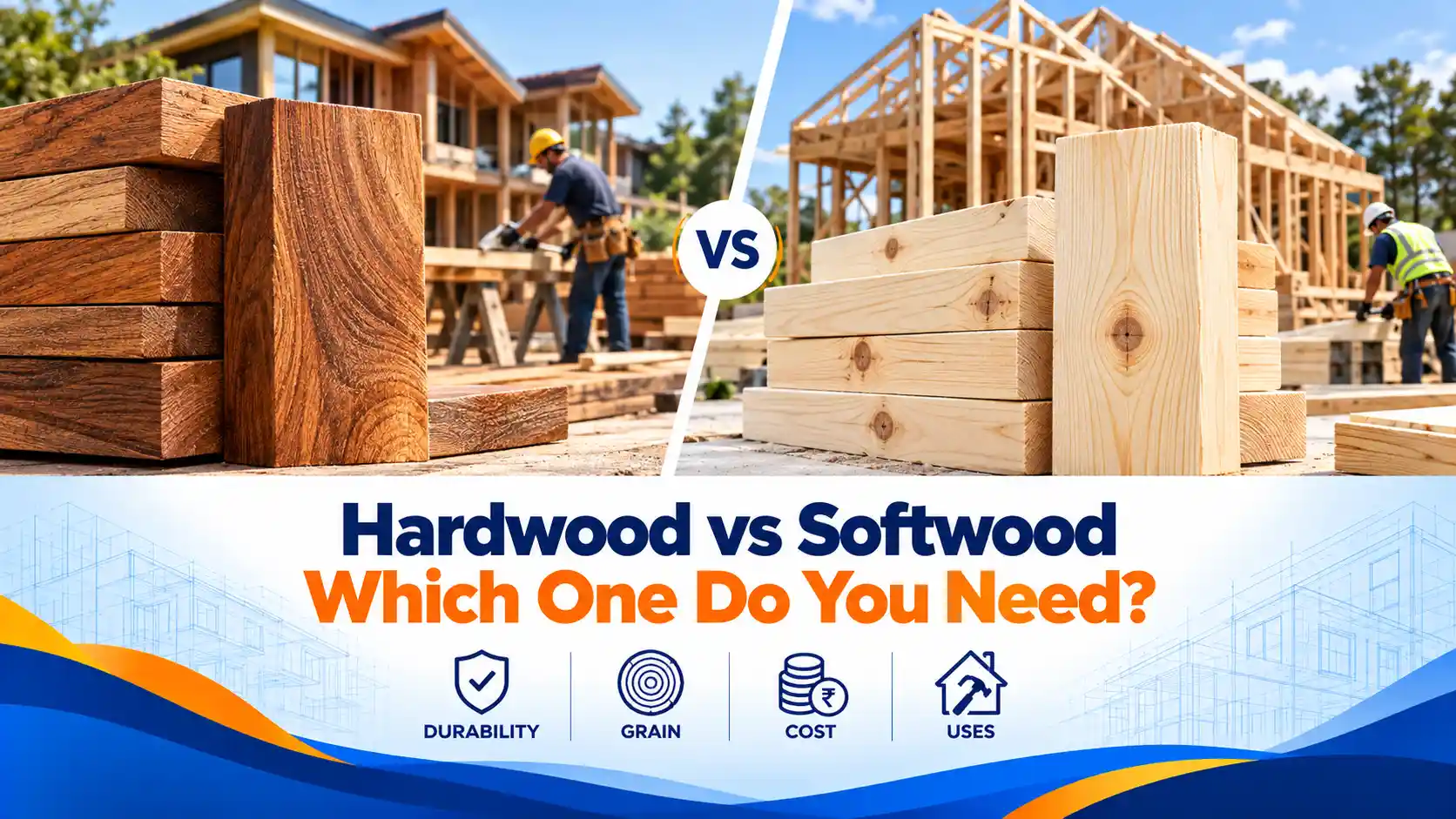
A carpenter shows you two pieces of wood. One is a heavy, dark teak plank. The other is a light, pale pine board. Then he says, "Hardwood or softwood, which one do you want?" Most people guess that hardwood must be harder and better. That guess is only half right.
The names can be confusing. This guide explains the real difference between hardwood and softwood in simple words. You will learn where each one works best, so you can choose the right timber for your home.
What Is the Difference Between Hardwood and Softwood?
Hardwood comes from broad-leaved trees. Softwood comes from cone-bearing trees, called conifers. The names describe the type of tree, not always how hard the wood is.
Hardwood trees grow slowly. Their wood is usually dense, heavy, and long-lasting. Softwood trees grow fast. Their wood is usually lighter, cheaper, and easier to cut. Here is a quick comparison:
|
Feature |
Hardwood |
Softwood |
|
Tree type |
Broad-leaved trees |
Conifers (cone-bearing trees) |
|
Growth speed |
Slow |
Fast |
|
Weight |
Usually heavy and dense |
Usually light |
|
Durability |
High |
Lower, needs treatment |
|
Price |
Higher |
Lower |
|
Easy to cut and nail |
Harder |
Easier |
|
Examples in India |
Teak, sal, sheesham, mahogany |
Pine, deodar, fir, spruce |
Is Hardwood Always Harder Than Softwood?
No. Most hardwoods are harder than most softwoods, but not always. The words come from the tree family, not from a hardness test.
Balsa is a hardwood, yet it is very soft and light. Some softwoods, like yew, are quite hard. So do not choose only by the name. Ask for the exact species, such as teak or pine, and check its density, grade, and treatment.
What Are the Common Hardwoods and Softwoods Used in India?
India uses a lot of wood. Here are the ones you will meet most often at timber yards.
Common hardwoods:
- Teak. Very durable and resists water and termites. Used for doors, windows, and fine furniture.
- Sal. Strong and heavy. Used for beams, frames, and doors.
- Sheesham (Indian rosewood). Dense with a rich grain. Used for furniture and staircases.
- Mahogany. Stable and smooth. Used for furniture and panels.
Common softwoods:
- Pine. Light and cheap. Used for formwork, packing, and light framing.
- Deodar. A Himalayan softwood. Natural oils help it resist decay, so it lasts longer than most softwoods.
- Fir and spruce. Used for framing, ceilings, and panels.
Which Timber Woods for Construction Should You Use: Hardwood or Softwood?
Use hardwood where the wood must last for decades or face weather. Use softwood where cost and speed matter more, or where the wood is temporary. The right choice depends on the job, so comparetimber woods for construction by use, not by name.
Here are the usual hardwood and softwood uses in a house:
Best uses for hardwood:
- Main doors and window frames
- Wooden flooring and staircases
- Furniture and cabinets
- Roof beams and posts that stay exposed
Best uses for softwood:
- Concrete formwork and shuttering
- Scaffolding planks and props
- False ceiling frames and partition frames
- Packing and temporary work
Do not use untreated softwood outdoors or near water. It rots and attracts termites faster than hardwood.
How Do Hardwood and Softwood Compare on Price and Durability?
Hardwood costs more but lasts longer. Softwood costs less but needs treatment to last.
A teak door may cost several times more than a pine door. But it can serve for decades with little care. Pine is cheaper, yet it needs paint, polish, or chemical treatment to resist damp and termites. If you must replace it often, the savings disappears.
So think about the full life of the wood. For a main door, hardwood is usually the better buy. For shuttering that will be used a few times, softwood makes more sense. Also remember that wood quality inside each group varies. A weak, poorly dried hardwood can fail faster than a good softwood.
How Big Is India's Demand for Softwood?
India imports about 85% of its softwood, according to Forest Trends, and demand is growing at about 11% a year. The softwood market is projected to reach about USD 1.06 billion by 2032. (Market data source:Forest Trends, Illegal Deforestation and Associated Trade Risk: India.)
A report from the US Department of Agriculture's Foreign Agricultural Service notes that Malaysia, Australia, and New Zealand supply over 22% of India's log imports. Hardwood meranti and softwood pine dominate those shipments.
(Trade data source:USDA FAS, Wood and Wood Products Update 2024, India.)
For buyers, this means most softwood is imported and its price can move with shipping and exchange rates. Domestic hardwoods like teak and sal have their own supply limits. Always ask the supplier about the species, origin, and drying.
What Mistakes Should You Avoid When Choosing Between Hardwood and Softwood?
Do not buy by the words "hardwood" or "softwood" alone. Ask for the exact species and grade.
Do not use untreated softwood for outdoor doors or window frames. It will swell, warp, and rot.
Do not buy wet, green timber for finished work. It shrinks and cracks as it dries. Check that the wood is properly seasoned.
Do not compare quotes for different species or sizes. A cheaper quote may be for a weaker wood or a thinner section.
Do not forget the paperwork. Ask where the timber comes from and whether it is legally sourced.
Where Can You Buy Timber Woods Online?
You can buy timber woods online through URSBID by posting your requirements and getting quotes from verified suppliers.
Once you know whether you need hardwood or softwood, the next step is to get rates. ToBuy Timber Woods Online through URSBID, share the species, size, grade, quantity, and delivery place. Registered vendors will send their quotations directly to you. Compare the rate per cubic foot, the drying and treatment, and the delivery terms before you decide.
Frequently Asked Questions
What is the main difference between hardwood and softwood?
Hardwood comes from broad-leaved trees and is usually denser and more durable. Softwood comes from conifers and is usually lighter, cheaper, and easier to work.
Is teak a hardwood or a softwood?
Teak is a hardwood. It is dense, resists water and termites, and is widely used for doors, windows, and furniture in India.
Is pine a hardwood or a softwood?
Pine is a softwood. It is light and cheap, and is mainly used for formwork, light framing, and furniture.
Which is better for doors and windows, hardwood or softwood?
Hardwood is usually better for doors and windows, because it handles moisture and daily use well. Softwood needs treatment and is better for dry, protected, or temporary use.
Is hardwood always harder than softwood?
No. The names come from the tree type. Balsa is a very soft hardwood, and some softwoods are quite hard.
Final Thoughts
Hardwood and softwood are two different tools. Hardwood gives you strength, long life, and a rich look, but it costs more. Softwood gives you low cost and speed, but it needs care. Pick the species by the job, check the grade and drying, and treat softwood well. That is how you get long life from timber without overspending.
Ready to compare prices?Buy Timber Woods Online on URSBID by posting your requirement, and receive quotes from verified suppliers.


.webp)