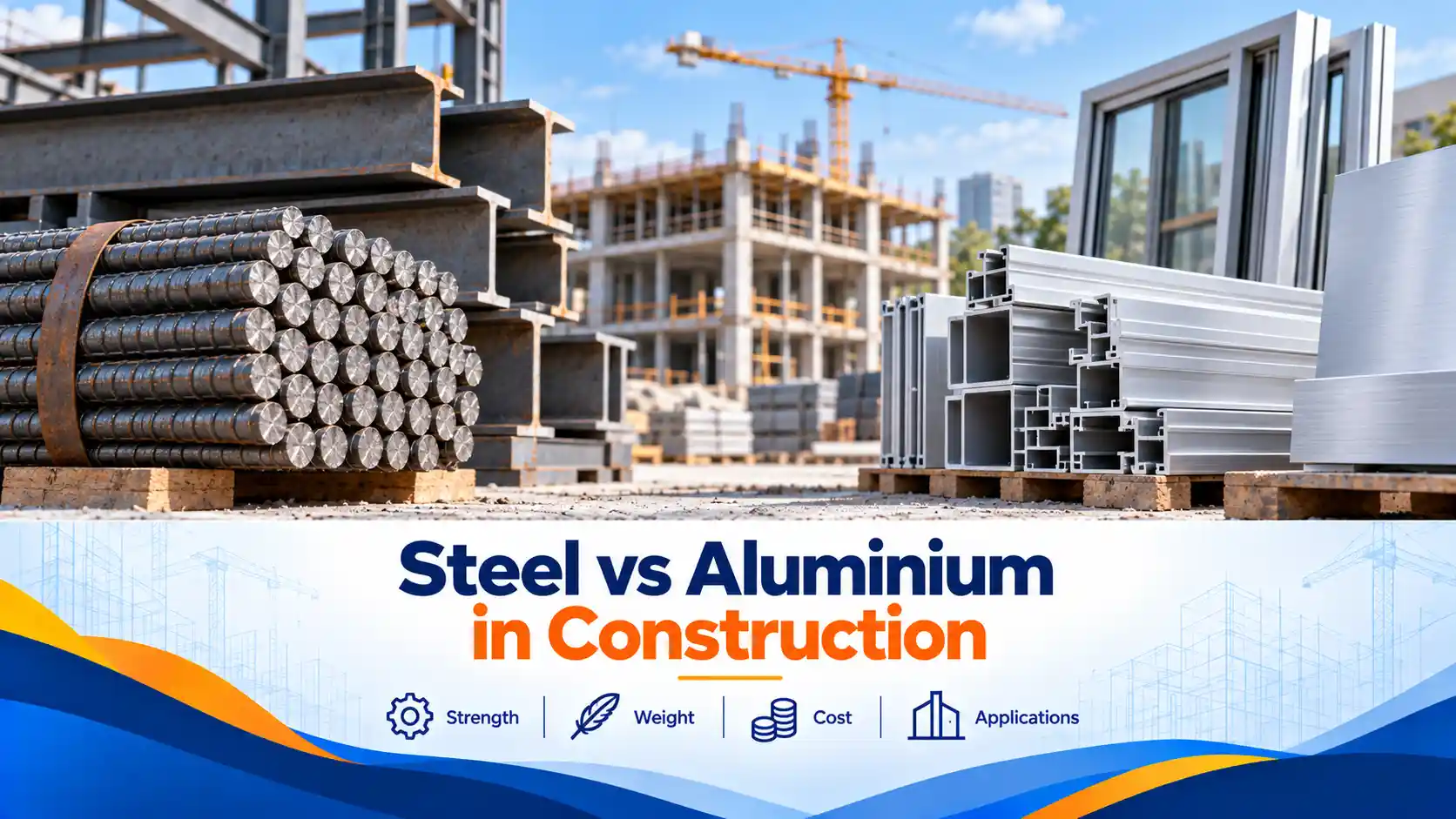
Look up at a modern office tower and you're seeing both materials at once without realising it, steel doing the invisible structural work inside the frame, aluminium wrapping the outside in window walls and facade panels that never rust and barely need maintenance. These two metals show up constantly in the same buildings, but almost never doing the same job, and mixing up when to use which one is where a lot of construction budgets and timelines go sideways.
This guide compares steel and aluminium in construction across strength, weight, cost, and durability, so you know exactly which one fits which part of a build.
What Is the Fundamental Difference Between Steel and Aluminium in Construction?
Steel is an iron-based alloy valued for its high strength and load-bearing capacity, while aluminium is a much lighter, naturally corrosion-resistant metal better suited to cladding, framing, and applications where weight matters more than raw strength.
This difference shapes where each material ends up in a building. Steel carries the loads that actually hold a structure up, columns, beams, and reinforcement embedded in concrete. Aluminium tends to handle the building's skin and lighter structural elements, window frames, facades, roofing sheets, and architectural features where its resistance to rust and lighter weight offer a real advantage over steel.
How Does Steel vs Aluminium Strength Actually Compare?
Steel offers significantly higher raw strength and load-bearing capacity than aluminium, but aluminium delivers a better strength-to-weight ratio, meaning it can be a more efficient structural choice when weight, not just raw strength, is the limiting factor.
For a given cross-section, steel carries far more load than aluminium, which is exactly why steel remains the standard for columns, beams, and any element embedded in concrete. But aluminium's strength-to-weight ratio runs roughly 35% better than steel's, according to recent industry analysis, meaning a structure or component designed around aluminium can sometimes achieve comparable performance at a fraction of the weight. (Data source:Precision Reports Aluminum for Construction Market Report, 2026.) This is exactly why aluminium shows up in applications like large facade systems and roofing, where reducing dead load matters more than matching steel's absolute strength.
Where Is Aluminium in Construction Actually Used Best?
Aluminium in construction performs best in window and door frames, facade systems, roofing sheets, and curtain walling, applications where corrosion resistance, light weight, and design flexibility matter more than structural load-bearing.
Aluminium's natural resistance to rust makes it especially valuable in humid or coastal regions, where steel would need ongoing protective coating and maintenance to avoid corrosion over time. Architects also favour aluminium for its extrudability, the ability to form it into complex, precise profiles, which makes elaborate facade designs and window systems achievable in ways that would be far more difficult and expensive with steel. Around 62% of construction projects globally now use aluminium specifically in windows, doors, and facades, reflecting how firmly this has become the default choice for that application. (Data source:Precision Reports Aluminum for Construction Market Report, 2026.)
When Should Structural Steel Framing Be Used Over Aluminium?
Structural steel framing should be used over aluminium for any load-bearing element, foundations, columns, beams, and reinforcement, anywhere the primary job is carrying the building's structural weight rather than forming its exterior skin.
Steel's higher raw strength and well-established structural design codes make it the reliable, predictable choice for a building's actual skeleton. Aluminium, while strong for its weight, generally isn't used as the primary structural frame material in conventional buildings, its role stays concentrated in cladding, framing for glazing, and lighter architectural elements rather than the core load path. Mixing this up, using aluminium where steel's load capacity is actually needed, isn't a matter of preference, it's a structural miscalculation that a qualified engineer would never sign off on.
Steel vs Aluminium: Side-by-Side Comparison
|
Factor |
Steel |
Aluminium |
|
Raw strength |
Higher, standard for structural framing |
Lower per unit, but strong for its weight |
|
Weight |
Heavy |
Roughly one-third the weight of steel |
|
Corrosion resistance |
Needs coating or galvanising |
Naturally resistant |
|
Typical use |
Columns, beams, reinforcement, foundations |
Windows, facades, roofing, curtain walls |
|
Maintenance |
Higher, especially in humid climates |
Lower, minimal upkeep needed |
|
Cost |
Generally lower for structural applications |
Generally higher per unit, offset by lower maintenance |
What Mistakes Should You Avoid When Choosing Between Steel and Aluminium?
Don't choose aluminium for load-bearing structural elements to save weight without your engineer confirming it can actually handle the load. Aluminium's lower raw strength compared to steel means it isn't a direct substitute for structural framing in most conventional buildings.
Don't leave structural steel uncoated or unprotected in humid or coastal environments. Unlike aluminium, steel needs proper galvanising or protective coating to avoid corrosion that can compromise structural integrity over time.
Don't assume aluminium is always more expensive overall just because its unit cost is higher. Its lower maintenance needs and longer effective lifespan in exposed applications can make it the more cost-effective choice over the life of the building, even with a higher upfront price.
Where Can You Buy Steel and Aluminium Online for Construction?
You can buy steel and aluminium online through URSBID by posting your requirement and getting quotes from verified suppliers.
Once you know which material your project needs, structural steel for load-bearing work or aluminium for cladding and framing, the next step is finding a supplier who delivers consistent, certified quality. Toget steel bar rates for your structural work, describe your requirement through URSBID and registered vendors send their quotations directly.
For windows, facades, and roofing, you canget aluminium rates the same way, comparing pricing across multiple verified suppliers before committing to one.
Frequently Asked Questions
Is aluminium stronger than steel?
No, steel has higher raw strength than aluminium, but aluminium offers a better strength-to-weight ratio, meaning it can perform efficiently in applications where reducing weight matters more than maximising raw load capacity.
Can aluminium replace steel in structural framing?
Generally no. Aluminium isn't used as the primary structural frame material in conventional buildings, its lower raw strength compared to steel means it's better suited to cladding, window frames, and lighter architectural elements rather than load-bearing structure.
Why is aluminium used for windows and facades instead of steel?
Aluminium is naturally corrosion-resistant, significantly lighter than steel, and easier to shape into precise architectural profiles, making it the practical choice for window frames, facades, and curtain walling.
Does steel need more maintenance than aluminium in construction?
Yes, steel generally requires protective coating or galvanising to resist corrosion, especially in humid or coastal climates, while aluminium's natural corrosion resistance means it needs comparatively little maintenance over its lifespan.
Is aluminium more expensive than steel for construction?
Aluminium typically costs more per unit than steel, but its lower maintenance requirements and longer effective lifespan in exposed applications can make it more cost-effective over the life of the building.
Final Thoughts
Steel and aluminium aren't competing for the same job in a building, they're doing entirely different work. Steel carries the structural load that holds a building up, while aluminium wraps and finishes it with a corrosion-resistant, lightweight skin that steel simply isn't suited for in the same way. Understanding this division, rather than treating the two as interchangeable options, is what keeps a project's structural design sound and its exterior genuinely low-maintenance for decades.
Ready to source materials for your project?Get steel and aluminium rates on URSBID by posting your requirement, and receive quotes from verified suppliers.