Drive past two construction sites in the same neighbourhood today, and there's a decent chance one is stacking traditional red clay bricks while the other is fitting large, pale AAC blocks that go up noticeably faster. Both walls will look similar once plastered and painted, but the material underneath decides very different things about that house, how much it weighs on the foundation, how it feels indoors in summer, and what the mason actually charges to build it.
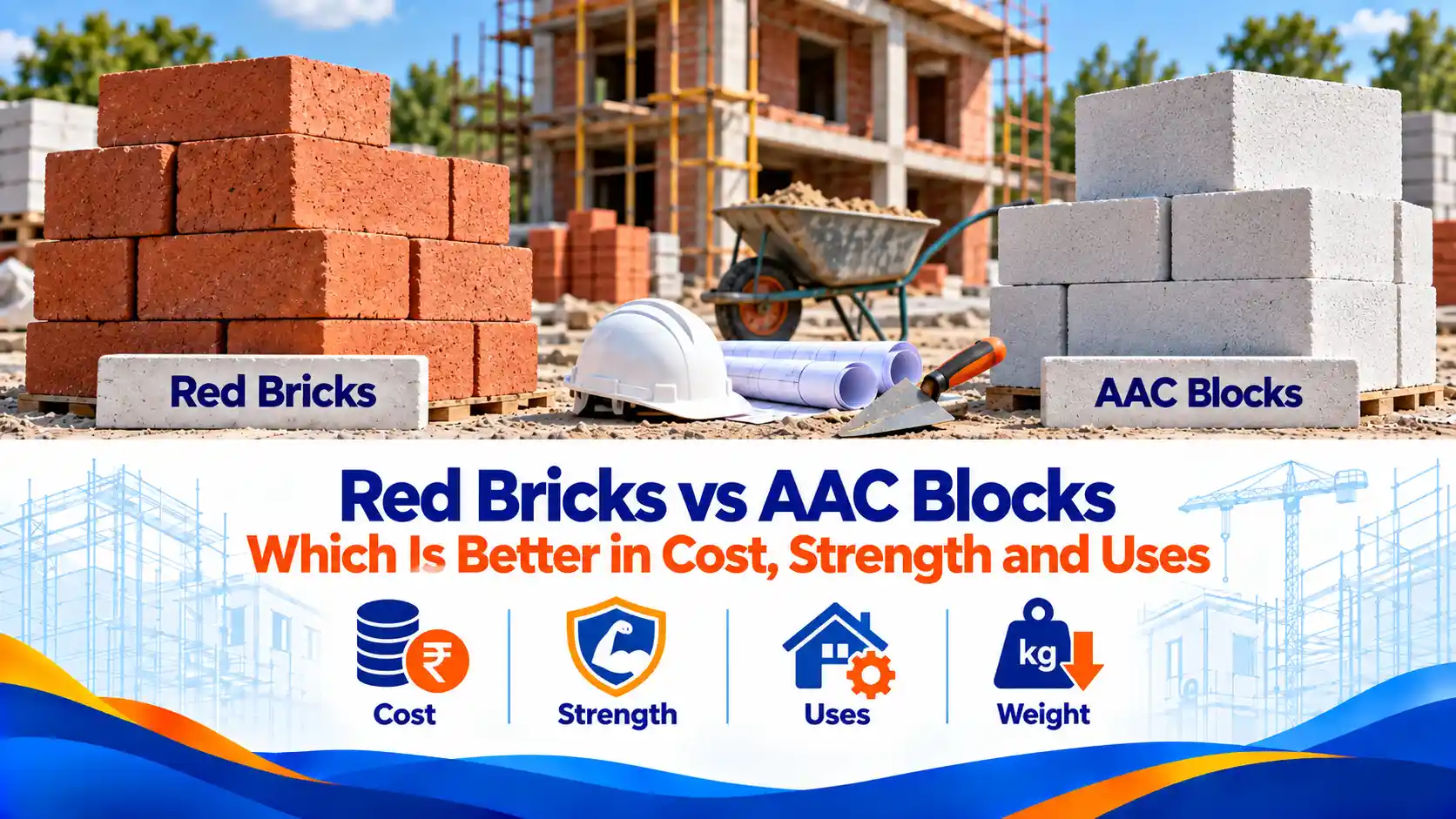
This guide compares red bricks and AAC blocks directly on cost, strength, and where each one genuinely performs better.
What Is the Fundamental Difference Between Red Bricks and AAC Blocks?
Red bricks are made from natural clay, molded and fired at high temperatures, while AAC blocks are manufactured from an aerated mix of cement, lime, and fly ash or sand, cured under heat and pressure in an autoclave.
This difference in manufacturing shows up immediately in the finished product. Red bricks are dense, solid, and relatively small, relying on centuries of proven masonry technique. AAC blocks are large, lightweight, and full of trapped air pockets, a structure that gives them genuine thermal insulation properties red bricks simply don't have on their own.
How Does Red Brick Cost and Strength Compare to AAC Blocks?
Red bricks generally cost less per unit and offer solid, well-understood compressive strength, while AAC blocks cost more per unit but often work out competitive or cheaper on a total installed-wall basis due to faster construction and lower mortar use.
A single red brick is inexpensive, but building a wall requires many more bricks and a proportionally larger amount of mortar to join them, since each unit is small. AAC blocks cost more individually, sometimes several times the price of a single brick, but one AAC block can replace six to eight standard bricks in wall area, which changes the real cost comparison considerably once labour and mortar are factored in rather than comparing unit prices alone. On raw compressive strength, red bricks remain a reliable, well-tested choice for load-bearing masonry, while AAC blocks offer moderate strength, sufficient for most residential walls within a framed structure, though generally not matching a dense red brick's compressive rating unit for unit.
Red Bricks vs AAC Blocks: Side-by-Side Comparison
|
Factor |
Red Bricks |
AAC Blocks |
|
Weight |
Heavy |
Very light, often a fraction of brick weight |
|
Compressive strength |
High, well-proven for load-bearing walls |
Moderate, suited to framed structures |
|
Thermal insulation |
Limited, relies on thermal mass |
Strong, due to aerated structure |
|
Construction speed |
Slower, more units and mortar needed |
Faster, larger units, thinner joints |
|
Water absorption |
Lower, generally reliable in most climates |
Higher, needs proper waterproofing |
|
Unit cost |
Lower per piece |
Higher per piece, often offset by speed |
|
Environmental impact |
Higher, due to clay extraction and firing |
Lower, uses industrial byproducts like fly ash |
Are AAC Blocks Good for House Walls Compared to Red Bricks?
AAC blocks work well for house walls, particularly in multi-storey construction, where their lighter weight reduces the load on the foundation and structural frame compared to red brick walls.
For a single-storey home, the weight difference between red brick and AAC matters less structurally, and many homeowners in that case choose based on cost, masonry familiarity, or thermal comfort preference instead. For a taller building, AAC's weight advantage becomes genuinely significant, since every floor of red brick walls adds substantial dead load that the foundation and lower columns need to carry, while the equivalent AAC walls add considerably less.
What Is the Best Wall Material in India for Different Climates?
The best wall material in India depends heavily on regional climate, AAC blocks generally perform better in hot climates due to their insulation, while red bricks remain a dependable, familiar choice across most regions with well-established masonry practices.
In hot, dry regions, AAC's thermal insulation can noticeably reduce indoor heat gain and cooling costs over the life of the building. In regions with heavy, sustained rainfall, red brick's lower water absorption and long-established waterproofing practices give it a practical edge, provided AAC walls receive proper external waterproofing if used in the same conditions. Neither material is the automatic right answer nationwide, the regional building tradition and climate should weigh into the decision alongside cost and structural needs.
How Big Is India's Bricks and Blocks Market Right Now
India's bricks and blocks market is projected to grow at a compound annual rate of around 9.5% between 2026 and 2032, driven by rising real estate development, growing government spending on urban infrastructure, and major innovations in lightweight, high-strength block technologies that are reshaping how builders choose wall material. (Market data source:6Wresearch India Bricks and Blocks Market Report, 2026.)
This growth reflects a genuine shift underway across Indian construction, with newer block technologies like AAC steadily gaining ground on traditional red brick, particularly in urban, multi-storey construction.
What Mistakes Should You Avoid When Choosing Between These Materials?
Don't compare red bricks and AAC blocks on unit price alone. AAC's larger size and faster installation often change the real cost picture once labour and mortar are included in the comparison.
Don't skip waterproofing on an AAC wall assuming it behaves like red brick in wet conditions. AAC's higher water absorption needs proper external treatment, especially in high-rainfall regions, to avoid long-term moisture issues.
Don't default to red brick purely out of masonry familiarity for a tall, multi-storey build. The cumulative weight savings from AAC can meaningfully reduce foundation and structural costs on taller construction, an advantage that's easy to overlook if the decision is made on habit alone.
Where Can You Buy Red Bricks and AAC Blocks Online?
You can buy red bricks and AAC blocks online through URSBID by posting your requirement and getting quotes from verified suppliers.
Once you've weighed cost, strength, and your local climate, the next step is finding a supplier who delivers consistent quality at a fair price. Toget bricks and blocks rates through URSBID, describe your requirement, red brick or AAC, and the quantity you need, and registered vendors send their quotations directly, so you can compare pricing before committing to a single local dealer.
Frequently Asked Questions
Are AAC blocks cheaper than red bricks? AAC blocks cost more per unit, but since one block replaces several bricks and needs less mortar and labour, the total installed wall cost can end up comparable to or sometimes cheaper than red brick, depending on the project.
Which is stronger, red bricks or AAC blocks? Red bricks generally offer higher raw compressive strength unit for unit, but AAC blocks provide sufficient strength for standard residential walls within a framed structure, where the columns and beams carry the primary structural load.
Do AAC blocks work well in hot climates compared to red bricks? Yes, AAC blocks offer better thermal insulation than red bricks due to their aerated structure, which can meaningfully reduce indoor heat gain and cooling costs in hot climates.
Is red brick or AAC block better for a multi-storey building? AAC blocks are generally better for multi-storey construction, since their significantly lighter weight reduces the load on the foundation and structural frame compared to the same wall area built in red brick.
Do AAC blocks need more waterproofing than red bricks? Yes, AAC blocks are more porous and absorb more water than red bricks, so proper external waterproofing is important, particularly in regions with heavy or sustained rainfall.
Final Thoughts
Red bricks and AAC blocks each bring real advantages that suit different projects rather than one being simply better than the other. Red brick offers proven strength and lower unit cost, while AAC offers lighter weight, faster construction, and better insulation, advantages that matter most in taller buildings and hotter climates. Weighing cost, strength, climate, and building height together, rather than defaulting to whichever material is more familiar, is what leads to the right choice for your specific house.
Ready to source material for your build?Get red brick and AAC block rates on URSBID by posting your requirement, and receive quotes from verified suppliers.