A buyer picks marble from a neat display tile. It shines. The colour is perfect. A month after the floor is laid, fine lines appear. A few spots turn yellow. One tile sounds hollow when tapped. The display tile was never the problem. The slabs that were actually delivered were.
Marble is natural stone, and no two slabs are the same. Unlike tiles, natural stone has no mandatory BIS mark, so the buyer has to do the checking. This guide shows how to check marble quality before buying, using simple tests anyone can do, plus the numbers that matter.
What Should You Look For When You Check Marble Quality?
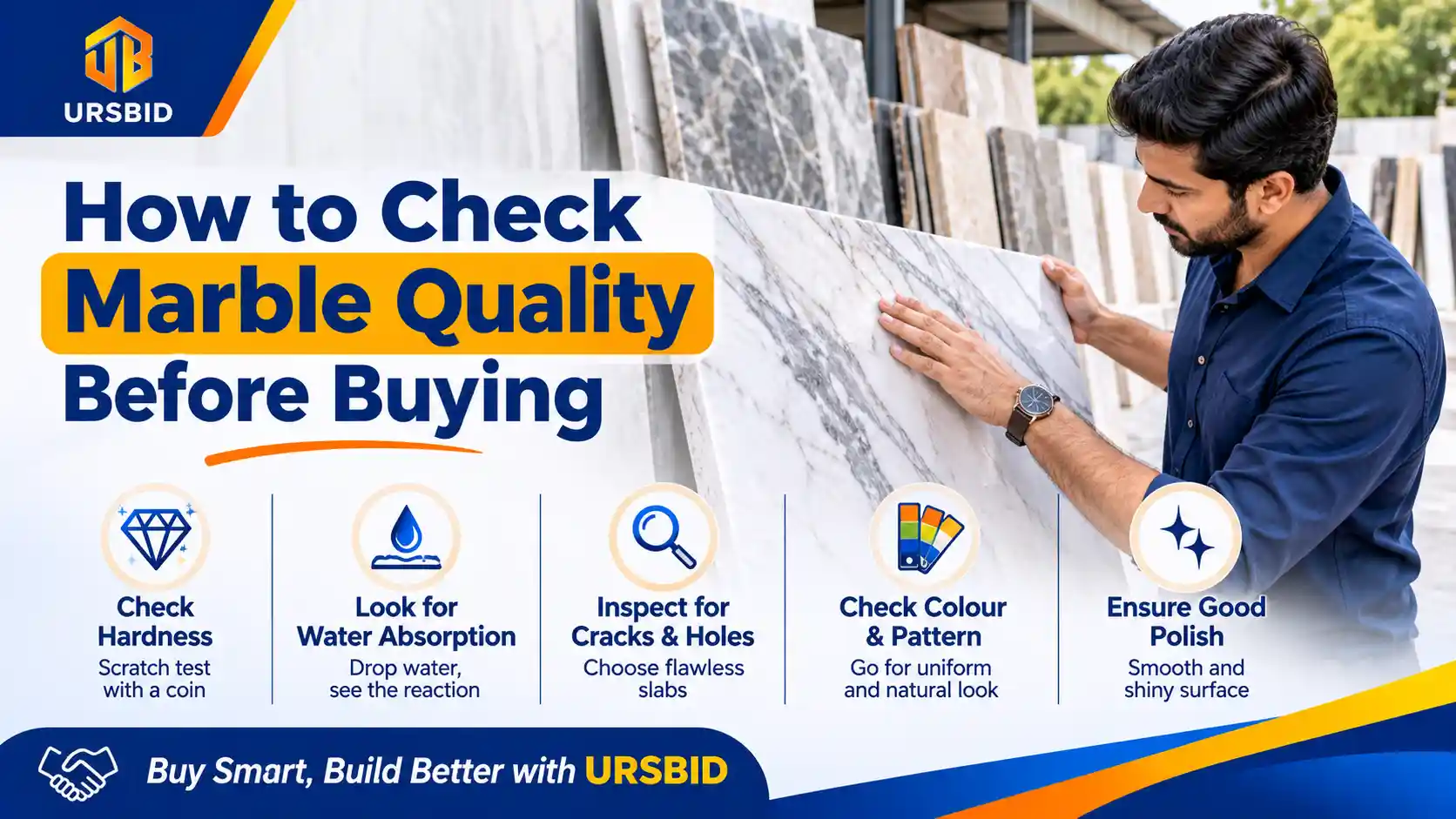
Good marble is dense, crack-free, even in colour, and even in thickness. Look at full slabs in daylight, not only at small samples. Here is a simple checklist for marble slabs:
- Full slab in daylight. Ask to see whole slabs outside the shed, not only polished display pieces.
- Cracks and fissures. Look for long lines, hairline cracks, and joined or repaired areas.
- Veins and colour. Check that the shade and veining match across the slabs in your lot.
- Pits and holes. Small pits are common, but too many show a weak, porous stone.
- Patches and fillers. Look for glossy patches, filled lines, and resin spots.
- Yellow or brown spots. These can point to impurities or iron that may stain over time.
- Polish. The shine should look clear and deep, not cloudy or waxy.
- Edges and thickness. Edges should be square. Thickness should be even.
How Do You Do a Marble Water Absorption Test?
Pour a little clean water on the slab and wait a few minutes. If a dark, damp patch spreads, the stone is porous. If the water stays on top, the marble is dense.
This is the quickest marble water absorption test you can do at the yard. Do it in several places on the slab, and on a few slabs, not only one. A dense marble stays dry under the water. A weak or heavily filled marble absorbs unevenly, and shows dark patches.
The site test is a quick screen. It is not a lab result. The proper test is done in a lab under IS 1124. It weighs a sample dry, soaks it in cold water for 24 hours, and weighs it again. For large jobs, ask the seller for a lab report.
What Other Quick Tests Can You Do on Site?
Four more quick tests help: the tap test, the fingernail test, the water-spray test, and a thickness check. Each takes about a minute.
- Tap test. Gently tap the slab with a coin or small metal object. A clear ring means dense stone. A dull or muffled sound can mean a crack or a weak patch. Test at several points.
- Fingernail test. Run your fingernail across the polished surface. A smooth, even polish should not catch. Rough spots can mean poor polishing.
- Water-spray test. Spray the slab lightly with water. Fine cracks and fissures often show up as dark lines.
- Thickness check. Use a calliper or a tape at several points on a few slabs. Thickness should be steady.
You can also check flatness with a straight edge, and look at the slab in sunlight to see the real colour.
How Do You Spot Resin-Filled Marble?
Resin-filled marble has cracks or pores filled with resin or wax to hide them. You can spot it by uneven water absorption, glossy patches, and fine lines that look filled.
Resin treatment is common for some stones, and it is not always a problem if the seller tells you. The risk is hidden filling. Over time, undisclosed resin can peel, yellow, or lose shine, and the crack underneath may reappear. To check, put water on the slab. Resin-filled areas often absorb differently from the stone around them. Look at the slab from a low angle in sunlight. Filled lines can look shinier than the marble. Then ask the seller directly whether the slab is resin-treated.
What Does the Indian Standard Say About Marble Quality?
IS 1130 is the Indian Standard for marble blocks, slabs, and tiles. It sets a maximum water absorption of 0.4%, a minimum hardness of 3 on the Mohs scale, and a minimum specific gravity of 2.5.
|
Property |
IS 1130 requirement |
Test method |
|
Water absorption (24 hours in cold water) |
0.4% maximum |
IS 1124 |
|
Hardness |
3 minimum (Mohs scale) |
Mohs scale |
|
Specific gravity |
2.5 minimum |
IS 1122 |
|
Flaws |
No foreign inclusions or prominent cracks |
Visual |
The standard also sets size tolerances. For slabs, length and width may vary by about 2%, and thickness by about 3%. For tiles, linear size may vary by about 3% and thickness by about 1%. Because natural stone carries no mandatory BIS mark, you are the inspector. A lab report against IS 1124 is the best proof of water absorption.When Should You Get a Lab Test for Marble?
Get a lab test for large orders, premium stone, and any job where a failed floor would be costly. A lab can check what your eyes cannot.
An accredited lab can test water absorption, hardness, specific gravity, and flexural strength under IS 1130 and related methods. Ask the lab what sample they need. Take the sample from the lot you will actually receive, and mark the slabs it came from. Do the test before the stone is cut and laid, not after.
What Mistakes Should You Avoid When Buying Marble?
Do not buy from a small polished sample. Always see the actual slabs from your lot.
Do not skip marking the slabs you chose. Mark them, so a different batch cannot be sent.
Do not ignore the supplier's answer on resin. Ask clearly, and ask for it in writing.
Do not pay in full before you have inspected the delivery. Check it against the slabs you picked.
Do not forget sealing and skilled laying. Marble is porous and heavy. You can find finishing and flooring work services on URSBID for stone laying.
Do not forget the extra. Order about 10% more for cuts and breakage.
Where Can You Buy Marble Online?
You can buy marble online through URSBID by posting your requirement and getting quotes from verified suppliers.
Once you know the variety, thickness, and finish you want, the next step is to compare rates. To Buy Marble Online through URSBID, share the marble type, grade, finish, thickness, area, and delivery place. Registered vendors will send their quotations directly to you. Ask each one for photos of the actual slabs and for a lab report on large orders.
Frequently Asked Questions
How can I check the quality of marble before buying?
See full slabs in daylight. Check for cracks and colour match. Do a water test, a tap test, and a thickness check. Ask the seller about resin treatment.
What is the water absorption limit for marble?
IS 1130 sets a maximum of 0.4% after 24 hours in cold water, tested under IS 1124.
How do I know if marble is resin-filled?
Look for glossy patches and filled lines, and watch for uneven water absorption. Then ask the seller directly whether the slab is resin-treated.
What does a tap test tell me about marble?
A clear ring points to dense stone. A dull or muffled sound can mean a crack or a weak spot.
Does marble have an ISI mark?
Natural stone does not carry a mandatory BIS mark. So you should inspect the slabs and ask for a lab report on large jobs.
Final Thoughts
Marble is natural, so quality changes from slab to slab. A few minutes with water, a coin, and a calliper can save you from a floor you regret. See full slabs in daylight, test for absorption, ask about resin, and ask for a lab report on big orders. Then your marble floor will look as good as the sample for decades.
Ready to compare prices? Get marble rates on URSBID by posting your requirement, and receive quotes from verified suppliers.