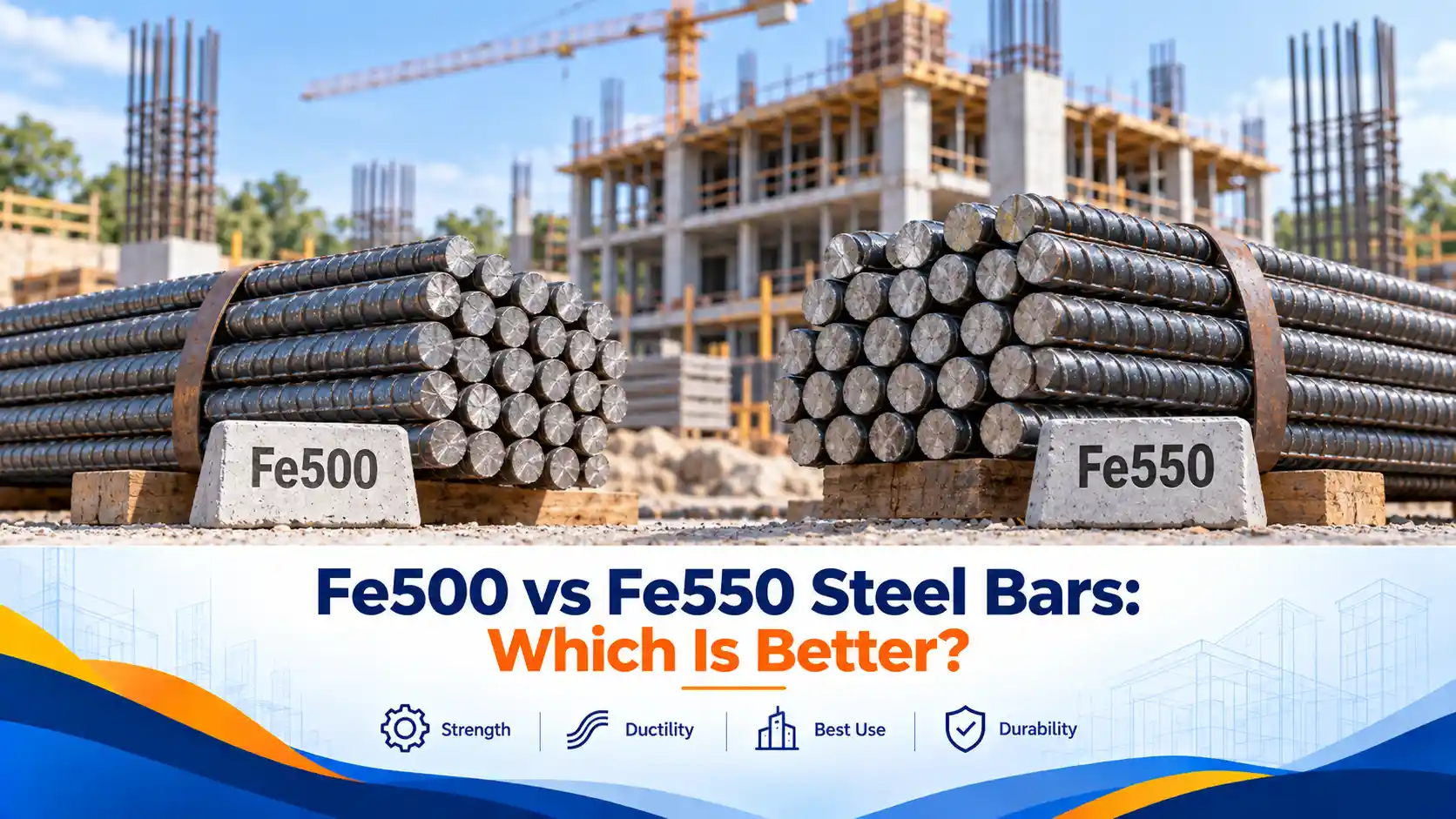
A structural engineer specifying steel for a four-storey apartment building and one specifying for a thirty-storey tower are working from the same IS 1786 standard, but they'll rarely land on the same grade. One number in that specification, Fe500 or Fe550, quietly reflects how much load the columns need to carry and how tall the structure is actually going. Getting this comparison right matters more than most buyers realise, since the two grades aren't simply "better" or "worse" versions of each other.
This guide compares Fe500 and Fe550 TMT steel bars on strength, ductility, and cost, so you know which one actually fits your project.
What Is the Core Difference Between Fe500 and Fe550 Steel Bars?
Fe500 steel bars are rated for a minimum yield strength of 500 MPa, while Fe550 bars are rated higher, offering roughly 10% more strength, at the cost of somewhat reduced ductility.
Yield strength measures how much stress the steel can handle before it begins to permanently deform. A higher number means the bar can carry more load before reaching that point, which is exactly why Fe550 gets specified for heavier structural demands. The tradeoff is ductility, the bar's ability to bend and absorb stress without snapping, where Fe500D typically offers around 16% elongation compared to Fe550D's roughly 14.5%, a difference that matters directly for how a structure behaves under sudden, dynamic loads like an earthquake. (Technical data source:SiteSetu TMT Steel Bar Grades Guide, 2026, citing IS 1786 and IS 13920 standards.)
When Should You Use Fe500 Steel Bars Over Fe550?
Fe500 steel bars, particularly the ductile Fe500D variant, are the right choice for most residential and mid-rise construction, offering a practical balance of strength, ductility, and cost that suits the vast majority of Indian homes and small buildings.
For regular houses, small apartment buildings, shops, and mid-rise projects up to several storeys, Fe500D has been the standard choice across India for years, with a strong track record and no need for unusually complex structural detailing. It also carries a lower cost than Fe550, and since most residential structures don't actually need the extra load capacity Fe550 offers, specifying it anyway adds expense without a meaningful structural benefit. Fe500D is also the grade generally mandated for seismic zones III and above under IS 13920, making it the default rather than the exception for a large share of Indian construction.
When Does Fe550 Make More Sense Than Fe500?
Fe550 steel bars make more sense than Fe500 for high-rise buildings, heavy infrastructure like bridges and flyovers, and foundations carrying very heavy loads, where the extra strength allows for real design efficiencies.
In a tall building, using Fe550 in columns and transfer beams can reduce the total quantity of steel needed to carry the same load, which can meaningfully cut both material cost and the sheer bulk of reinforcement that needs to fit into a congested structural section. This benefit only materialises when a structural engineer designs specifically around Fe550's higher strength though, simply substituting Fe550 into a design calculated for Fe500 doesn't automatically make a structure stronger or safer. The extra strength has to be accounted for in the design itself to actually pay off.
Fe500 vs Fe550: Side-by-Side Comparison
|
Factor |
Fe500 (Fe500D) |
Fe550 (Fe550D) |
|
Minimum yield strength |
500 MPa |
Approximately 10% higher than Fe500 |
|
Elongation (ductility) |
Around 16% for the D-grade variant |
Around 14.5% for the D-grade variant |
|
Typical use |
Residential, mid-rise, most general RCC work |
High-rise, bridges, heavy foundations, industrial structures |
|
Seismic suitability |
Standard requirement for zones III and above |
Used with careful structural detailing at greater height |
|
Cost |
Lower |
Higher, generally a few rupees more per kilogram |
|
Design complexity |
Simpler, well-established practice |
Requires more careful structural detailing |
How Much Does the Price Difference Between Fe500 and Fe550 Actually Matter?
Fe550 typically costs a few rupees more per kilogram than Fe500, a gap that looks small on paper but adds up meaningfully once a project's total steel tonnage is factored in.
On a small residential job using a few tonnes of steel, the price difference between grades is a minor line item. On a larger structure using tens or hundreds of tonnes, even a modest per-kilogram premium translates into a real budget number, which is exactly why the choice shouldn't be made casually in either direction. Using Fe550 where Fe500 would suffice adds unnecessary cost, while trying to save money by downgrading from an engineer-specified Fe550 to Fe500 without redesigning the structure undermines the safety margin the design was actually built around.
What Mistakes Should You Avoid When Choosing Between Fe500 and Fe550?
Don't substitute Fe500 for an engineer-specified Fe550 to cut costs. The structural design accounts for Fe550's specific strength, and swapping grades without a redesign compromises the safety calculations behind it.
Don't assume Fe550 automatically makes a structure stronger by itself. Its strength advantage only shows up when a structural engineer designs the reinforcement specifically to take advantage of it, dropping it into an unchanged Fe500 design achieves very little.
Don't overlook ductility when comparing the two grades purely on strength numbers. In seismic zones, Fe500D's higher elongation can matter as much as, or more than, Fe550's extra yield strength, depending on the structure's design and location.
Where Can You Buy Fe500 and Fe550 Steel Bars Online?
You can buy Fe500 and Fe550 steel bars online through URSBID by posting your requirement and getting quotes from verified suppliers.
Once your structural engineer has confirmed which grade your project needs, the next step is finding a supplier who can deliver genuine, correctly certified stock. Toget TMT steel bar rates through URSBID, describe your requirement, grade, diameter, and quantity, and registered vendors send their quotations directly, so you can compare pricing before committing to a single local dealer.
Frequently Asked Questions
Which is better, Fe500 or Fe550?
Neither is universally better. Fe500, particularly Fe500D, suits most residential and mid-rise construction with a good balance of strength, ductility, and cost, while Fe550 suits high-rise buildings and heavy infrastructure where its extra strength allows for real design efficiencies.
Is Fe550 stronger than Fe500?
Yes, Fe550 offers roughly 10% higher minimum yield strength than Fe500, though this comes with somewhat lower ductility compared to Fe500's ductile variant.
Can I use Fe500 instead of Fe550 to save money?
Not without your structural engineer redesigning the reinforcement. Fe550 is specified because a structure's design accounts for its higher strength, and substituting a lower grade undermines that safety margin.
Is Fe500 or Fe550 better for earthquake-prone areas?
Fe500D is generally the standard requirement for seismic zones III and above under IS 13920, thanks to its higher elongation and ductility, though Fe550D can also be used in seismic areas with appropriate structural detailing for taller structures.
How much more expensive is Fe550 compared to Fe500?
Fe550 typically costs a few rupees more per kilogram than Fe500, a difference that's minor on small residential projects but becomes a meaningful budget factor on larger structures using significant steel tonnage.
Final Thoughts
Fe500 and Fe550 aren't a simple upgrade path from one to the other, they're suited to different scales of construction entirely. Fe500D remains the practical, well-proven choice for the vast majority of residential and mid-rise buildings in India, while Fe550 earns its place specifically in high-rise and heavy-load structures where an engineer has designed around its extra strength. Following your structural engineer's specified grade, rather than substituting based on cost alone, is what keeps the comparison from turning into a safety risk.
Ready to source reinforcement for your project?Get TMT steel bar rates on URSBID by posting your requirement, and receive quotes from verified suppliers.