A structural engineer sizing aggregate for a densely reinforced column isn't picking a number out of habit. There's an actual rule behind it, tied to how far apart the rebar sits and how easily wet concrete needs to flow around it. Get the aggregate size wrong for that specific application, too large for the gaps between bars, and the concrete simply can't compact properly around the steel, leaving voids that weaken the entire element.
This guide goes size by size through the stone grit options used in Indian construction, what governs the choice technically, and exactly which application each size is built for.
Why Does Stone Grit Size Actually Matter for Concrete Strength?
Stone grit size matters because it directly affects how densely a concrete mix packs together and how easily it flows around reinforcement, both of which determine the final strength and quality of the pour.
Larger aggregate reduces the amount of cement paste needed to fill the mix, which can improve strength and lower cost, but only if the size still allows the concrete to flow properly around reinforcement and into every corner of the formwork. Too large, and the mix segregates or leaves voids around tightly spaced rebar. Too small, and the mix needs more cement paste to bind the same volume, adding cost without adding proportional strength. IS 456 addresses this directly: nominal maximum aggregate size generally shouldn't exceed one-fourth of the minimum thickness of the structural member, and it must also stay smaller than the minimum clear spacing between reinforcement bars, minus about 5mm of clearance.
What Are the Standard 6mm, 10mm and 20mm Stone Grit Sizes Used For?
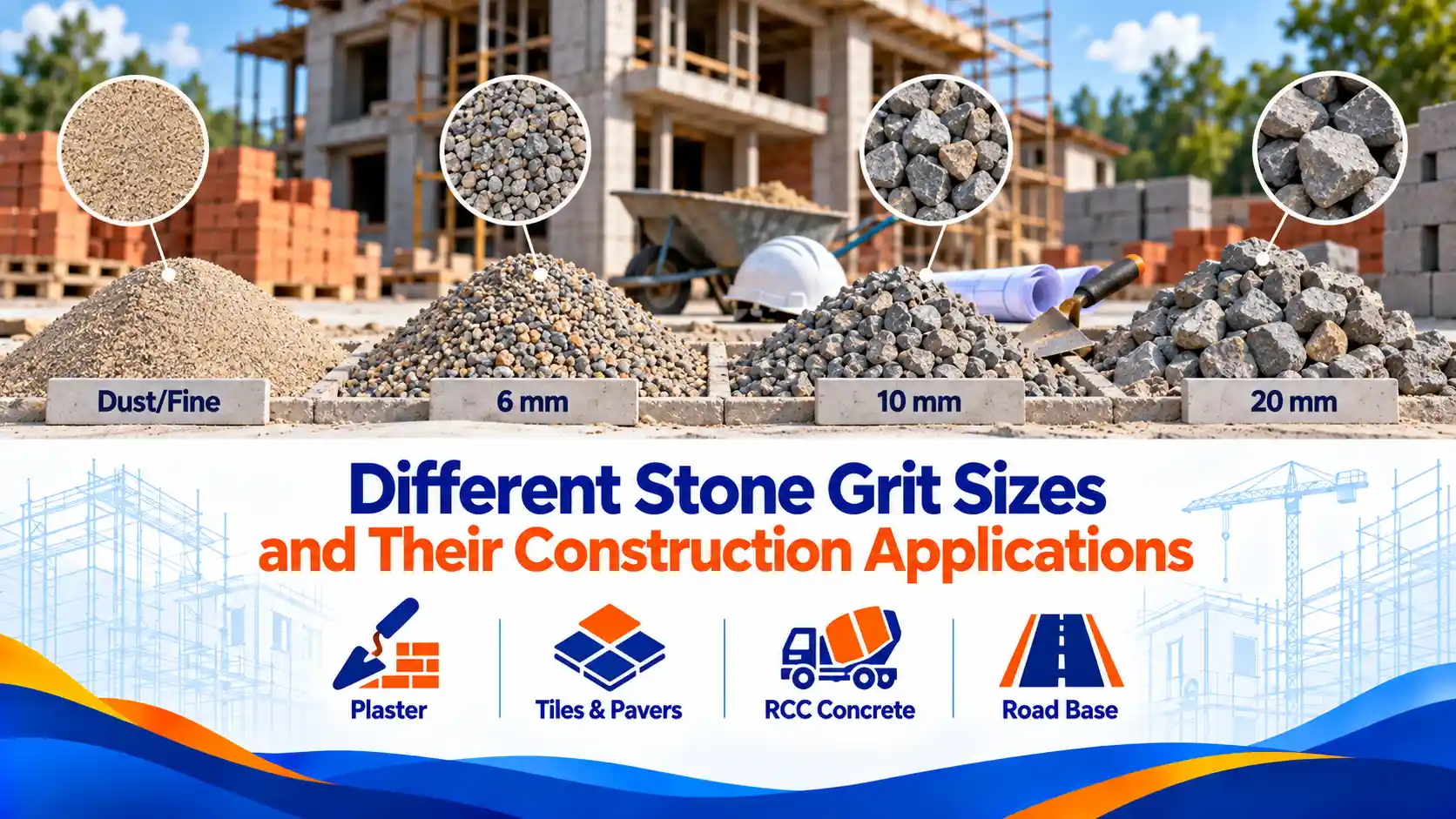
The 6mm, 10mm and 20mm stone grit sizes each serve a different band of construction work, moving from fine precast and finishing applications up to standard structural concrete.
- 6mm stone grit suits precast concrete products, thin screed layers, and decorative or pathway applications where a finer mix consistency matters more than the coarser strength of larger aggregate.
- 10mm stone grit works well in RCC elements with congested reinforcement, thinner slabs, and precast components, where the smaller size lets concrete flow properly around closely spaced bars without leaving voids.
- 20mm stone grit is the default size for general structural concrete, foundations, columns, beams, and standard slabs, offering the strongest interlocking within the mix for typical residential and commercial construction.
When Should You Use Larger Stone Grit Sizes Like 40mm?
Larger stone grit sizes, generally 40mm and above, are used in mass concrete work where the structural member is thick enough and lightly reinforced enough to accommodate bigger aggregate without compaction problems.
Dam construction, large foundation rafts, and other high-volume, low-reinforcement-density pours benefit from larger aggregate because it reduces the total cement paste needed to fill a given volume, which lowers both material cost and the heat generated during curing on very large pours. This size is almost never appropriate for typical residential construction, where reinforcement is packed too tightly for 40mm aggregate to flow around properly.
What Stone Grit Size Is Best for Road Construction?
Stone grit for road construction typically uses a mix of sizes, with larger aggregate (20mm to 40mm) forming the base and sub-base layers, and smaller, well-graded aggregate used in the surface course for a tighter, more durable finish.
Road base layers need aggregate large enough to distribute vehicle load effectively and allow drainage beneath the surface, which is why coarser grit dominates this stage. The surface layer, by contrast, uses more tightly graded and often smaller aggregate combined with bitumen or concrete to create a smooth, durable driving surface. Basalt grit is commonly preferred here over granite, given its stronger resistance to wear under continuous traffic load.
How Big Is India's Demand for Crushed Stone and Aggregate
India ranks as the world's second-largest consumer and producer of gravel and crushed stone, with consumption and production volumes both sitting at just over 3,080 million tonnes. This scale is driven heavily by continued public investment in highways, railways, and urban transit systems, alongside strong private construction demand, making crushed stone one of the most consistently traded construction materials in the country. (Market data source:IndexBox India Gravel and Crushed Stone Market Report, 2026.)
For buyers, this scale generally means reliable availability across most sizes, but it also means quality and grading consistency can vary significantly between the large organized suppliers and the many smaller regional quarries that make up this market.
What Mistakes Should You Avoid When Selecting Stone Grit Size?
Don't default to 20mm grit for every structural element without checking reinforcement spacing. A heavily reinforced column or beam may need 10mm grit specifically to avoid voids forming around the closely packed bars.
Don't use oversized grit in precast molds. Precast products are typically dimensioned for finer aggregate, and using 20mm grit in a mold designed for 10mm can produce visible surface defects and inconsistent mix quality.
Don't assume a single grit size works for an entire road project. Base layers and surface courses call for different sizes and gradations, and treating them the same undermines both drainage and surface durability.
Where Can You Buy Stone Grit Online in the Right Size?
You can buy stone grit online through URSBID by posting your requirement, including the exact size you need, and getting quotes from verified suppliers.
Once your structural drawings or road specification confirm the correct size, 6mm, 10mm, 20mm, or larger, the next step is finding a supplier who can deliver that grading consistently. Toget stone grit rates through URSBID, describe your requirement and registered vendors send their quotations directly, so you can compare pricing across the exact size your project calls for.
Frequently Asked Questions
What stone grit size is used for house construction?
20mm stone grit is the standard size for most residential structural concrete, including foundations, columns, beams, and slabs, while 10mm is used in more congested reinforcement sections.
Does IS 456 specify a rule for choosing aggregate size?
Yes, IS 456 generally limits nominal maximum aggregate size to one-fourth of the structural member's minimum thickness, and it must also be smaller than the minimum clear spacing between reinforcement bars.
Why can't I use 40mm stone grit for a house column?
Residential columns typically have closely spaced reinforcement, and 40mm aggregate is too large to flow properly around tightly packed bars, which can leave voids and weaken the concrete.
What size stone grit is best for road base layers?
Road base and sub-base layers generally use larger aggregate, 20mm to 40mm, for load distribution and drainage, while the surface course uses smaller, more tightly graded aggregate for a smoother finish.
Is smaller stone grit always weaker than larger stone grit?
Not necessarily. Smaller grit is chosen for specific technical reasons, like fitting around dense reinforcement or precast mold dimensions, rather than because it's structurally inferior, the right size depends entirely on the application.
Final Thoughts
Stone grit size isn't a matter of preference, it's governed by real technical rules tied to reinforcement spacing, member thickness, and the specific job the concrete needs to do. Matching 6mm, 10mm, 20mm, or larger aggregate to the actual structural or paving requirement, rather than defaulting to whatever's easiest to source, is what keeps a pour compacting properly and reaching its designed strength.
Ready to source the right stone grit size for your project?Get stone grit rates on URSBID by posting your requirement, and receive quotes from verified suppliers.