A mason on a small site once mixed up two sand deliveries, coarse for the plaster batch, fine for the concrete pour, and didn't notice until the plaster started cracking within weeks and the concrete came out weaker than the mix design called for. Nobody told him the wrong sand had arrived. From a distance, the two piles looked almost the same. Up close, and in how they actually perform, they're nothing alike.
This guide lays out the real difference between coarse and fine sand, so mix-ups like that one don't quietly cost you money and durability on your own project.
What Is the Key Difference Between Coarse and Fine Sand?
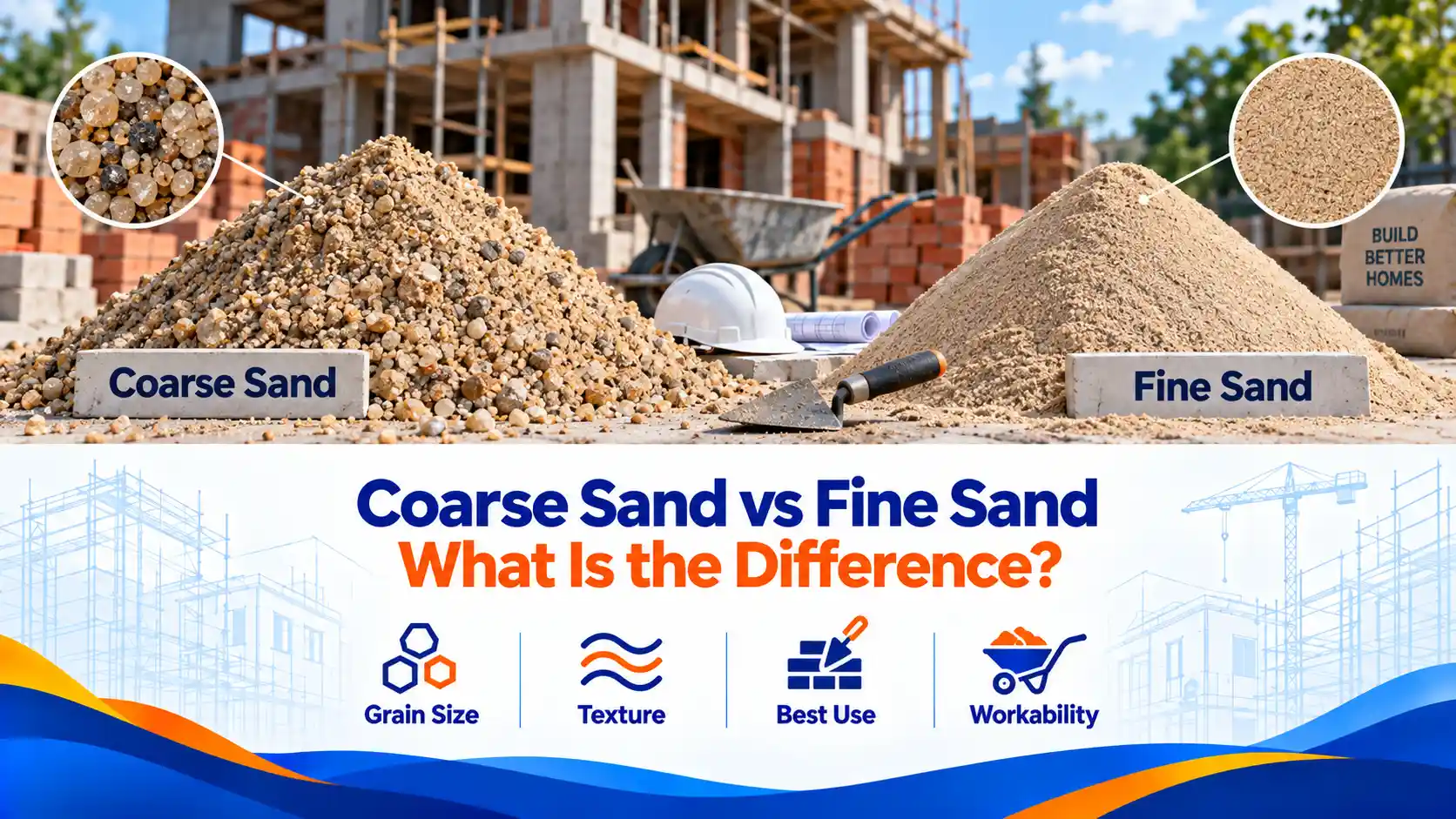
The key difference between coarse and fine sand comes down to particle size. Coarse sand ranges from 2.0mm to 4.75mm, while fine sand stays under 2.0mm, and that size gap changes almost everything about how each one behaves in a mix.
Coarse sand feels gritty and rough to the touch, with visibly larger grains that interlock firmly when mixed with cement and aggregate. Fine sand feels smooth, almost powdery in comparison, and it's this smoothness that makes it far easier to work into an even, crack-resistant surface. Neither is "better" in a general sense, they're built for different jobs, and using one where the other belongs is where most sand-related construction problems start.
Coarse Sand vs Fine Sand: Side-by-Side Comparison
|
Property |
Coarse Sand |
Fine Sand |
|
Particle size |
2.0mm to 4.75mm |
Below 2.0mm |
|
Texture |
Rough, gritty |
Smooth, soft |
|
Primary use |
Concrete, structural mortar |
Plastering, flooring screed |
|
Strength contribution |
High, through particle interlocking |
Low, prioritises finish over strength |
|
Surface finish |
Rough if used for plastering |
Smooth, ideal for visible surfaces |
|
Common name |
Badarpur sand, river sand |
Plaster sand |
When Should You Use Sand for Concrete vs Plastering?
Use coarse sand for concrete and structural mortar, and fine sand for plastering and surface-level work, since each one is suited to a completely different mechanical job.
In a concrete mix, coarse sand's larger, angular particles pack tightly against the cement and coarse aggregate, creating a dense, strong structure capable of carrying real load. That same roughness works against you in plastering, where the goal is an even, smooth surface rather than structural strength, which is exactly why fine sand takes over for that stage. The same logic applies to brickwork: coarse sand handles the structural mortar joining load-bearing walls, while fine sand finishes exposed joints and pointing work where appearance matters more than raw bonding strength.
What Sand Particle Size Should You Choose for Each Job?
Choose coarse sand's 2.0mm to 4.75mm range for anything structural, and fine sand's under-2.0mm range for anything meant to be seen or walked on as a finished surface.
Foundations, columns, beams, and slabs all rely on coarse sand's particle size to achieve proper mix strength, since this is where the sand's job is to bond, not to look good. Flooring screed, wall plaster, and ceiling finish work go the opposite direction, relying on fine sand's smaller particle size to create a level, crack-resistant surface that's ready for tiling or painting. Getting the particle size matched to the job isn't a minor preference, it's the difference between a wall that finishes smoothly and one that needs to be redone.
How Sand Sourcing Restrictions Are Changing What's Available
India's sand supply has been shifting for a few years now, and it affects both coarse and fine sand buyers. The National Green Tribunal's enforcement of sustainable mining practices has reduced legal river sand supply by roughly 40% compared to five years ago, pushing many buyers toward manufactured alternatives like M-sand for coarse applications and processed plaster sand for fine work. (Data source:Civil Site India Sand Price Report, 2026.)
This shift means the "coarse sand" or "fine sand" arriving at your site today may increasingly be manufactured rather than naturally river-sourced, which isn't a problem in itself, but it does make confirming the grading and quality with your supplier more important than it used to be when river sand was the default everywhere.
What Mistakes Should You Avoid With Coarse and Fine Sand?
Don't use fine sand in a structural concrete mix to save cost or because it's what's already on site. Fine sand doesn't interlock the way coarse sand does, and the resulting concrete can fall short of its intended strength.
Don't use coarse sand for plastering just because a delivery arrived and it seems close enough. The rough finish it leaves behind is difficult to correct without redoing the entire plaster layer.
Don't assume every "coarse sand" or "fine sand" delivery is graded consistently. Silt content and grading can vary between suppliers, so a quick settling test or visual check before a large pour is worth the few minutes it takes.
Where Can You Buy Coarse and Fine Sand Online in India?
You can buy coarse sand and fine sand online through URSBID by posting your requirement and getting quotes from verified suppliers.
Since most projects need both types at different stages, it helps to plan and source them together. Toget coarse sand rates for your structural concrete and mortar work, orget fine sand rates for plastering and flooring, describe your requirement through URSBID and registered vendors send their quotations directly, so you can compare pricing before committing to a single local supplier.
Frequently Asked Questions
What is the main difference between coarse sand and fine sand?
The main difference is particle size, coarse sand ranges from 2.0mm to 4.75mm while fine sand stays under 2.0mm, which is why coarse sand suits structural concrete and fine sand suits plastering and surface finishing.
Can fine sand be used instead of coarse sand in concrete?
No, fine sand doesn't interlock as firmly with cement and aggregate as coarse sand does, so using it as a substitute in structural concrete can reduce the mix's strength.
Which sand is better for plastering, coarse or fine?
Fine sand is better for plastering, since its smooth, small particles create an even, crack-resistant surface, while coarse sand's rough texture makes it difficult to achieve a smooth plastered finish.
Is river sand the same as coarse sand?
River sand is often used as coarse sand due to its particle size and texture, but with river sand mining increasingly restricted in India, manufactured coarse sand or M-sand is now a common substitute in many regions.
How can I tell coarse sand and fine sand apart before using them?
Coarse sand feels noticeably gritty with visible larger particles, while fine sand feels smooth and almost powdery, a difference you can usually confirm by touch alone before a delivery goes into a mix.
Final Thoughts
Coarse sand and fine sand aren't two versions of the same material, they're suited to entirely different jobs based on particle size alone. Coarse sand gives concrete and structural mortar the strength they need, while fine sand gives plaster and flooring the smooth finish they need. Keeping that distinction clear before ordering, and checking what actually arrives on site, is a small habit that prevents the kind of mix-up that only shows up as a problem weeks later.
Ready to source sand for your project? Getcoarse sand orfine sand rates on URSBID by posting your requirement, and receive quotes from verified suppliers.