Uses of Toughened Glass in Modern Buildings: A Simple Guide
Look around a modern home or office. The shower cubicle, the frameless door, the balcony railing, the office partition, and the shop front are probably all made of toughened glass. It has quietly become the default safety glass in modern buildings.
But toughened glass is not right for every job, and the wrong thickness or type can cause real problems. This guide explains the main uses of toughened glass, the thickness for each, what it costs, and the places where it should not be used alone.
What Is Toughened Glass and How Is It Made?
Toughened glass is ordinary glass that has been heated and cooled quickly to make it much stronger. If it breaks, it shatters into small, blunt pieces instead of sharp shards.
This heat treatment makes the glass several times stronger than normal annealed glass. It is made to meet IS 2553 (Part 1), the Indian standard for safety glass, and good glass carries an etched ISI mark. There is one big rule. Toughened glass cannot be cut, drilled, or edged after it is toughened. All cutting, holes, and edge work must be finished before the glass goes into the furnace. (Cutting rule source: Better Home, Toughened Glass.)
What Are the Main Uses of Toughened Glass in Modern Buildings?
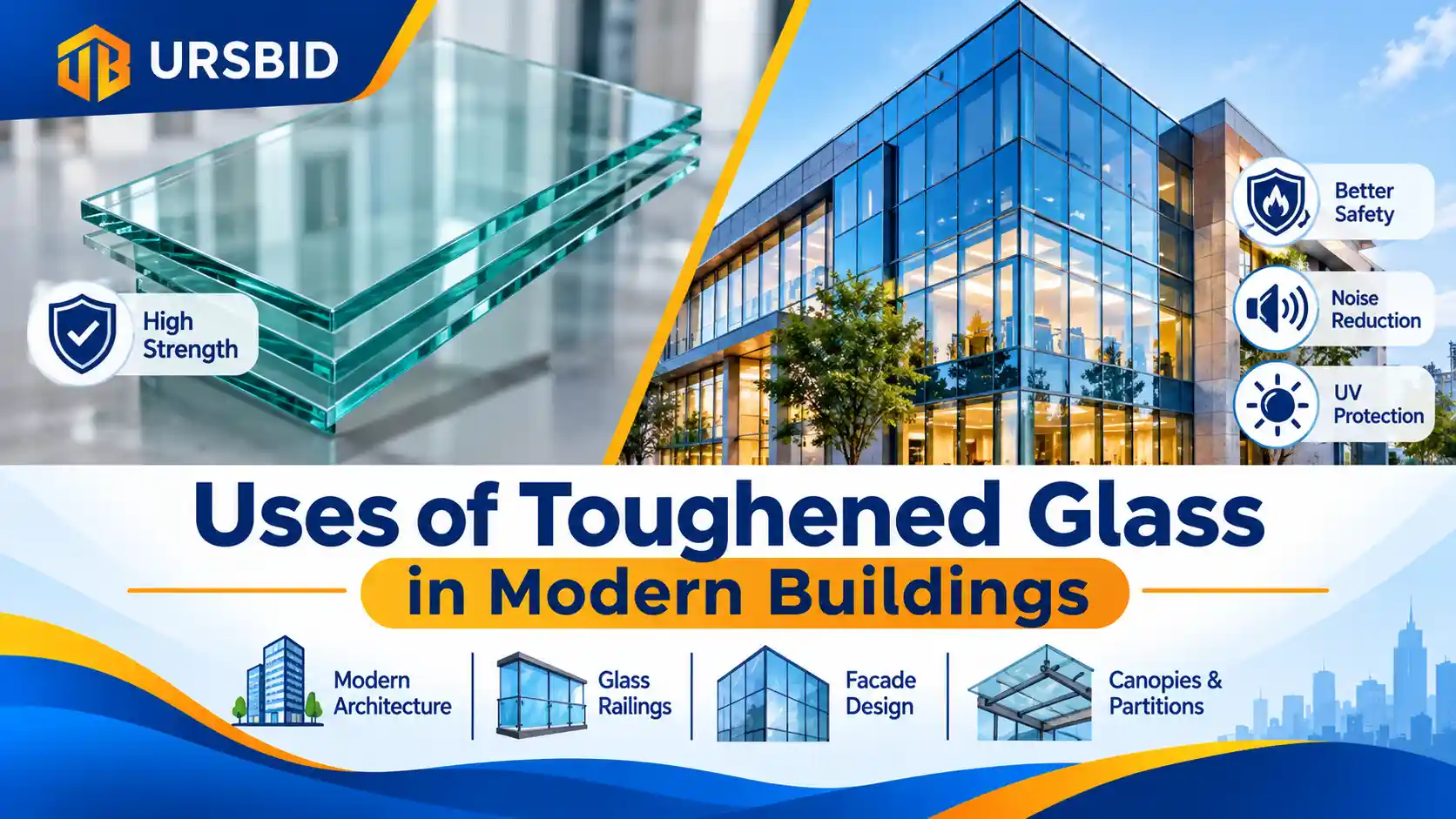
Toughened glass is used for shower enclosures, doors, partitions, railings, windows, shop fronts, facades, and furniture. It is the safe choice wherever people may touch or hit the glass.
- Shower enclosures and bathroom screens. Wet floors and bare skin make safety glass a must.
- Frameless glass doors. For entrances, offices, and balconies.
- Partitions. For offices, homes, and meeting rooms.
- Balcony and staircase railings. A clear, modern barrier that keeps the view open.
- Windows and glazing. Often 5 to 6 mm for smaller windows.
- Shop fronts and showcases. Strong and clear, good for retail.
- Facades and curtain walls. Heat-treated glass is used here, and thickness depends on wind load.
- Furniture and kitchens. Table tops, dining table covers, and kitchen shutters.
You can compare toughened glass from verified suppliers by posting your requirement on URSBID.
What Toughened Glass Thickness Should You Use for Each Use?
Thickness depends on the use. Showers use 8 to 10 mm, doors and partitions use 10 to 12 mm, and railings use 10 to 12 mm or more.
|
Use |
Typical thickness |
|
Windows and small panes |
5 to 6 mm |
|
Shower enclosures |
8 to 10 mm |
|
Framed partitions and shop fronts |
10 mm |
|
Frameless doors and partitions |
10 to 12 mm |
|
Balcony railings (framed) |
10 mm |
|
Frameless railings, high balconies |
12 mm |
|
Facades |
Set by wind load, often designed to IS 875 Part 3 |
One guide says 10 mm is the standard for most residential balcony railings, and 12 mm is recommended for frameless systems and heights above 1.2 m. These are guides. Your designer or engineer should confirm the thickness for each job.
Is Toughened Glass Good for Shower Enclosures?
Yes. A toughened glass shower enclosure is the standard choice. Use 8 to 10 mm glass with an ISI mark, polished edges, and quality hardware.
Wet bathrooms are risky. If a normal glass pane breaks, the shards are dangerous. Toughened glass breaks into small, blunt pieces, which is far safer. Place all holes for hinges and handles in the design before the glass is toughened. Because the glass cannot be changed later, measure carefully, and order after the frame or tiles are ready.
Where Should You Not Use Toughened Glass Alone?
Do not use toughened glass alone overhead or underfoot. Skylights, canopies, glass floors, and stair treads need laminated glass, so a broken pane stays in place.
When toughened glass breaks, it falls out as small pieces. That is fine for a door but dangerous overhead. Laminated toughened glass has a plastic layer that holds the pieces together. It costs more but is safer where a broken pane must not fall. Railings also need extra care. Some guides advise heat-soak tested or laminated glass for balustrades.
Heat-soak testing is an optional factory step. The glass is held at about 290°C for a few hours, so panes with tiny nickel sulphide flaws break at the factory and not in your building. For large facades and high railings, ask for it.
What Is the Toughened Glass Price per Sq Ft?
Clear toughened glass costs about Rs 135 to 140 per sq ft for 8 mm, Rs 165 to 170 for 10 mm, and Rs 195 to 200 for 12 mm. These are glass-only rates before GST.
|
Thickness |
Clear toughened glass (Rs per sq ft) |
Common use |
|
8 mm |
About 135 to 140 |
Showers, light partitions |
|
10 mm |
About 165 to 170 |
Partitions, shower doors, shop fronts |
|
12 mm |
About 195 to 200 |
Frameless doors, railings, glass walls |
(Price source: Chandra Lakshmi Glass, Toughened Glass Price per Sq Ft, 2026, ex-works, excluding GST and transport.)
Here is a simple example. A frameless door of 4 x 7 ft is 28 sq ft. At 12 mm and Rs 195 to 200 per sq ft, the glass costs about Rs 5,460 to 5,600 before GST. Edge polish, holes, and cut-outs cost extra, and so do transport and fitting.
Prices differ a lot by seller, city, and brand. Some retail ranges start much lower for thin glass, and some installed railing quotes run higher. Laminated toughened glass costs more still. Always compare quotes with the same thickness, finish, and extras.
How Do You Check Toughened Glass Quality?
Check the etched ISI mark, the thickness, and the edge finish. Ask for the specification in writing.
Genuine toughened glass carries a permanent etched mark with the maker's name and the IS standard. Measure the thickness at several points. Edges should be smooth and polished, with no chips. For railings and facades, ask whether the glass is heat-soak tested or laminated. Keep the supplier's bill and specification. If the glass is cut wrongly, it cannot be fixed, so check sizes twice before ordering.
What Mistakes Should You Avoid With Toughened Glass?
- Do not order before the frame or opening is final. You cannot trim toughened glass later.
- Do not use toughened glass alone for skylights, canopies, or floors. Use laminated glass.
- Do not choose a thin pane for a large door or high railing. Follow the thickness guide and confirm it with your designer.
- Do not skip the ISI mark. Unmarked glass may not be safety glass.
- Do not forget hardware. Hinges, patch fittings, and rails must suit the glass thickness. You can find glass work services on URSBID for fitting.
- Do not forget GST and extras. Edge polish, holes, and transport can add to the bill.
Where Can You Buy Toughened Glass Online?
You can buy toughened glass online through URSBID by posting your requirement and getting quotes from verified suppliers.
Once you know the thickness and sizes you need, the next step is to compare rates. To Buy Toughened Glass Online through URSBID, share the use, thickness, size, finish, quantity, and delivery place. Registered vendors will send their quotations directly to you. Ask each one about the ISI mark, edge work, and whether heat-soak testing is available.
Frequently Asked Questions
What are the uses of toughened glass in buildings?
Toughened glass is used for shower enclosures, frameless doors, partitions, railings, windows, shop fronts, facades, and furniture like table tops.
What thickness of toughened glass is used for a shower?
Usually 8 to 10 mm, with an ISI mark and polished edges.
Can toughened glass be cut after it is made?
No. It cannot be cut, drilled, or edged after toughening. All cutting must be done before.
What is the price of toughened glass per sq ft in India?
Clear toughened glass is about Rs 135 to 140 for 8 mm, Rs 165 to 170 for 10 mm, and Rs 195 to 200 for 12 mm before GST. Rates vary by seller.
Is toughened glass safe for skylights?
Not on its own. Skylights and canopies should use laminated toughened glass, so a broken pane stays in place.
Final Thoughts
Toughened glass is the safe, clear, modern choice for showers, doors, partitions, railings, and facades. Pick the right thickness for each use. Order only after sizes are final. Look for the ISI mark. And use laminated glass wherever a broken pane could fall. With these simple rules, your glass will stay safe and good-looking for years.
Ready to compare prices? Get toughened glass rates on URSBID by posting your requirement, and receive quotes from verified suppliers.