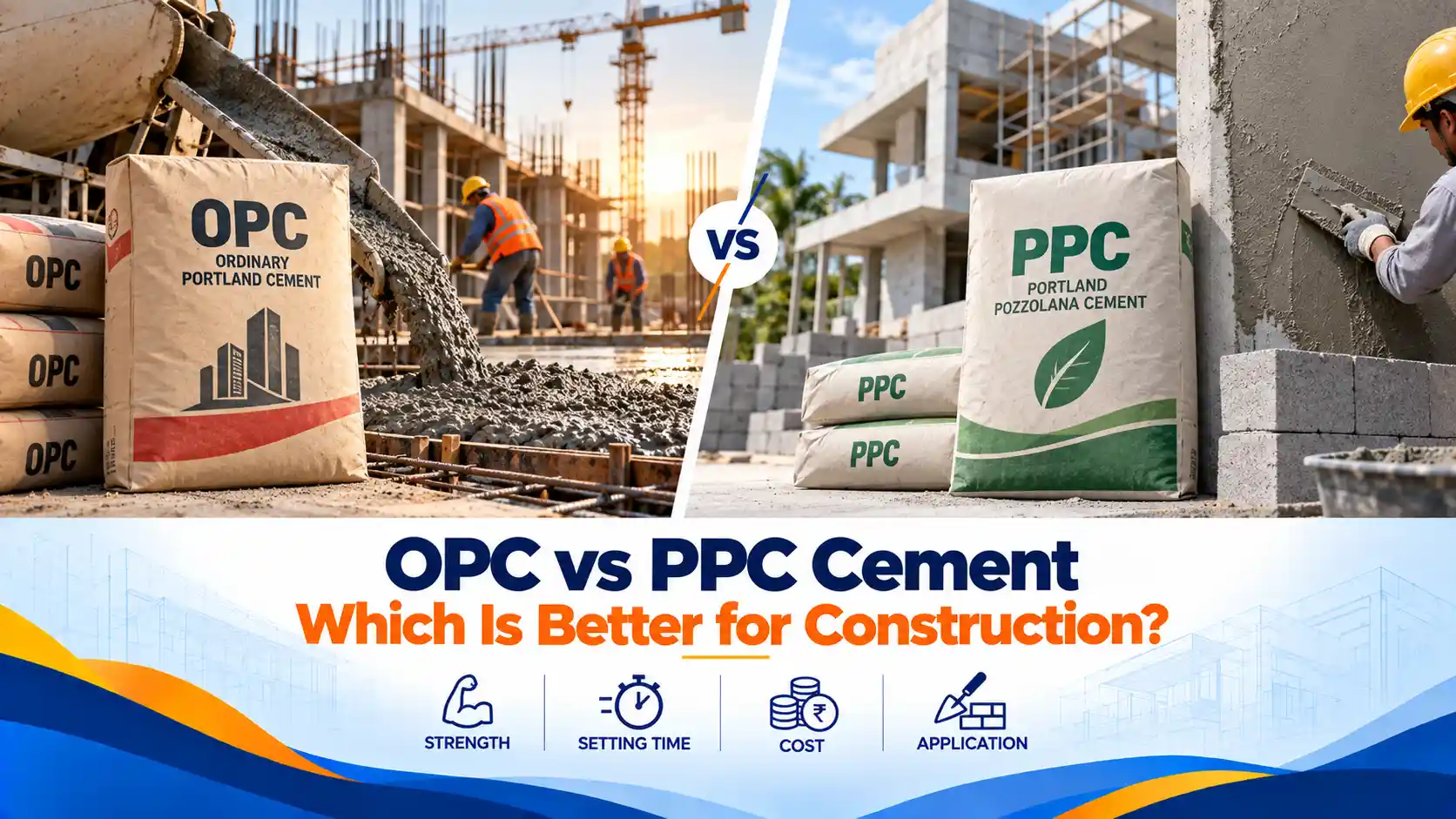
Two bags of cement sitting side by side in a dealer's shop look nearly identical, same grey powder, same basic packaging, often a similar price. But what's inside each bag is genuinely different, and that difference shows up years later in how a structure handles moisture, chemical exposure, and long-term wear. OPC and PPC aren't just brand variations of the same product, they're built from different raw material compositions entirely.
This guide compares OPC and PPC cement on strength, durability, and cost, so the choice between them comes from understanding the actual difference rather than habit.
What Is the Core Difference Between OPC and PPC Cement?
OPC (Ordinary Portland Cement) is made almost entirely from Portland clinker, while PPC (Portland Pozzolana Cement) replaces roughly 15% to 35% of that clinker with a pozzolanic material, most commonly fly ash from thermal power plants.
This substitution isn't just about cost or sustainability, though both benefit from it. The fly ash in PPC chemically reacts with the lime released during cement hydration, forming an additional binding gel that gradually densifies the concrete over time. OPC, with its higher clinker content, develops strength faster in the early curing period but doesn't get this same long-term densification benefit from a pozzolanic reaction.
How Does OPC Cement Strength Compare to PPC Over Time?
OPC cement strength develops faster in the first days and weeks of curing, while PPC starts slower but often catches up and can exceed OPC's long-term strength as the pozzolanic reaction continues densifying the concrete over months and years.
This timing difference matters practically on site. If formwork needs to be removed quickly to keep a construction schedule moving, OPC's faster early strength gain is a genuine advantage. For elements that aren't under that same time pressure, PPC's slower but ultimately comparable or superior long-term strength, combined with its other durability benefits, often makes it the more sensible overall choice. Some structural designs specify extended curing periods (40 or 56 days instead of the standard 28) specifically to let PPC's full strength potential develop before load is applied.
What Makes PPC Cement Durability Better in Certain Conditions?
PPC cement durability comes from its denser, less permeable concrete structure, which resists water penetration, chloride attack, and sulphate exposure meaningfully better than OPC in the same conditions.
This makes PPC a strong choice for foundations, coastal construction, marine-adjacent sites, and any structure exposed to sustained moisture or chemical attack, exactly the conditions where OPC's higher permeability becomes a long-term liability. PPC's finer, more spherical fly-ash particles also improve workability, giving a smoother finish that many masons find easier to work with for plastering. The tradeoff is PPC's slower early strength, which is why it's less ideal where rapid formwork turnaround or very fast-track construction scheduling is the priority.
Which Cement Is Better for RCC Work, OPC or PPC?
For RCC work, OPC 53 grade is traditionally preferred where early strength and rapid construction scheduling matter most, while PPC increasingly performs comparably well in standard RCC elements and offers a genuine durability advantage in exposed or moisture-prone conditions.
Many Indian structural engineers now specify PPC for general RCC work, reserving higher-grade OPC specifically for structural elements with demanding timelines or heavy early load requirements. For foundations and any element with prolonged exposure to groundwater or soil chemicals, PPC is frequently the more durable, appropriate choice, provided curing time accounts for its slower strength development curve.
OPC vs PPC Cement: Side-by-Side Comparison
|
Factor |
OPC |
PPC |
|
Composition |
Mostly Portland clinker |
Clinker blended with 15-35% fly ash |
|
Early strength |
Faster |
Slower |
|
Long-term strength |
Strong, but plateaus earlier |
Often comparable or higher over time |
|
Durability (water, chloride, sulphate resistance) |
Lower |
Higher |
|
Workability and finish |
Standard |
Smoother, easier to work with |
|
Heat of hydration |
Higher |
Lower, reducing cracking risk in mass pours |
|
Environmental impact |
Higher embodied carbon |
Lower, due to reduced clinker use |
|
Cost |
Comparable, sometimes slightly higher |
Comparable, sometimes slightly lower |
How Big Is PPC's Share of India's Cement Market Right Now
Blended cement, which includes PPC, now commands roughly 68% of India's total cement market, driven by lower production costs and a meaningfully smaller environmental footprint compared to pure OPC. According to the Cement Manufacturers' Association, the Indian cement industry is the country's largest consumer of fly ash, and under Bureau of Indian Standards rules, fly ash blending in PPC is permitted up to 35%. India generated around 340 million tonnes of fly ash in 2024-25, with a significant share consumed by the cement industry specifically for PPC production.
(Market data source:MarkNTel Advisors India Cement Market Report, 2026.)
This dominant share reflects how mainstream PPC has become, it isn't a niche or budget alternative anymore, it's the default cement type across most of Indian construction today.
What Mistakes Should You Avoid When Choosing Between OPC and PPC?
Don't assume OPC is automatically the stronger choice just because it gains strength faster early on. Over the full curing period, PPC frequently matches or exceeds OPC's final strength while offering better durability.
Don't use PPC where fast formwork turnaround is critical without accounting for its slower early strength gain, which can delay construction schedules if not planned for properly.
Don't ignore exposure conditions when choosing between the two. For foundations, coastal sites, or anywhere with sustained moisture or chemical exposure, PPC's durability advantage is significant enough that defaulting to OPC out of habit can genuinely shorten a structure's service life.
Where Can You Buy OPC and PPC Cement Online?
You can buy OPC and PPC cement online through URSBID by posting your requirements and getting quotes from verified suppliers.
Once you've confirmed which cement type and grade your project needs, the next step is finding a supplier who delivers genuine, correctly certified stock. Toget cement rates through URSBID, describe your requirement, OPC or PPC, grade, and quantity, and registered vendors send their quotations directly, so you can compare pricing before committing to a single local dealer.
Frequently Asked Questions
Is OPC or PPC cement better for construction?
Neither is universally better. OPC offers faster early strength, useful where construction schedules demand quick formwork removal, while PPC offers better long-term durability and chemical resistance, making it the stronger choice for foundations and moisture-exposed structures.
Does PPC cement take longer to gain strength than OPC?
Yes, PPC generally develops strength more slowly in the early curing period compared to OPC, though it often catches up to or exceeds OPC's strength over the longer term as the pozzolanic reaction continues.
Is PPC cement more environmentally friendly than OPC?
Yes, PPC replaces a portion of energy-intensive clinker with fly ash, a byproduct of thermal power generation, which reduces both production cost and the embodied carbon footprint compared to OPC.
Which cement is better for a house foundation, OPC or PPC?
PPC is often the better choice for foundations, since its denser concrete structure offers better resistance to water, chlorides, and sulphates, conditions foundations are commonly exposed to through soil and groundwater contact.
Can OPC and PPC cement be used in the same construction project?
Yes, many projects use OPC for elements needing fast early strength and quick formwork turnaround, and PPC for general RCC work and any elements benefiting from its durability advantages, rather than committing to a single type throughout.
Final Thoughts
OPC and PPC aren't competing to be the single better cement, they're suited to different priorities within the same project. OPC earns its place where fast early strength and quick construction turnaround matter most, while PPC's durability, chemical resistance, and lower environmental impact make it the increasingly dominant choice across general Indian construction. Understanding this tradeoff, rather than defaulting to whichever cement is most familiar, is what leads to a structure that performs well for its full intended lifespan.
Ready to source cement for your project?Get OPC and PPC cement rates on URSBID by posting your requirement, and receive quotes from verified suppliers.