A contractor who built houses with river sand for twenty straight years suddenly found himself unable to source it legally in his district. The riverbed that supplied his entire career had become off-limits, caught up in mining restrictions he'd barely paid attention to until his usual supplier simply stopped delivering. He's not alone. Across more than a dozen Indian states, this exact shift has forced an entire industry to rethink where its sand actually comes from.
This guide compares natural sand and manufactured sand on strength, cost, and legal availability, so the choice makes sense for where your project actually stands today.
What Is the Core Difference Between Natural Sand and Manufactured Sand?
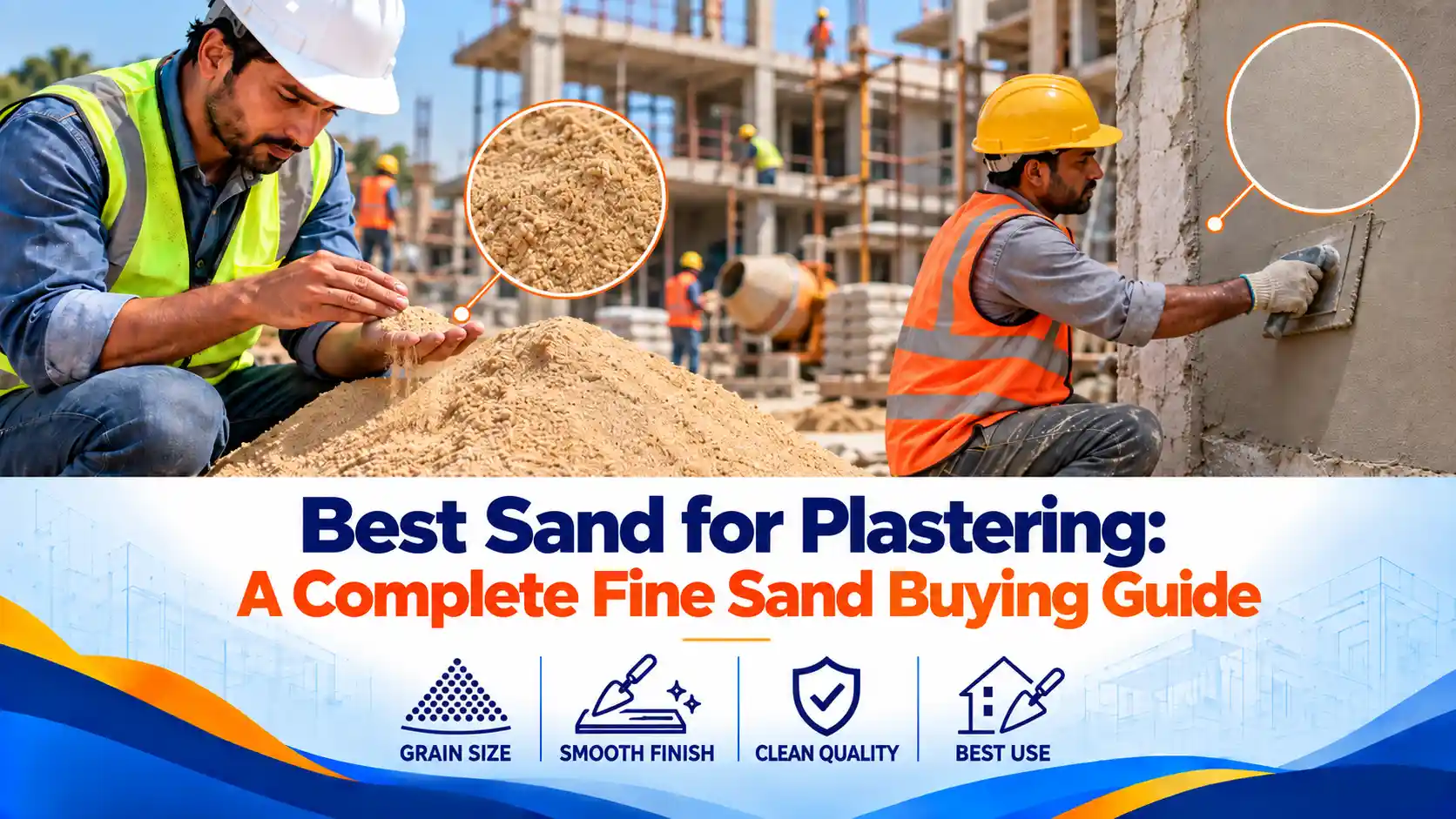
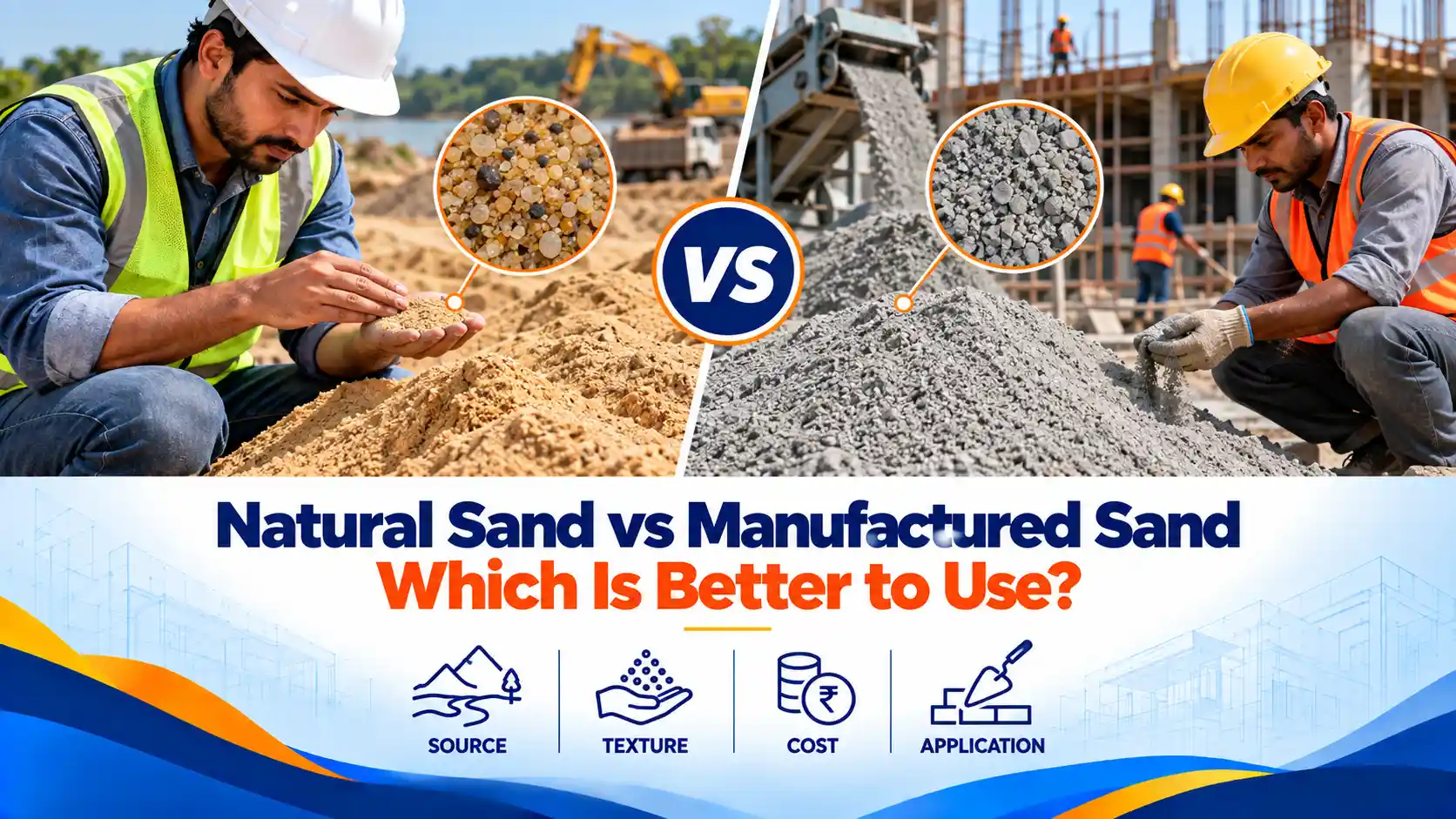
Natural sand is dredged from riverbeds, formed over time by water naturally eroding and rounding rock particles, while manufactured sand, commonly called M-sand, is produced by mechanically crushing hard rock like granite into a controlled, consistent size.
This origin difference shows up directly in each sand's shape and behaviour in a mix. Natural sand's rounded grains give it good workability, particularly valued for a smooth plaster finish. M-sand's crushed, more angular grains interlock more firmly in a concrete mix, often contributing to better compressive strength, though sometimes requiring slightly more water or admixture to achieve the same workability as rounded natural sand.
Why Has River Sand Vs M-Sand Become Such a Pressing Question in India?
River sand vs M-sand has become a pressing question because more than fourteen Indian states have now imposed bans, caps, or strict licensing on river sand mining, driven by serious environmental damage to riverbeds, bridge foundations, and groundwater levels.
Unregulated dredging scars riverbeds, destabilises banks, and lowers water tables, damage that accumulated for decades before enforcement caught up. In response, state after state has restricted extraction, which has made legal river sand increasingly scarce, more expensive, and often inconsistent in quality where it's still available at all. M-sand stepped into that supply gap directly, manufactured to order in controlled facilities rather than extracted from an increasingly protected natural resource.
What Are the Real Benefits of Manufactured Sand Over River Sand?
The benefits of manufactured sand include steady year-round availability, more consistent grading, lower silt content, and full legal compliance, advantages that matter more with each passing year as river sand access tightens further.
M-sand typically comes with a silt content under 3%, often cleaner than unwashed river sand, which can run higher and introduce impurities that weaken a concrete or plaster mix. Because M-sand is manufactured rather than extracted, supply doesn't fluctuate with monsoon seasons or mining permit cycles the way river sand does, giving contractors more predictable project planning. According to India's Ministry of Mines, the country consumed over 150 million metric tonnes of M-sand in 2026, reflecting just how firmly it has already become the mainstream choice rather than a niche alternative.
(Market data source:Verified Market Reports M Sand Market Report, 2026.)
Is M-Sand for Construction Use as Strong as Natural River Sand?
Yes, M-sand for construction use generally performs as well as, and often better than, natural river sand in structural concrete, since its angular particle shape creates stronger mechanical interlocking within the mix.
This makes M-sand the increasingly standard choice for structural RCC work, foundations, columns, beams, and slabs, where consistent grading and strength matter more than surface finish. For fine plastering work, legally sourced river sand's naturally rounded, smooth grains still hold a slight workability edge for masons used to that specific feel, though many sites now successfully use properly graded M-sand or plaster-specific manufactured sand for this stage too.
Natural Sand vs Manufactured Sand: Side-by-Side Comparison
|
Factor |
Natural Sand (River Sand) |
Manufactured Sand (M-Sand) |
|
Source |
Riverbeds, naturally eroded |
Crushed rock, typically granite |
|
Particle shape |
Rounded, smooth |
Angular, interlocking |
|
Legal availability |
Restricted or banned in many states |
Legal and widely available |
|
Silt content |
Often higher, especially unwashed |
Generally lower, under 3% |
|
Strength in concrete |
Good |
Often comparable or better |
|
Workability for plastering |
Slightly smoother, traditional feel |
Good with proper grading |
|
Supply consistency |
Seasonal, permit-dependent |
Steady, year-round |
What Mistakes Should You Avoid When Choosing Between These Sand Types?
Don't assume river sand is automatically the safer, more traditional choice without checking its legal status in your region first. Using illegally sourced river sand carries real regulatory risk on top of the environmental concerns driving the bans in the first place.
Don't buy M-sand without confirming its grading and silt content. Quality varies between manufacturers, and poorly screened M-sand can still cause workability or strength issues, just as inconsistent river sand can.
Don't default to river sand for plastering purely out of habit if it's restricted or expensive in your area. Properly graded M-sand or plaster-specific manufactured sand now performs well enough for most residential finishing work.
Where Can You Buy Natural and Manufactured Sand Online?
You can buy natural sand and M-sand online through URSBID by posting your requirement and getting quotes from verified suppliers.
Since availability and legality vary significantly by region, it's worth comparing both options for your specific location before committing to an order. Toget coarse sand rates through URSBID, describe your requirement, natural or manufactured, and your project's application, and registered vendors send their quotations directly, so you can compare pricing and confirm what's legally available in your area.
Frequently Asked Questions
Is M-sand better than river sand for construction?
For structural concrete, M-sand generally performs as well as or better than river sand due to its angular particle shape, while river sand's smoother grains traditionally offer a slight edge for plastering, though well-graded M-sand now works well for both.
Why is river sand restricted in so many Indian states?
River sand mining causes significant environmental damage, including riverbed erosion, bank collapse, and lowered groundwater levels, which has led more than fourteen Indian states to impose bans, caps, or strict licensing on its extraction.
Is M-sand cheaper than river sand?
M-sand is often more cost-stable and sometimes cheaper than legally sourced river sand, especially in regions where river sand mining restrictions have made legal supply scarce and expensive.
Can M-sand be used for plastering work?
Yes, properly graded M-sand or plaster-specific manufactured sand can be used for plastering, though it may require slightly different handling than traditional river sand to achieve the same smooth finish.
How do I know if M-sand is good quality before buying?
Check that the silt content stays under around 3%, confirm the particles are reasonably consistent in size, and ask your supplier about the source rock and crushing process used to produce it.
Final Thoughts
Natural sand and manufactured sand aren't simply a traditional choice versus a modern substitute, they're two materials shaped by very different circumstances, one increasingly constrained by environmental regulation, the other built specifically to fill that gap reliably and legally. For most structural work today, M-sand has become the practical default, while natural sand, where it remains legally available, still holds a place in specific finishing applications. Checking legality, quality, and grading before committing to either is what keeps a project both compliant and structurally sound.
Ready to source sand for your project?Get natural or manufactured sand rates on URSBID by posting your requirement, and receive quotes from verified suppliers.