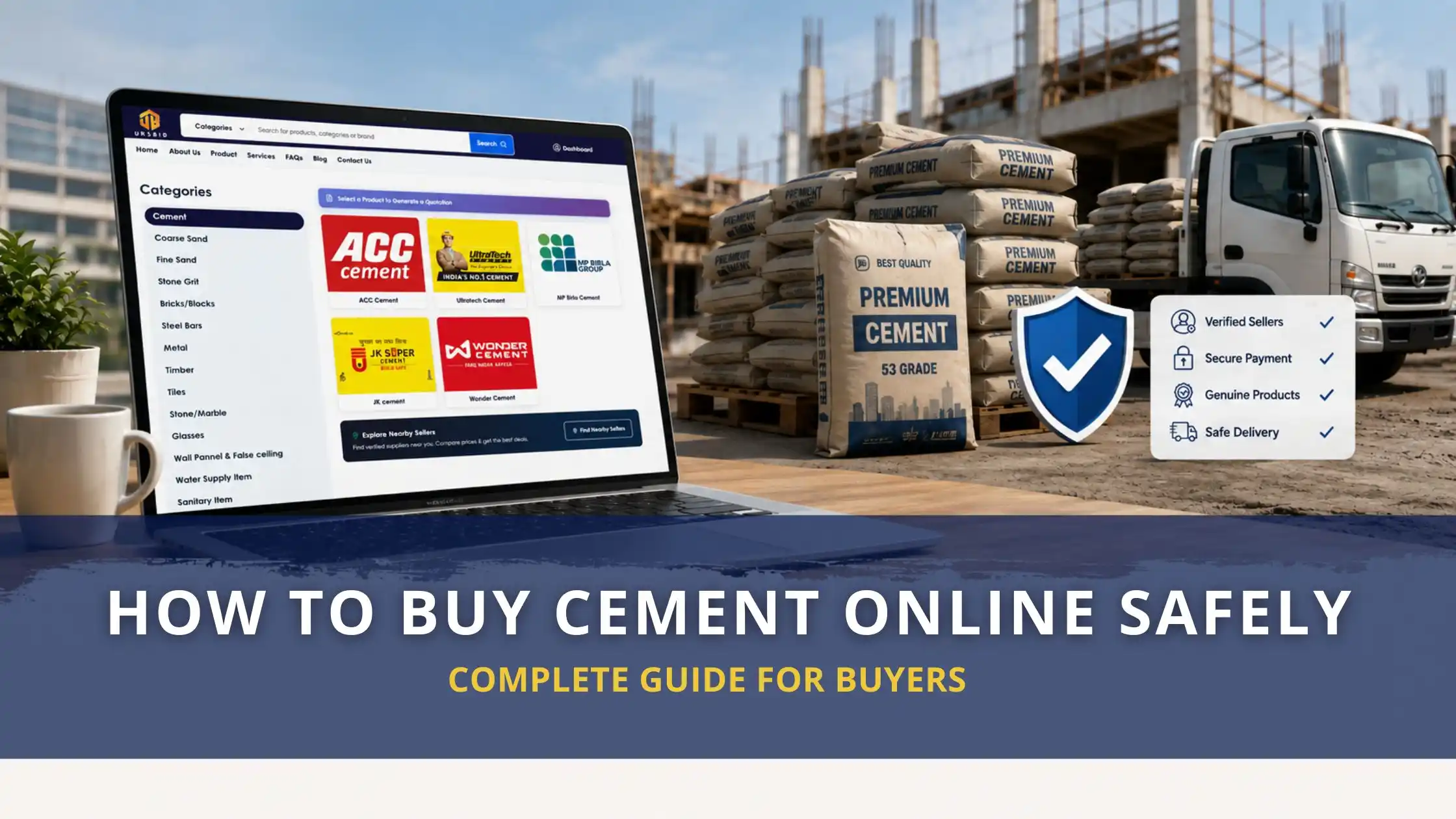
Somewhere in almost every construction project, there's a moment where the cement delivery doesn't quite match what was ordered - a different brand than agreed, bags that feel lighter than they should, or a grade that's clearly not what was quoted. It's one of those problems that's easy to overlook until it's already poured into a foundation. And as more buyers move from local dealers to ordering cement online, the same question keeps coming up: how do you actually know what you're getting before it arrives?
Buying cement online isn't inherently risky - it's actually one of the easier materials to compare and verify, if you know what to check. This guide walks through exactly that: how to buy cement online safely, what separates a legitimate supplier from a risky one, how to choose the right grade for your project, and where to actually find verified sellers instead of gambling on an unfamiliar listing.
Why Buyers Are Moving Cement Purchases Online
Traditionally, cement procurement meant calling a local dealer, trusting their stock, and accepting whatever price was quoted that day — with little room to compare. Buying cement online flips that dynamic:
- Price transparency: Multiple sellers' rates are visible side by side, instead of one dealer's word.
- Wider selection: Buyers aren't limited to whichever brand a local dealer happens to stock.
- Documented transactions: Orders, quotes, and communication leave a digital trail, useful if there's ever a dispute.
- Bulk comparison for large projects: Contractors sourcing for multiple sites can compare quotes at scale rather than negotiating individually at each location.
The convenience is real, but it does shift some responsibility onto the buyer to verify quality and seller legitimacy, something a familiar local dealer relationship used to handle informally.
Risks of Buying Cement Online And How to Avoid
1. Counterfeit or Mislabeled Bags
The most common risk isn't a scam in the traditional sense, it's cement sold under a well-known brand name that isn't actually from that manufacturer, or a lower grade repackaged as a higher one.
How to avoid it: Check that the bag carries the manufacturer's batch number, manufacturing date, and BIS (Bureau of Indian Standards) certification mark. Genuine cement bags always list the IS grade (e.g., IS 269 for OPC 33 grade, IS 8112 for OPC 43 grade, IS 12269 for OPC 53 grade) printed clearly. If a listing or seller can't confirm this information before you order, that's a red flag.
2. Under-Filled or Damaged Bags
Cement bags are standardised at 50 kg, but under-filled bags or bags exposed to moisture during storage and transit are a known issue with less reliable sellers.
How to avoid it: Ask for recent photos of the actual stock being sold, not just a generic product image, and confirm the weight guarantee before payment. On arrival, weigh a sample bag if possible — a shortfall of even 2-3 kg per bag adds up significantly across a bulk order.
3. Vague or Missing Seller Information
A listing with no verifiable business details, no GST number, and no way to confirm past transaction history is inherently riskier — if something goes wrong, you have no real recourse.
How to avoid it: Only order from sellers with verified business credentials and a visible track record. This is exactly the gap that platform-based verification is meant to close — more on that below.
4. Price That's "Too Good" Compared to Market Rate
Cement pricing across major brands tends to move within a fairly predictable band based on region and grade. A quote significantly below market rate for a well-known brand is more often a sign of counterfeit stock or a bait-and-switch tactic than a genuine deal.
How to avoid it: Cross-check the quoted price against at least two or three other sellers before committing. If one quote is dramatically lower, ask why — sometimes there's a legitimate reason (excess stock clearance), but often there isn't.
5. No Clarity on Delivery Timelines or Damage Liability
Cement is heavy, moisture-sensitive, and takes time to transport in bulk. Buyers sometimes get quoted a low price without any clear delivery date or terms for what happens if bags arrive damaged.
How to avoid it: Get delivery timelines and damage/replacement terms confirmed in writing (or on-platform, where it's documented) before finalising payment.
Choosing the Right Cement Grade Before You Buy online
Buying cement online safely isn't only about avoiding fraud, it's also about ordering the right product in the first place. The three most common grades used in Indian construction are:
- OPC 33 Grade: Lower strength, typically used for plastering and non-structural masonry work where high strength isn't critical.
- OPC 43 Grade: The most commonly used grade for general RCC work, plastering, and residential construction with moderate structural demands.
- OPC 53 Grade: Higher strength and faster curing, typically used for structural elements like columns, beams, and slabs in larger or high-load construction.
Ordering the wrong grade, say using OPC 33 for structural RCC work, isn't just inefficient, it can genuinely compromise the strength of the structure. If you're unsure which grade your project needs, it's worth confirming with your site engineer or contractor before placing a bulk order, rather than assuming based on price alone.
How to Verify a Cement Seller Before Ordering
Whether you're buying cement through a marketplace or a standalone supplier, a few checks apply universally:
- Business verification: Does the seller have a registered business identity, GST number, and any visible KYC or verification badge?
- Transaction or review history: Has the seller completed previous orders that are documented or reviewed by other buyers?
- Direct communication: Can you actually ask the seller questions about batch numbers, manufacturing dates, or delivery terms before paying, or is the listing a black box?
- Clear, itemised quotation: Does the quote separate material cost, transport, and any other charges clearly, or is it a single vague number?
Buying Cement Online Through a Verified Marketplace
This is where a construction marketplace genuinely reduces risk compared to buying from an unfamiliar standalone listing or an unverified local ad. OnURSBID, cement is listed as a dedicated product category, and every registered seller goes through a KYC and multi-step verification process before their listings go live. That means the seller identity, business registration, and product category are checked before you're even comparing quotes — not something you have to independently investigate from scratch.
You can browsecement listings directly, post a requirement specifying the grade and quantity you need, and receive quotes from multiple verified sellers to compare side by side — rather than relying on a single supplier's word for pricing and availability. If your project also needssteel bars for RCC work, orepoxy grouting material for structural repairs, sourcing them through the same verified pool of sellers keeps your procurement process consistent across materials, instead of separately vetting a new supplier for each item.
For buyers managing the actual construction work alongside procurement, it's also worth checking service categories likeconcreting work andshuttering work — since cement quantity and grade decisions are often tied directly to the structural work being planned.
A Simple Pre-Purchase Checklist
Before finalising any cement order online, run through this quickly:
- Confirm the exact grade required for your specific use (plastering vs. structural work).
- Verify the seller's business credentials and any platform verification badge.
- Check for BIS certification and IS grade marking on the product listing.
- Compare at least 2-3 quotes for the same grade and quantity.
- Confirm delivery timeline and damage/replacement terms before payment.
- Request recent photos or documentation of actual stock, not stock images.
- Keep all communication and quotes documented in case of a dispute later.
Frequently Asked Questions
Is it safe to buy cement online in India? Yes, as long as you verify the seller's credentials, confirm the cement grade and BIS certification, and compare quotes across multiple verified sellers rather than ordering from a single unverified listing.
How do I know if cement is genuine before it's delivered? Genuine cement bags list the manufacturer's batch number, manufacturing date, and IS grade certification clearly. Ask the seller to confirm and share this information before you place the order, not after delivery.
What cement grade should I buy for home construction? OPC 43 grade is commonly used for general residential construction including plastering and moderate structural work, while OPC 53 grade is preferred for higher-strength structural elements like columns, beams, and slabs.
Why do cement prices vary so much between online sellers? Prices vary based on brand, grade, region, order quantity, and transport costs — but a price significantly below the market average for the same brand and grade is often a sign of counterfeit or substandard stock.
What should I do if the cement I receive doesn't match what was ordered? Document the discrepancy immediately with photos and batch details, and raise it with the seller through the same channel the order was placed on — this is much easier to resolve when the transaction and communication are recorded on a platform rather than conducted informally.
Final Thoughts
Buying cement online safely comes down to the same principle that applies to any bulk construction purchase: verify before you pay, not after you're unhappy with what arrives. Checking BIS certification, comparing multiple quotes, and confirming seller credentials takes a few extra minutes upfront, but it's far less costly than discovering a grade mismatch or counterfeit stock after it's already part of your build.
If you're ready to source cement for your next project,browse verified cement listings on URSBID and compare quotes from KYC-verified sellers before you commit to an order.