A mason once told a homeowner that "any fine sand works for plaster" while quoting a price well below what the local market usually charges. Three months after the walls were finished, hairline cracks started spreading across nearly every plastered surface in the house. The sand hadn't been wrong in an obvious way, it just wasn't properly graded for plastering, and nobody checked before it went on the wall. Buying the right plaster sand isn't complicated, but it does require knowing what to actually look for.
This guide walks through exactly how to choose the best sand for plastering, covering grading, silt content, and how much you actually need to order.
What Grading Should Fine Sand for Plastering Actually Have?
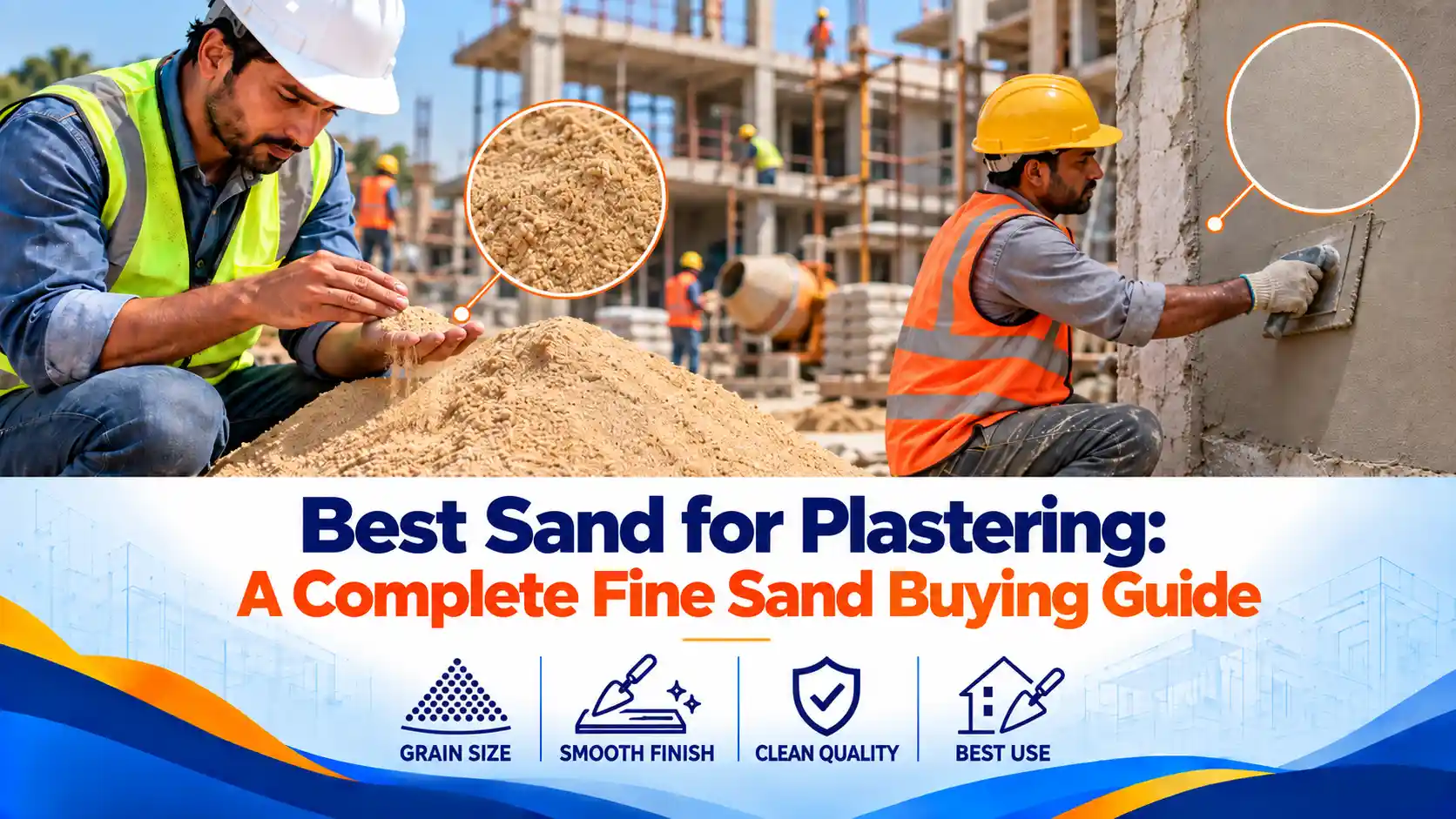
Fine sand for plastering should fall under IS 383's Zone III or Zone IV grading, the finer end of the standard's particle size classification, which gives plaster its smooth, crack-resistant finish.
IS 383:2016 classifies sand into four grading zones, Zone I being the coarsest and Zone IV the finest. Plastering sand, often sold commercially as P-sand, is specifically processed to sit in Zone III or Zone IV, with Zone IV sand requiring that 80% to 100% of particles pass through a 600 micron sieve. Sand graded for concrete work (typically Zone II) is noticeably coarser and will leave a rough, uneven surface if used for plastering instead, which is exactly the kind of mix-up that leads to problems like the one in the story above.
What Is Safe Silt Content in Sand for Plastering?
Silt content in sand for plastering should generally stay under 3% to 4%, since silt weakens the bond between sand and cement and can cause the plaster to crack or develop a powdery surface over time.
A simple field test checks this quickly: take a sample in a clear bottle, add water, shake it, and let it settle for a few minutes. A visible layer of fine silt on top of the sand after settling indicates the content is likely too high for quality plaster work. Quality P-sand suppliers often batch-test and advertise their silt content directly, sometimes as low as 1.5%, which is worth asking about specifically rather than assuming all "fine sand" meets the same standard.
River Sand vs. Manufactured P-Sand for Plastering: Which Is Better?
Manufactured P-sand has become the more consistent, widely available choice for plastering in most of India today, offering controlled grading and lower silt content compared to river sand, which varies more and faces mining restrictions in many states.
River sand's naturally rounded grains do give a traditionally smooth feel that some masons still prefer, but legal availability has become genuinely unpredictable in regions where mining is restricted, and unwashed river sand can carry higher silt content than properly processed P-sand. P-sand is manufactured specifically to Zone III or Zone IV gradation from crushed rock, giving contractors a controlled, repeatable product rather than relying on what a particular river deposit happens to offer that season.
How Much Plaster Sand Do You Need for Your House?
Plaster sand quantity is generally estimated from the total wall area and plaster thickness, with roughly 20 to 25 tonnes of P-sand commonly needed for internal and ceiling plastering in a standard 1,000 square foot home.
This figure varies with plaster thickness, number of coats, and how much external plastering your specific design includes, so it's best treated as a planning estimate rather than a final order quantity.
(Quantity estimate source:OneInfra M-Sand and Aggregate Quantity Calculator, 2026.)
Getting a more precise figure from your contractor, based on your actual wall area and plaster specification, avoids both running short mid-job and over-ordering material that then sits unused on site.
What Mistakes Should You Avoid When Buying Sand for Plastering?
Don't buy sand labeled generically as "fine sand" without confirming its actual grading zone. Sand that's fine enough for plastering specifically falls into Zone III or IV, not just any sand that feels smooth to the touch.
Don't skip the silt settling test on a new supplier's stock, even if the price looks attractive. A few extra minutes of testing is far cheaper than redoing a cracked plaster job months later.
Don't order the exact calculated quantity with zero buffer. Plaster work involves some wastage during mixing and application, so a 5% to 10% buffer on top of your estimate avoids a frustrating mid-job shortage.
Where Can You Buy Fine Sand for Plastering Online?
You can buy fine sand for plastering online through URSBID by posting your requirement and getting quotes from verified suppliers.
Once you know the grading and quantity your project needs, the next step is finding a supplier who can confirm silt content and consistent grading before delivery. Toget fine sand rates through URSBID, describe your requirement, quantity, and application, and registered vendors send their quotations directly, so you can compare pricing before committing to a single local supplier.
Frequently Asked Questions
What is the best type of sand for plastering?
Fine sand graded to IS 383 Zone III or Zone IV, commonly sold as P-sand, is the best choice for plastering, offering the smooth texture and crack resistance needed for a quality finish.
How do I check the silt content of sand before buying it for plastering?
Add a sample to a clear bottle of water, shake it, and let it settle for a few minutes. A visible layer of silt on top indicates the content may be too high, ideally it should stay under 3% to 4% for plastering work.
Is P-sand better than river sand for plastering?
P-sand generally offers more consistent grading and lower silt content than river sand, and with river sand mining restricted in many Indian states, P-sand has become the more reliable, widely available choice for plastering today.
How much sand do I need for plastering a 1,000 sq ft house?
Roughly 20 to 25 tonnes of plaster-grade sand is a common estimate for internal and ceiling plastering in a 1,000 square foot home, though your exact requirement depends on plaster thickness and the specific areas being covered.
Can I use the same sand for plastering and concrete work?
No, concrete typically uses coarser Zone II sand for structural strength, while plastering needs the finer Zone III or Zone IV grading for a smooth surface, using one in place of the other usually leads to a poor result.
Final Thoughts
Choosing the best sand for plastering comes down to a few checkable details, the right grading zone, a low silt content, and enough quantity to finish the job without a mid-project gap. None of this requires specialized equipment or expert training, just knowing what to ask your supplier and taking a few minutes to verify it before the sand goes into your mix. That small bit of diligence is what separates a smooth, lasting plaster finish from one that starts cracking within months.
Ready to source sand for your plastering work?Get fine sand rates on URSBID by posting your requirement, and receive quotes from verified suppliers.