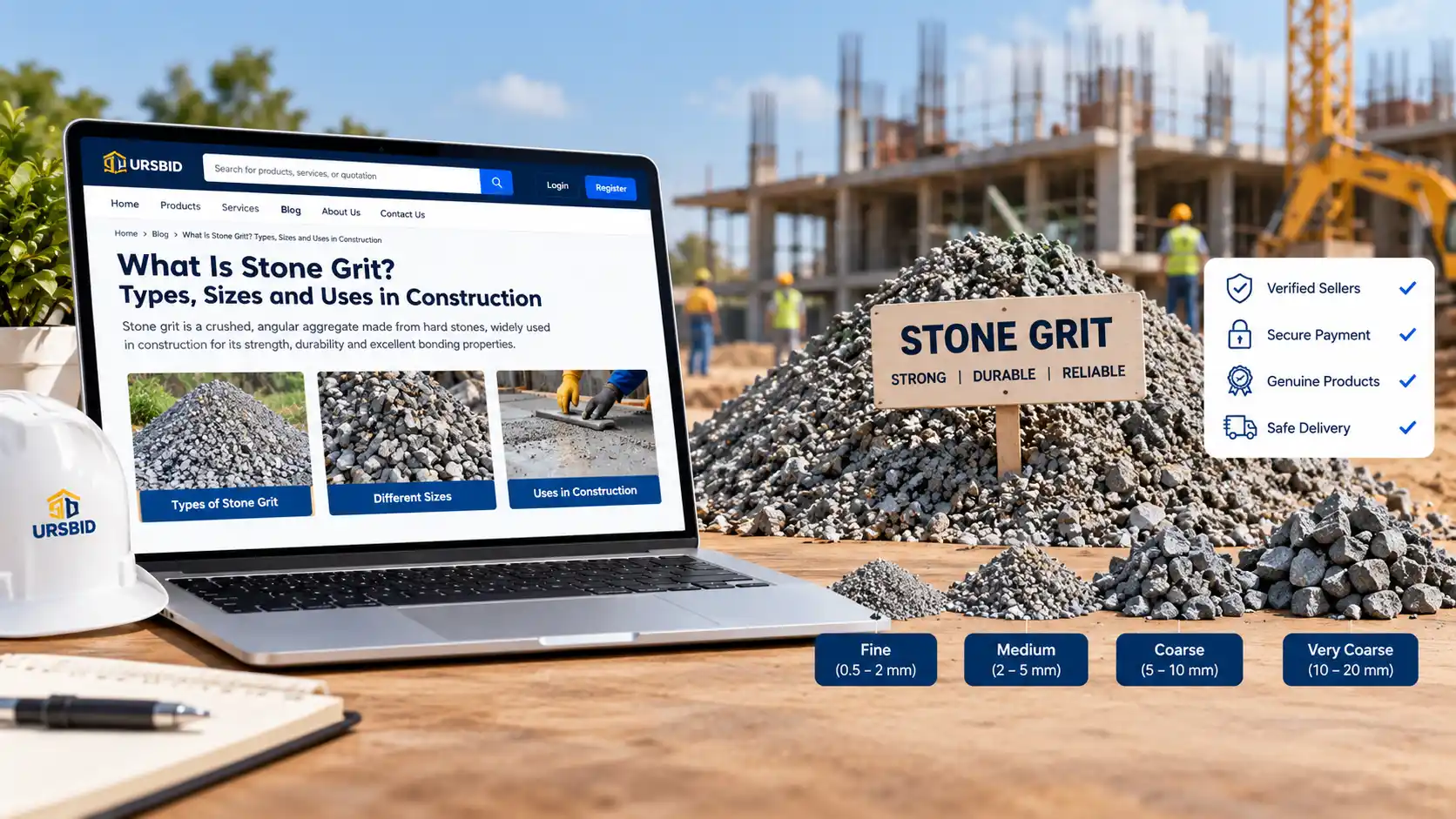
Pour concrete without the right aggregate mix, and no amount of good cement or careful curing will save it. The structure will still end up weaker than it should be. Most people focus on cement and steel when they think about what makes concrete strong, but a huge part of that strength actually comes from the crushed stone sitting inside the mix, doing work that's easy to overlook because it's the least talked-about ingredient.
That crushed stone is stone grit. Getting the right type and size for the job is one of those decisions that quietly determines whether a slab, road, or drainage layer performs the way it's supposed to. This guide covers what stone grit actually is, the common sizes and types used across Indian construction, where each one belongs, and how to check quality before you place a bulk order.
What Is Stone Grit?
Stone grit, also known as crushed stone aggregate, is produced by mechanically crushing hard rock, typically granite or basalt, into smaller, angular fragments of a defined size range. Unlike naturally rounded river aggregate, stone grit's crushed, angular shape gives it stronger mechanical interlocking within concrete and other mixes, which directly improves load-bearing strength and stability.
It's used across a wide range of construction applications, from structural concrete to road base layers to landscaping, with the right size and grade depending entirely on what the material needs to do in that specific application. If you're comparing options, stone grit listings on URSBID show the available sizes and suppliers in one place, which is a useful starting point before deciding what to order.
Common Stone Grit Sizes and What They're Used For
Stone grit is typically sold and specified by size, and the three most commonly available sizes in the Indian market are 6mm, 10mm, and 20mm.
6mm Stone Grit
The smallest of the common grades, 6mm stone grit is generally used in finer concrete work, screed layers, and applications where a smoother mix consistency matters more than the coarse strength of larger aggregate. It's also frequently used in decorative and pathway applications where a finer surface texture is preferred. For projects that need an even finer aggregate than 6mm grit, stone dust is worth comparing as an alternative for base-layer and finishing work.
10mm Stone Grit
A versatile mid-range size, 10mm stone grit is widely used in RCC work, particularly for slabs, thinner structural sections, and precast concrete elements where a slightly finer aggregate allows for better mix flow around reinforcement without compromising strength.
20mm Stone Grit
The most commonly used size for general structural concrete, 20mm stone grit is the standard choice for foundations, columns, beams, and slabs in typical residential and commercial construction. Its larger particle size provides strong interlocking within the concrete mix, contributing directly to compressive strength. Since this grade is almost always mixed alongside coarse sand and cement in a standard concrete pour, it helps to plan quantities for both materials together rather than sourcing them separately.
Beyond these three, larger sizes (40mm and above) are used in mass concrete work like dams and heavy foundations, where a coarser aggregate helps reduce the overall cement requirement in very large pours.
Types of Stone Grit
Beyond size, stone grit is also categorised by the source rock and finish, which affects its strength, appearance, and suitability for different uses.
Granite Stone Grit
The most widely used type in structural construction, granite grit is valued for its high compressive strength and durability, making it the default choice for RCC and general concrete work.
Basalt Stone Grit
Basalt grit offers strong resistance to weathering and is often preferred for road construction and areas exposed to heavy traffic loads, given its durability under repeated stress.
Limestone Grit
Used more in road base layers and certain non-structural applications, limestone grit is softer than granite or basalt and generally not recommended for high-strength structural concrete.
Where Stone Grit Is Used in Construction
1. RCC and Structural Concrete Work
This is stone grit's primary application. As the coarse aggregate in a concrete mix, it works alongside sand and cement to form the load-bearing body of foundations, columns, beams, and slabs. The size chosen, commonly 20mm for general structural work, directly affects the mix's workability and final strength.
2. Road Construction and Base Layers
Stone grit forms a core part of road sub-base and base layers, where its angular shape provides strong load distribution and drainage beneath the surface layer. Basalt grit is particularly common here due to its wear resistance under vehicle load.
3. Drainage and Filtration Layers
Because of its angular shape and consistent void spacing, stone grit is often used in drainage layers around foundations and in French drains, where water needs to pass through without the layer collapsing or clogging over time.
4. Precast Concrete Products
Precast elements like paver blocks, culverts, and concrete pipes typically use finer grit sizes (6mm to 10mm) to achieve a denser, more uniform mix suited to the smaller, more precise dimensions of precast molds.
5. Landscaping and Pathway Work
Smaller-sized stone grit is also used decoratively in garden pathways, driveways, and landscaping features, where its texture and drainage properties work well outside of structural applications entirely.
What Stone Grit Is Not Ideal For
- Fine surface finishing work: Plastering and flooring finish layers need fine sand, not stone grit, which is far too coarse for a smooth surface.
- Applications requiring very high compressive strength with limestone: Limestone grit's relatively lower hardness makes it a weaker choice for heavy structural loads compared to granite or basalt.
- Precision precast work with oversized grit: Using 20mm grit in small precast molds designed for finer aggregate leads to poor mix consistency and surface defects.
How to Check Stone Grit Quality Before Buying
1. Shape and Angularity
Good stone grit should be angular and irregularly shaped rather than rounded, since this angularity is what creates strong interlocking within a concrete mix. Rounded or worn aggregate suggests either a different material entirely or excessive processing wear.
2. Cleanliness Check
Stone grit should be free of dust, clay, and organic impurities. Excess dust content, in particular, coats the aggregate surface and weakens its bond with cement paste, reducing overall concrete strength.
3. Size Consistency
Within a specified grade (6mm, 10mm, or 20mm), the particles should be reasonably consistent in size. A load with a wide, inconsistent size spread suggests poor screening at the crushing plant and can affect mix predictability.
4. Crushing Strength and Source Rock
For structural work, confirming the source rock, granite or basalt rather than a weaker sedimentary stone, gives a reasonable indication of the aggregate's compressive strength, even without a formal lab test.
5. Water Absorption
Lower water absorption generally indicates denser, higher-quality aggregate. Suppliers working with reputable quarries should be able to share this specification on request for larger structural orders.
Frequently Asked Questions
What is stone grit used for in construction?
Stone grit is primarily used as coarse aggregate in RCC and structural concrete work, as well as in road base layers, drainage systems, precast concrete products, and landscaping applications.
What are the common sizes of stone grit?
The most commonly available sizes are 6mm, 10mm, and 20mm, with 20mm being the standard choice for general structural concrete, while 6mm and 10mm are used for finer mixes and precast work.
What is the difference between granite and basalt stone grit?
Granite grit is the most widely used type for general structural concrete due to its high compressive strength, while basalt grit is often preferred for road construction because of its strong resistance to weathering and traffic load.
Can stone grit be used for plastering or flooring?
No, stone grit is too coarse for plastering or surface finish work. Fine sand is the appropriate material for smooth, finish-level applications.
How do I know if stone grit is good quality before buying?
Check that the particles are angular rather than rounded, free of excess dust or clay, reasonably consistent in size within the specified grade, and sourced from a hard rock type like granite or basalt for structural use.
Final Thoughts
Stone grit doesn't get the attention cement and steel do, but as the aggregate that fills most of a concrete mix's volume, it plays a direct role in how strong and durable the final structure turns out to be. Choosing the right size and type for the job, and checking basic quality markers like angularity, cleanliness, and source rock before a bulk order arrives, is a small step that protects a much larger investment in the structure it becomes part of.
If you're sourcing aggregate for an upcoming project, browse verified stone grit suppliers on URSBID and compare quotes before placing your order.