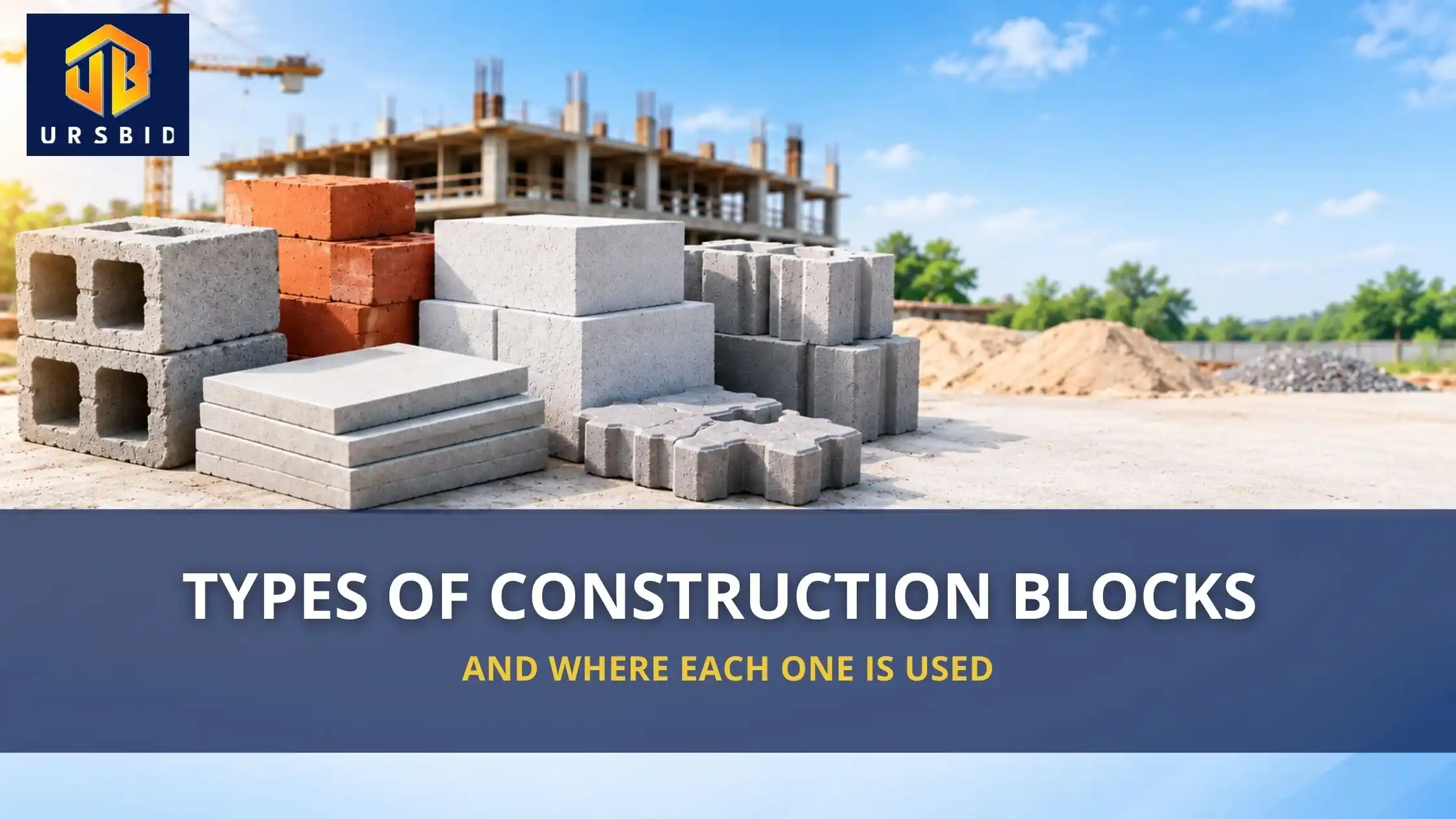
Walk into any building material yard today and you'll notice something that wasn't true even fifteen years ago: red clay bricks are no longer the default choice sitting front and center. AAC blocks, fly ash bricks, and concrete blocks now compete for the same wall space, each promising something a little different, faster construction, better insulation, lower weight, or a smaller environmental footprint.
For a buyer or contractor deciding what to actually order, that variety can feel more confusing than helpful. This guide breaks down the main types of construction blocks used in Indian construction today, what each one is genuinely good at, where it falls short, and how to choose the right one for a specific project instead of defaulting to whatever the last supplier happened to stock.
Why the Type of Block You Choose Actually Matters
It's tempting to treat all wall blocks as roughly interchangeable, but the choice affects far more than just appearance. Block type influences construction speed, wall thickness and usable floor area, insulation and energy efficiency, load-bearing capacity, plaster consumption, and overall project cost. A block that's ideal for a load-bearing boundary wall isn't necessarily the right choice for a partition wall in a high-rise apartment, and vice versa.
Red Clay Bricks
The traditional choice across most of India, red clay bricks are made by molding and firing natural clay at high temperatures.
Strengths: Strong compressive strength, widely available, well understood by masons everywhere, good thermal mass for temperature regulation.
Limitations: Heavier than most modern alternatives, requires more mortar for laying, and manufacturing consumes significant topsoil and firewood, raising environmental concerns in several regions.
Best suited for: Load-bearing walls, boundary walls, and traditional construction where local masonry expertise and material availability favor the familiar clay brick.
Fly Ash Bricks
Made from a mixture of fly ash (a byproduct of coal combustion in thermal power plants), sand, and cement, fly ash bricks have become one of the most widely used alternatives to traditional clay bricks over the past decade.
Strengths: More uniform size and shape than clay bricks, which reduces mortar consumption and gives a cleaner finish. They're also lighter, and using fly ash as a raw material reduces the environmental burden of both brick-making and industrial waste disposal.
Limitations: Quality can vary significantly between manufacturers depending on fly ash sourcing and curing process, so verifying supplier quality matters more here than with standardized clay bricks.
Best suited for: General residential and commercial construction where cost-efficiency, uniformity, and a lighter environmental footprint are priorities.
AAC Blocks (Autoclaved Aerated Concrete)
AAC blocks are manufactured from a mix of cement, fly ash or sand, lime, gypsum, and an aerating agent, then cured in an autoclave under heat and pressure. The result is a lightweight, highly porous block that has rapidly gained popularity in urban construction.
Strengths: Significantly lighter than clay or concrete blocks, which reduces dead load on a structure's foundation and beams. Excellent thermal insulation properties help with energy efficiency, and their larger size means faster wall construction with less mortar and labor.
Limitations: Higher upfront material cost compared to clay bricks, and their porous structure requires proper waterproofing treatment in areas exposed to moisture. Since AAC blockwork uses a thin-joint mortar system rather than standard cement mortar, it's worth confirming your mason is familiar with the technique before committing to this block type.
Best suited for: High-rise buildings where reducing structural dead load matters, and any project prioritizing thermal comfort and faster construction timelines.
Concrete Blocks (Solid and Hollow)
Made by casting a mixture of cement, aggregate, and water into standardized molds, concrete blocks come in both solid and hollow variants, each suited to different structural roles.
Solid Concrete Blocks
Denser and stronger than hollow blocks, solid concrete blocks are commonly used in load-bearing walls and foundation-level masonry where higher compressive strength is required.
Hollow Concrete Blocks
Lighter than solid blocks due to their hollow cavities, these are widely used for non-load-bearing partition walls, boundary walls, and general masonry where reduced weight and material cost matter more than maximum load capacity. Their hollow cores also offer a practical benefit during construction, since they can accommodate electrical conduits and plumbing lines without extensive chiseling.
Best suited for: Solid blocks for structural and foundation work; hollow blocks for partitions, compound walls, and cost-conscious general construction.
Comparing Construction Blocks at a Glance
|
Block Type |
Weight |
Cost |
Best For |
|
Red Clay Bricks |
Heavy |
Moderate |
Load-bearing, traditional builds |
|
Fly Ash Bricks |
Moderate |
Low to Moderate |
General residential/commercial use |
|
AAC Blocks |
Light |
Higher upfront |
High-rise, insulation-focused projects |
|
Solid Concrete Blocks |
Heavy |
Moderate to High |
Foundations, load-bearing walls |
|
Hollow Concrete Blocks |
Light to Moderate |
Moderate |
Partitions, boundary walls |
What to Consider Before Choosing a Block Type
A few practical factors should guide the decision beyond just price per unit.
Structural role: Load-bearing walls need higher compressive strength than partition walls, which narrows the choice toward clay bricks, solid concrete blocks, or higher-grade AAC blocks depending on the load.
Building height: Taller structures benefit from lighter blocks like AAC, since reduced dead load eases the demand on the foundation and structural frame.
Climate and insulation needs: In regions with extreme summer heat, AAC blocks' thermal insulation properties can meaningfully reduce cooling costs over the building's lifetime.
Construction timeline: Larger-format blocks like AAC reduce the number of units needed per square meter of wall, which speeds up masonry work considerably compared to smaller clay bricks.
Local masonry expertise: Not every mason is equally comfortable working with every block type. AAC and fly ash blocks, in particular, require slightly different handling and jointing techniques than traditional clay brickwork, which is worth confirming with your contractor before finalizing the material choice.
Quality Checks Before Buying Any Construction Block
Regardless of the type selected, a few quality markers apply broadly:
- Dimensional consistency: Blocks should be uniform in size within a batch, since inconsistent dimensions increase mortar consumption and weaken the wall's overall finish.
- Compressive strength documentation: For structural applications, ask suppliers for test certificates confirming the block's rated compressive strength.
- Visible defects: Check for cracks, chips, or uneven surfaces, which are common signs of poor curing or manufacturing quality.
- Water absorption rate: Excessive water absorption affects both durability and plaster adhesion, so it's worth confirming this specification for larger structural orders.
Sourcing Construction Blocks Through a Verified Marketplace
Comparing block types side by side is only half the decision. Finding a supplier who can actually deliver consistent quality at a fair price is the other half, and that's traditionally been harder to verify than the technical specifications themselves. URSBID lists verified suppliers across red bricks, fly ash bricks, AAC blocks, and both solid and hollow concrete blocks, so buyers can post a specific requirement and compare quotes rather than settling for whatever a single local dealer has in stock.
Most wall construction also depends on getting the surrounding materials right, and once the blockwork is up, checking tiles or finishing options for the same project keeps the material sourcing process moving without a fresh search for every stage of construction.
Frequently Asked Questions
What are the main types of construction blocks used in India? The main types are red clay bricks, fly ash bricks, AAC (Autoclaved Aerated Concrete) blocks, and concrete blocks in both solid and hollow variants, each suited to different structural and cost requirements.
Which type of block is best for a load-bearing wall? Red clay bricks, solid concrete blocks, and higher-grade AAC blocks are all suitable for load-bearing applications, depending on the specific load requirement and structural design.
Are AAC blocks better than red bricks? AAC blocks offer advantages in weight, insulation, and construction speed, making them well suited for high-rise and energy-efficient buildings, but they typically cost more upfront than red clay bricks, which remain a reliable and familiar choice for traditional construction.
Why are fly ash bricks becoming more popular? Fly ash bricks offer more consistent dimensions than clay bricks, reduce mortar consumption, and repurpose industrial waste material, making them a cost-effective and more environmentally conscious option for general construction.
Are hollow concrete blocks as strong as solid blocks? No, hollow concrete blocks have lower compressive strength than solid blocks due to their cavities, which is why they're generally used for non-load-bearing partition and boundary walls rather than structural applications.
Final Thoughts
There isn't a single "best" construction block, only the block that best fits a specific wall's structural role, a project's timeline, and the climate it needs to perform in. Understanding what each type is genuinely good at, rather than defaulting to whatever's locally familiar, is what separates a wall that performs well for decades from one that quietly underperforms on insulation, weight, or strength.
If you're planning your next project's masonry work, browse verified construction block suppliers on URSBID and compare quotes across block types before placing your order.