A truck pulls up at your site and unloads a big pile of bricks. The top layer looks fine. Red, clean, and neat. Then the workers dig deeper. Some bricks are pale. Some are cracked. Some break in half when they are lifted. By then, you have already paid for the whole load.
This happens more often than people admit. Most brick making in India is small scale and unorganised, so quality changes from one kiln to the next. The good news is that you can spot weak bricks with a few easy tests. You do not need a lab or special tools.
This guide shows you how to check brick quality before buying, step by step.
What Are the Signs of First Class Bricks?
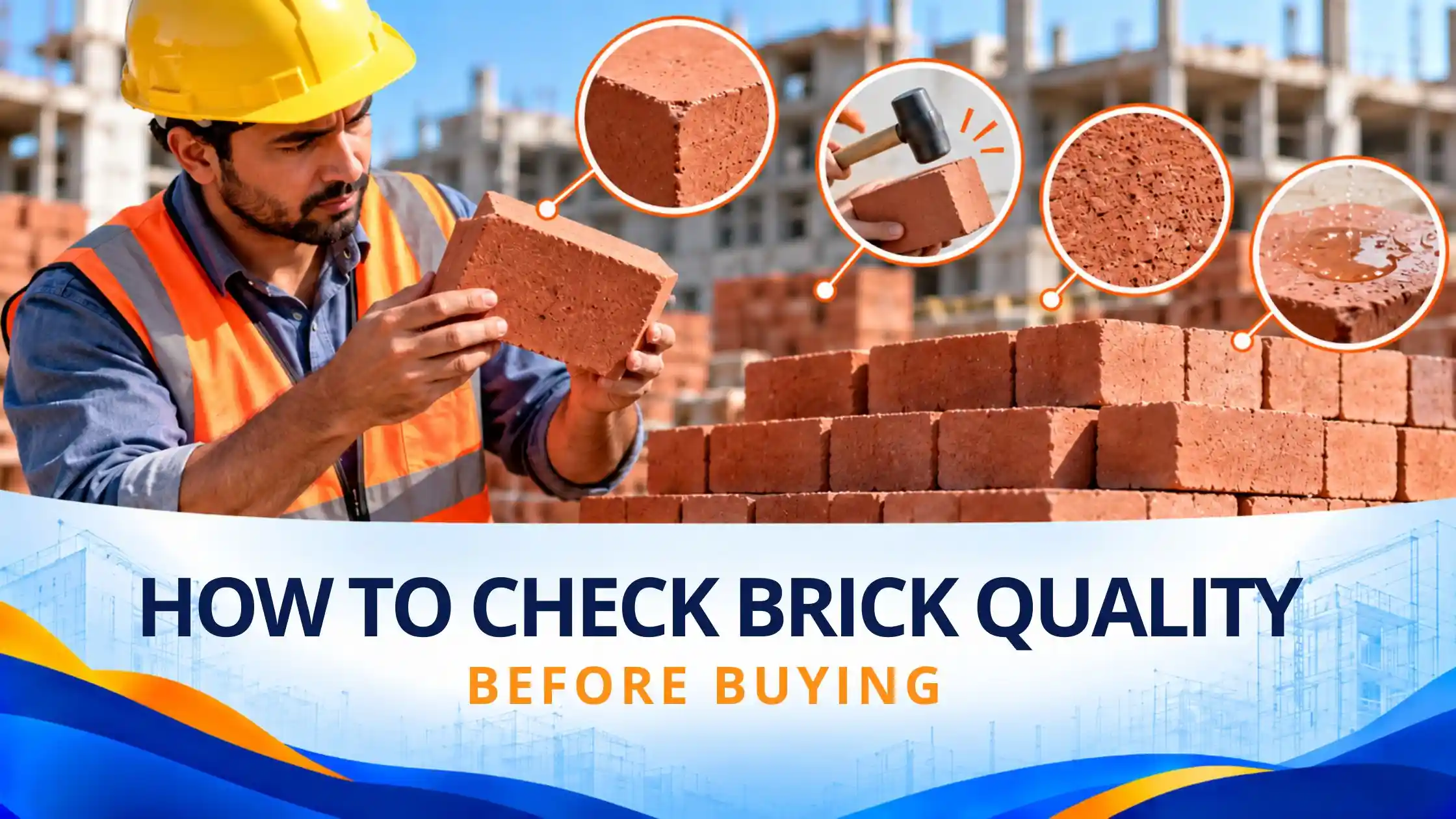
First class bricks have an even deep red colour, sharp edges, a regular shape, and no cracks. They also give a clear ringing sound when struck.
Look for these signs in the bricks you are about to buy:
- Colour. Good bricks are an even copper-red. Pale yellow bricks are usually under-burnt and weak. Very dark, glassy bricks are usually over-burnt and brittle.
- Shape. Edges should be straight and corners sharp. Faces should be flat. Warped bricks make crooked walls.
- Size. Bricks in one lot should all match. Check that the size suits your design.
- Surface. There should be no cracks, no lumps, no holes, and no stones stuck in the clay.
- Sound. A clear metallic ring means the brick is well burnt. A dull thud means it is weak.
- Inside. Break one brick. The inside should look even and tight, with no gaps or white lime lumps.
What Are the Best Brick Quality Test Methods You Can Do on Site?
The easiest brick quality test methods are the sound test, the hardness test, the drop test, and the size test. Each one takes only a minute.
- Sound test. Hold one brick in each hand. Strike them together. A clear ring is good. A dull sound points to a weak brick.
- Hardness test. Scratch the brick with your fingernail. A good brick does not scratch easily.
- Drop test. Drop a brick from about one metre onto hard ground. A good brick should not break into pieces.
- Size test. Stack 20 bricks in a row along their length. Then do the same for width and height. Compare the totals with the size you ordered. Big gaps mean the lot is uneven.
Always test bricks from different parts of the pile. Do not test only the top layer. The best bricks are often placed on top.
How Do You Do a Water Absorption Test for Bricks?
A good brick should soak up no more than 20% of its dry weight in water after 24 hours. Lower is better, because it means the brick is dense and strong.
This is the most useful test after the sound test. Here is how to do it:
- Take a dry brick and weigh it. Call this weight W1.
- Put the brick in clean water for 24 hours.
- Take it out and wipe the surface. Weigh it again. Call this weight W2.
- Work out the gain: (W2 minus W1) divided by W1, times 100.
If the answer is above 20%, the brick is too porous. It will hold damp, weaken in rain, and crack over time. IS 1077 allows up to 20% absorption for classes up to 12.5, and a lower limit of 15% for stronger classes.
(Testing source:CEW Magazine, Types of Tests Done on Bricks.)
While the brick is soaking, you can also check for salt. Dry the brick in shade after the soak. White powder on the surface is called efflorescence. It comes from salts in the clay. A little is fine. A lot will spoil your plaster and paint.
What Do Brick Strength Classes Mean?
Brick strength classes tell you how much load a brick can carry. A higher class means a stronger brick.
IS 1077 sorts common burnt clay bricks by compressive strength. The classes include 3.5, 5, 7.5, 10, 12.5, 15, and go all the way up to 35 N/mm². The lowest class starts at 3.5 N/mm². Lab tests follow IS 3495, which covers compressive strength, water absorption, efflorescence, and warpage.
(Standards source:Brick n Bolt, Properties of Bricks, citing IS 1077 and IS 3495.)
You cannot test strength with your hands. For a large order, or for load-bearing walls, ask the supplier for a lab test report. Labs usually test a small sample picked at random from the lot. If the supplier cannot show any report, treat that as a warning sign.
Why Does Brick Quality Vary So Much in India?
Brick quality varies because the industry is huge and mostly unorganised. India is the second largest brick producer in the world, making around 200 billion bricks a year.
Most of these bricks come from more than 100,000 small kilns, according to the Centre for Science and Environment (CSE). Many of these kilns use old methods. Clay type, firing time, and kiln heat differ from place to place. So two loads sold at the same price can be very different in quality. That is why checking before you pay matters so much.
(Industry data source:Dialogue Earth, citing the Centre for Science and Environment.)
What Mistakes Should You Avoid When Buying Bricks?
Do not check only the top layer of the pile. Pull bricks from the middle and the bottom too.
Do not mix pale bricks and dark bricks in one wall. Different burn levels mean different strength and different water absorption. The wall will age unevenly.
Do not accept a load with a lot of broken bricks. A few broken pieces are normal. Ask the supplier before you buy how much breakage they will allow.
Do not think good mortar can fix a weak brick. It cannot. Check the bricks first, and then buycement for the mortar.
Where Can You Buy Bricks Online?
You can buy bricks online through URSBID by posting your requirement and getting quotes from verified suppliers.
Once you know what quality you need, the next step is to find a seller who can deliver it. ToBuy Bricks Online through URSBID, say what you need: the brick type, size, quantity, and delivery place. Registered vendors will send their quotations directly to you. Ask each one about the strength class, the water absorption, and the breakage allowance before you decide.
If you also need a mason team to lay the bricks, you can look atbrick work services on the same platform.
Frequently Asked Questions
How can I check brick quality at the site?
Use simple tests. Check the colour, shape, and surface. Strike two bricks together to hear the ring. Scratch one with your nail. Drop one from about a metre. Then do a 24-hour soak test to check water absorption.
What is the water absorption limit for good bricks?
A good brick should absorb no more than 20% of its dry weight after 24 hours in water. For stronger classes, the limit under IS 1077 is lower, around 15%.
What does a ringing sound mean when I strike two bricks?
A clear metallic ring means the brick is well burnt and dense. A dull thud usually means it is under-burnt, over-burnt, or cracked inside.
What are first class bricks?
First class bricks have an even red colour, sharp edges, a regular shape, no cracks, and low water absorption. They give a clear ring when struck.
Which IS code covers brick quality in India?
IS 1077 gives the specification for common burnt clay building bricks. IS 3495 gives the test methods for strength, water absorption, efflorescence, and warpage.
Final Thoughts
Bricks are cheap compared to the rest of your house. But a weak brick sits inside your wall for decades. A few minutes of testing at delivery can save you from cracked plaster, damp walls, and costly repairs. Look at the colour. Listen to the ring. Run the soak test. Ask for a lab report on big orders.
Ready to compare prices?Buy Bricks Online on URSBID by posting your requirement, and receive quotes from verified suppliers.