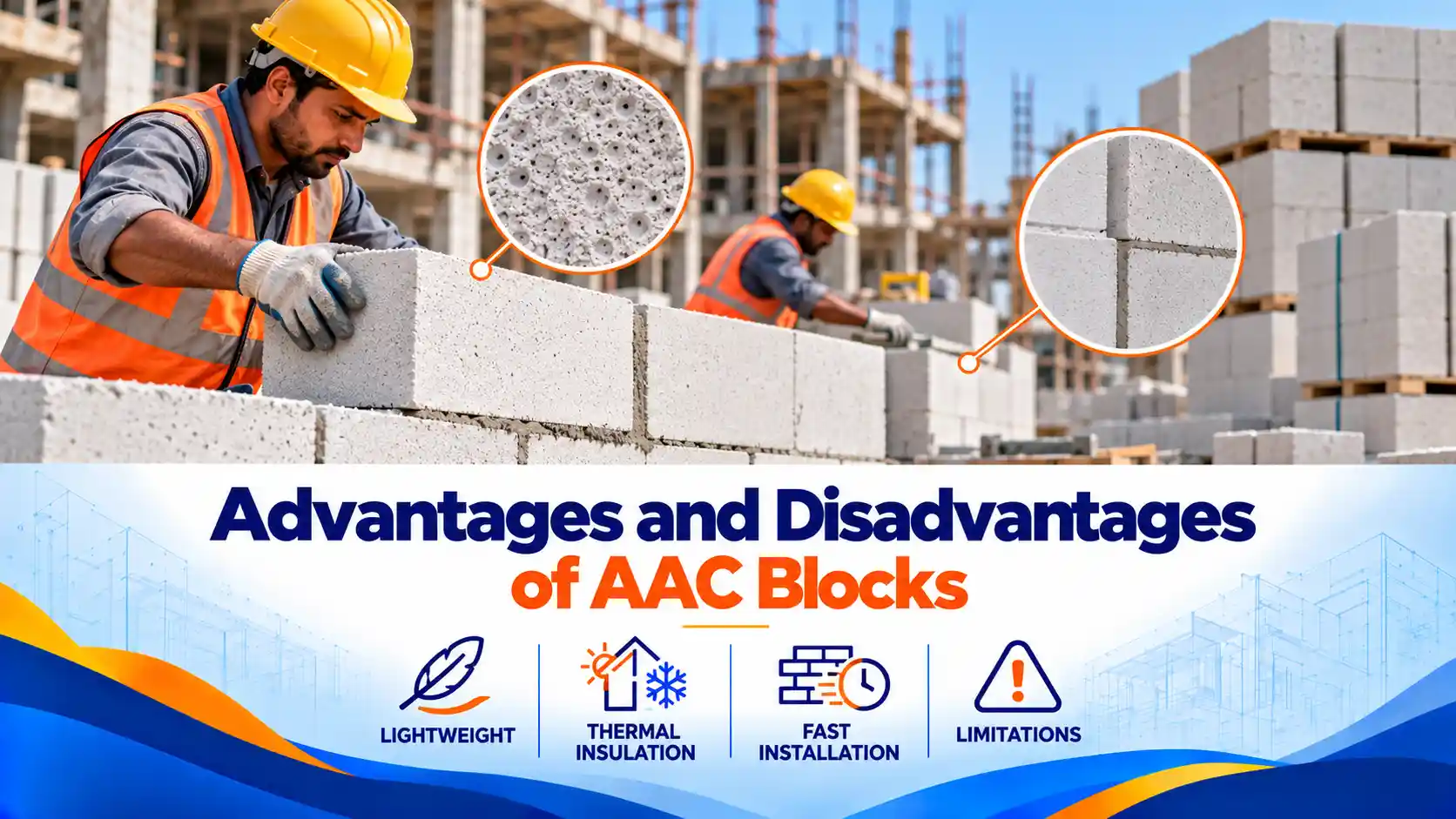
Pick up an AAC block on a site. It feels strange. It is big, but it is light enough to lift with one hand. A mason can lay a full wall in far less time than with small bricks. But ask the same mason about plaster cracks or damp patches, and you may hear a different story.
AAC blocks are a good material. They are not perfect. This guide explains the real advantages and disadvantages of AAC blocks in simple words, so you can decide if they suit your home.
What Are AAC Blocks and Why Are They So Popular?
AAC blocks are light, grey blocks made from cement, lime, fly ash or sand, and an air-making agent. They are cured with steam under high pressure in a machine called an autoclave.
This process fills the block with tiny air pockets. That is why the block is so light. It is also why AAC has become a common choice for new apartments and homes across India. Builders like it because walls go up fast. Owners like it because rooms stay cooler.
What Are the Main AAC Block Benefits?
The main AAC block benefits are light weight, good heat insulation, fire safety, fast building, and lower environmental impact.
- Light weight. AAC is far lighter than red brick. Typical AAC density is about 550 to 650 kg per cubic metre. Clay brick is around 1,800. Lighter walls put less load on the foundation and the frame.
- Thermal insulation. The air pockets slow down heat. Rooms stay cooler in summer and warmer in winter.
- Fire resistance. AAC does not burn. A 200 mm wall can resist fire for about four hours.
- Sound insulation. A 200 mm AAC wall can reduce noise by around 45 dB.
- Fast construction. Blocks are large and cut to exact sizes. Fewer joints mean faster work and less mortar.
- Lower environmental impact. Many AAC blocks use fly ash, a waste product from power plants.
- Easy to cut and shape. Masons can cut AAC with simple hand tools. This makes it easy to fit around pipes and openings.
- Pest resistance. Termites and rats cannot damage AAC the way they damage wood.
How Good Are AAC Blocks for Thermal Insulation?
AAC blocks thermal insulation is excellent. AAC blocks conduct heat about five times less than red bricks, which helps keep indoor rooms cooler.
Thermal conductivity tells you how easily heat passes through a wall. Lower is better. AAC usually sits between 0.12 and 0.24 W/m·K. Red brick is around 0.8 to 1.0. For a home in a hot city like Delhi, Jaipur, or Nagpur, this can cut the load on your air conditioner. The National Building Code 2016 and the Energy Conservation Building Code both recognise AAC as an energy-efficient wall material.
(Technical data source:Brick n Bolt AAC Blocks Specifications, citing IS 2185 Part 3.)
What Are the Main AAC Block Disadvantages?
The main AAC block disadvantages are lower strength, high water absorption, cracking risk, and a higher unit price.
- Lower compressive strength. AAC strength is usually around 3 to 4 N/mm². That is fine for infill walls in a framed building. It is not enough for heavy load-bearing walls in a tall building.
- Water absorption. AAC is porous. It soaks up water if left unprotected. Outer walls need proper waterproofing and the right plaster.
- Cracks after plastering. AAC has a smooth surface. Normal sand-cement plaster may not stick well. Cracks can appear within months if the wrong mix is used.
- Brittle in handling. The blocks can chip or break during transport and stacking. Some waste is normal.
- Hard to fix heavy items. Wall-hung TVs, cabinets, and water heaters need special fasteners. Ordinary nails and plugs can be pulled out.
- Higher cost per block. One AAC block costs more than one brick. The saving comes later, from less labour and less mortar.
- Needs trained masons. AAC uses thin-bed adhesive, not thick cement mortar. A mason used only to brick may make mistakes.
- Quality varies. Blocks from small factories can differ in size and strength.
Are AAC Blocks Strong Enough for House Construction?
Yes, AAC blocks are strong enough for most houses, but only as infill walls inside an RCC frame, not as the main load-bearing structure.
In a framed building, columns and beams carry the weight. The walls only divide space and keep weather out. AAC does this job very well. IS 2185 Part 3 sets the minimum strength for AAC, and good blocks meet it easily. For heavy load-bearing walls, or buildings with several floors of masonry, ask your structural engineer first. Do not decide this on your own.
What Do the Numbers Say About AAC Blocks?
Compared with clay brick, AAC is much lighter, insulates much better, and resists fire for longer.
|
Property |
AAC Block |
Clay Brick |
|
Dry density |
550 to 650 kg/m³ |
About 1,800 kg/m³ |
|
Thermal conductivity |
0.16 to 0.18 W/m·K |
About 0.81 W/m·K |
|
Fire resistance |
2 to 6 hours, depending on thickness |
About 2 hours |
|
Sound reduction |
About 45 dB (200 mm wall) |
About 50 dB (230 mm wall) |
|
Compressive strength |
3 to 4.5 N/mm² |
2.5 to 3.5 N/mm² |
(Comparison data source:Eco Green Products Technical Specification.)
(Fire rating source for a 200 mm AAC wall:Maruti Hydraulics AAC Guide, citing IS 1642.)
The table shows why many builders choose AAC. It also shows why strength is not its main selling point.
How Can You Avoid Common Problems With AAC Blocks?
You can avoid most AAC problems with three things: proper waterproofing, the right mortar and plaster, and a trained mason.
Protect outer walls with a good waterproof coat. Usewaterproofing services if you are not sure how to do it. Fix heavy items with proper anchors made for AAC.
Use thin-bed adhesive for joints, not thick cement mortar. Use a bonding coat or AAC-specific plaster. And ask your contractor if the team has laid AAC before. If not, a skilledbrick work contractor can guide them.
What Mistakes Should You Avoid With AAC Blocks?
Do not use AAC for heavy load-bearing walls without an engineer's approval. Do not leave outer AAC walls without waterproofing, especially in heavy rain areas. Do not use plain sand-cement plaster directly on a smooth AAC face. And do not buy the cheapest block without checking that it meets IS 2185 Part 3 and carries a BIS mark.
Where Can You Buy AAC Blocks Online?
You can buy AAC blocks online through URSBID by posting your requirement and getting quotes from verified suppliers.
Once you know how many blocks you need, the next step is comparing prices. A good supplier gives you blocks that match the standard. ToBuy Blocks Online through URSBID, describe your requirement, block size and quantity. Registered vendors will send their quotations directly to you.
Frequently Asked Questions
What are the main advantages of AAC blocks?
AAC blocks are light, insulate well against heat and sound, resist fire, speed up construction, and use fly ash, which helps the environment.
What are the main disadvantages of AAC blocks?
AAC blocks have lower strength than dense concrete blocks, absorb water if not protected, can crack under the wrong plaster, and cost more per block than bricks.
Are AAC blocks good for hot climates?
Yes. AAC blocks thermal insulation is much better than red brick, so rooms stay cooler and air conditioners work less.
Can AAC blocks be used for load-bearing walls?
Usually no. AAC works best as infill walls in an RCC-framed building. For load-bearing use, ask a structural engineer first.
Why do AAC walls crack?
Cracks usually come from the wrong plaster, thick cement mortar joints, or poor curing. Using thin-bed adhesive and AAC-suitable plaster greatly reduces the risk.
Final Thoughts
AAC blocks are light, cool, fire-safe, and quick to build with. They are also weaker, thirstier for water, and more sensitive to bad workmanship than brick. The good news is that most problems are easy to avoid. Use the right mortar, waterproof the outer walls, and hire a mason who knows the material.
Ready to compare prices?Buy Blocks Online on URSBID by posting your requirement, and receive quotes from verified suppliers.